
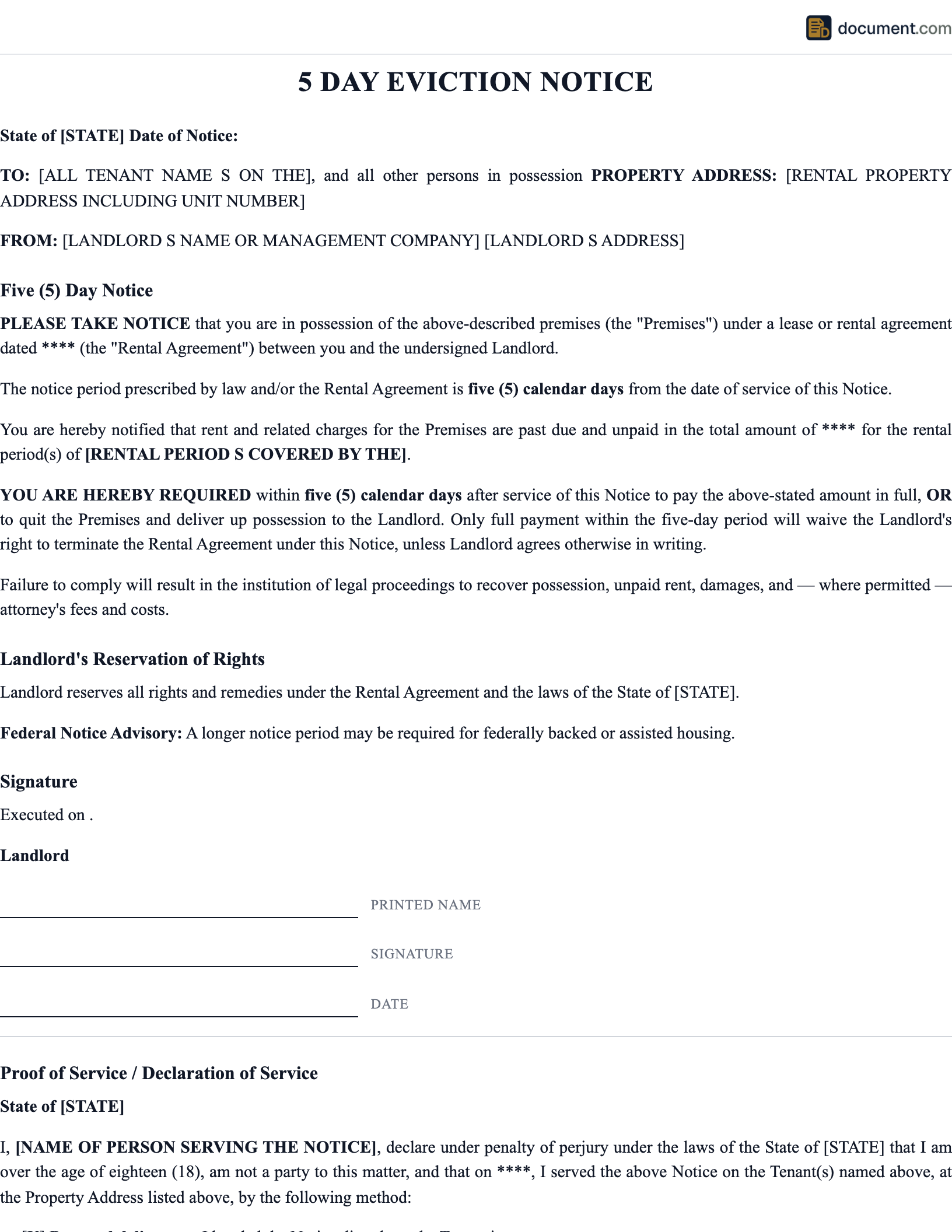



Georgia Eviction Notice Overview
Georgia does not require a specific notice period before filing an eviction for non-payment. Under O.C.G.A. 44-7-50, the landlord may file a dispossessory action (eviction) immediately after rent is late, unless the lease specifies a grace period. Georgia does not use a 5-day notice. Evictions are filed in Magistrate Court.
Understanding the correct notice period is critical for Georgia landlords. Using a 5-day notice when the law requires a different period will result in the court dismissing the eviction case, costing the landlord additional time and filing fees. Always verify the current Georgia statutory requirements before serving any eviction notice.
No fixed (demand only)
Actual notice period
$50 - $75
Court filing fee
Magistrate
Court type
3-6 Wks
Total process
Why Georgia Uses No fixed (demand only), Not 5 Days
Important: Georgia Does Not Have a 5-Day Notice
A 5-day eviction notice is not the correct notice period in Georgia. Under O.C.G.A. 44-7-50, the required notice for non-payment of rent is No fixed (demand only). Serving a 5-day notice will likely result in the court dismissing your case. Use the correct No fixed (demand only) notice period.
States that do use a 5-day notice include Arizona, Delaware, Hawaii, Illinois, Oklahoma, Rhode Island, South Carolina, Virginia, and Wisconsin. Georgia is not among them. The No fixed (demand only) notice requirement in Georgia applies to the most common eviction scenario: non-payment of rent. Other eviction grounds (lease violations, month-to-month terminations) may require different notice periods under Georgia law.
If you are a landlord in Georgia, ensure your eviction notice complies with O.C.G.A. 44-7-50 and includes all elements required by Magistrate Court. Using our Georgia-specific template ensures you have the correct notice period and statutory language.
Georgia Legal Requirements for Eviction Notices
To withstand judicial scrutiny in Georgia Magistrate Court, your eviction notice must contain all elements required by state law. Missing even one required element gives the tenant grounds to challenge the notice.
Required Notice Contents
- Tenant Names: Full legal names of all adult tenants on the lease agreement
- Property Address: Complete address including unit number, city, and Georgia county
- Amount Owed: For non-payment cases, specific dollar amount of rent due plus any lawful late fees
- Notice Period: Clear statement of the No fixed (demand only) period to pay or vacate as required by O.C.G.A. 44-7-50
- Consequences: Warning that failure to pay or vacate will result in eviction proceedings in Magistrate Court
- Landlord Information: Name, signature, and contact information of the landlord or property manager
- Date of Service: The date the notice is delivered, which starts the No fixed (demand only) clock
How to Serve an Eviction Notice in Georgia
Proper service of the eviction notice is essential under Georgia law. Magistrate Court judges regularly dismiss cases where the landlord cannot demonstrate proper service.
Personal Hand-Delivery (Preferred)
Deliver the notice directly to the tenant in person. Bring a witness or use a process server for documentation. This is the method Georgia courts trust most.
Substituted Service
If the tenant is not available, leave the notice with a competent adult (18+) residing at the property. Record the name and date of service.
Post and Mail
Post the notice on the main entry door and mail a copy via first-class or certified mail. Use this as a last resort when personal delivery fails.
Document Everything
Prepare a proof of service affidavit recording the date, time, method, and witnesses. Georgia courts require this when filing the eviction complaint.
File After Notice Period Expires
Once the No fixed (demand only) period expires without payment or vacancy, file the eviction complaint at the Magistrate Court in the jurisdiction where the property is located.
Georgia Eviction Timeline
The eviction process in Georgia follows a specific timeline from notice to enforcement. A typical uncontested eviction takes approximately 3-6 Wks from the date the notice is served. Contested cases can take significantly longer.
After the No fixed (demand only) notice period expires and the complaint is filed, the court schedules a hearing. At the hearing, the judge reviews the notice, lease, and proof of service. If the landlord prevails, the court enters a judgment for possession.
Following the judgment, the tenant has a limited time to appeal or vacate. If the tenant does not leave voluntarily, the landlord obtains a writ of possession, and the sheriff or constable enforces the removal. Self-help evictions are illegal in Georgia and can expose the landlord to substantial liability.
Georgia Eviction Filing Fees & Costs
Below are the typical costs associated with the eviction process in Georgia. Actual fees may vary by county and specific circumstances.
| Fee / Cost | Typical Amount |
|---|---|
| Magistrate Court Filing Fee | $50 - $75 |
| Service of Process | $25 - $75 |
| Writ of Possession | $25 - $100 |
| Attorney Fees (Uncontested) | $400 - $2,000 |
Sample Georgia Eviction Notice
Below is a preview of the Georgia-specific eviction notice using the correct No fixed (demand only) notice period required by O.C.G.A. 44-7-50.
NOTICE TO PAY RENT OR QUIT
STATE OF GEORGIA
Pursuant to O.C.G.A. 44-7-50
TO TENANT(S):
Name(s): [All Tenant Names]
Address: [Full Georgia Address]
NOTICE:
You are notified that rent in the amount of $[Amount] is past due. Pursuant to O.C.G.A. 44-7-50, you have NO FIXED (DEMAND ONLY) from the date of service to pay the total amount due or surrender possession.
GEORGIA COMPLIANCE
This notice uses the correct No fixed (demand only) period required by Georgia law under O.C.G.A. 44-7-50. A 5-day notice is not valid in Georgia.