
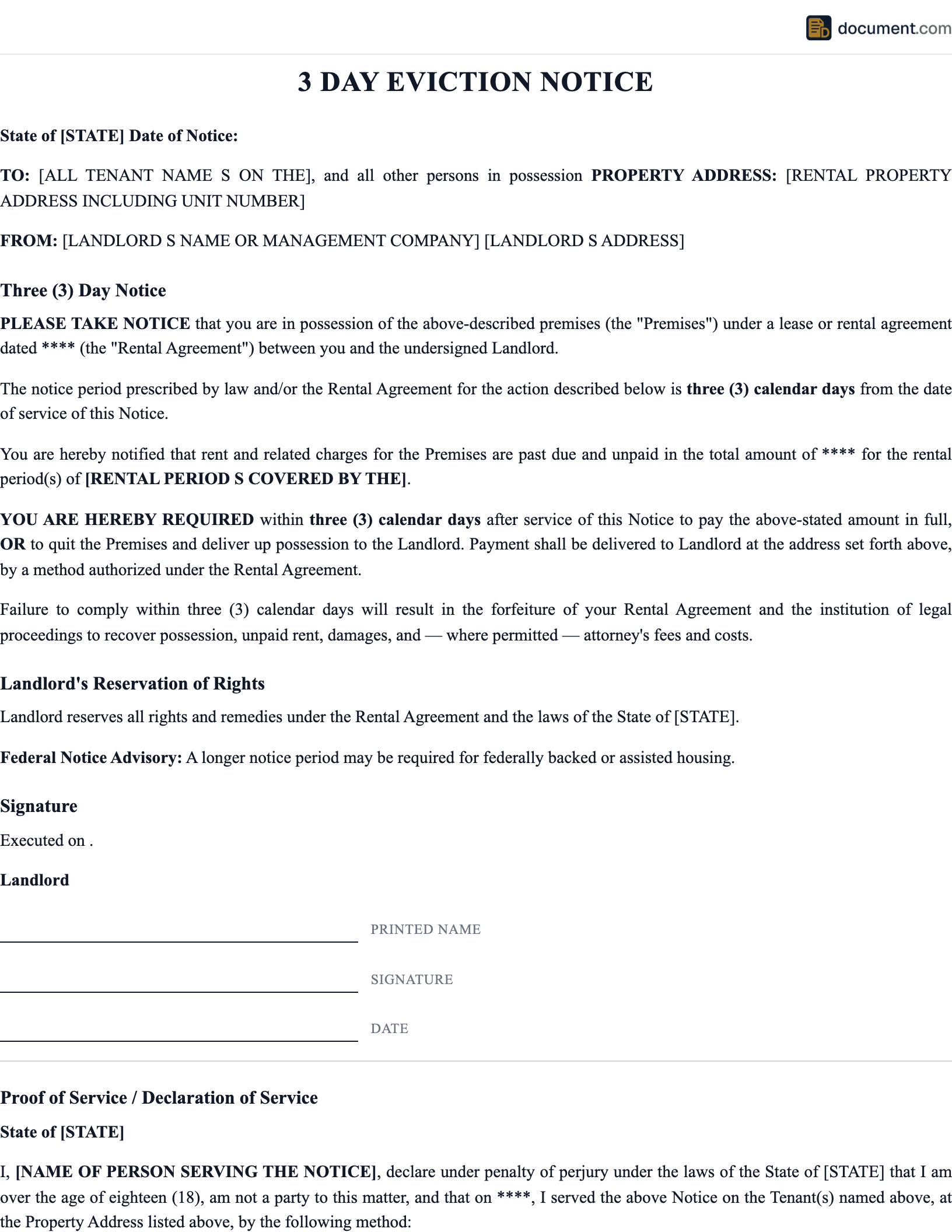



California 3-Day Eviction Notice Overview
California's 3-day notice is the most well-known eviction notice in the country. Governed by the California Code of Civil Procedure (CCP) Sections 1161 through 1179a, the 3-day notice is the mandatory prerequisite to filing an unlawful detainer action in Superior Court. California's notice requirements are among the strictest in the nation, and even minor errors can void the notice and require the landlord to start over.
The California 3-day notice comes in three forms: pay rent or quit (CCP 1161(2)), perform covenant or quit (CCP 1161(3)), and unconditional quit (CCP 1161(4)). Each has different rules and requirements. Additionally, the Tenant Protection Act of 2019 (AB 1482), local rent control ordinances, and COVID-era tenant protections have added layers of complexity. Landlords should understand both state law and applicable local rules before serving any notice.
3 Days
Excl. weekends/holidays
$240-$435
UD filing fee
Rent Only
No late fees allowed
5-8 Wks
UD court process
Types of California 3-Day Notices
3-Day Notice to Pay Rent or Quit (CCP 1161(2))
The most common form. Used when the tenant fails to pay rent. The notice must state the exact amount of rent due, which must include only past-due rent, not late fees, utilities, parking, storage, or any other charges. The notice must identify the name, telephone number, and address of the person to whom rent can be paid, and specify the forms of payment accepted. If the lease allows electronic payment, the notice must include that option.
3-Day Notice to Perform Covenant or Quit (CCP 1161(3))
Used when the tenant violates a curable lease term (unauthorized pet, unauthorized occupant, excessive noise). The notice must describe the specific violation in detail and demand the tenant cure it within 3 days. If the violation is cured, the notice is void. This notice is not used for non-payment of rent.
3-Day Unconditional Quit Notice (CCP 1161(4))
Used for serious violations that cannot be cured: subletting the entire premises, committing waste, using the property for illegal purposes, or committing a nuisance. The tenant has no right to cure and must vacate within 3 days. This is the strongest notice but applies only to specific grounds enumerated in the statute.
CCP 1161 Requirements for the 3-Day Notice
California Courts Are Extremely Strict
California courts will dismiss an unlawful detainer if the 3-day notice contains any error, including overstating the amount owed by even $1, including charges beyond rent, failing to include required contact information, or using improper service. Because the unlawful detainer is a summary proceeding that can result in rapid loss of housing, courts interpret notice requirements strictly in favor of tenants.
- Exact Rent Amount Only: State only the past-due rent. No late fees, utilities, storage, parking, or damages. AB 2819 makes this explicit
- Payment Contact Information: Include name, phone number, and address of the person authorized to receive rent. Specify accepted payment methods
- Tenant Names: List all tenants on the lease. Adding "and all occupants" is recommended but all named tenants must be included
- Property Address: Full address including unit number, city, state, and ZIP code
- 3-Day Demand: Clearly state the tenant has 3 days to pay or quit (or perform or quit, or unconditionally quit)
- Date and Signature: Date the notice and sign it. Some courts require the landlord's or agent's printed name as well
How to Serve a 3-Day Notice in California
CCP 1162 specifies exactly how a 3-day notice must be served in California. There are three methods, and they must be used in a specific order of priority.
Personal Service (CCP 1162(a)(1))
Hand the notice directly to the tenant. This is the preferred method. The 3-day period begins the next day. Use a process server or bring an adult witness who can later testify about the delivery
Substituted Service (CCP 1162(a)(2))
Only if personal service fails: leave the notice with a competent adult at the tenant's home or workplace, AND mail a copy by first-class mail to the tenant's address. Both steps are required. The 3-day period begins the day after mailing
Post and Mail (CCP 1162(a)(3))
Only if personal and substituted service both fail: post the notice on the door or other conspicuous place, AND mail a copy by first-class mail. The 3-day period begins the day after mailing. This is the last resort method
Complete a Proof of Service
After serving, the person who served the notice must complete a proof of service (declaration) detailing the date, time, method, and location of service. This document is required when filing the unlawful detainer complaint
California Unlawful Detainer Timeline
The California unlawful detainer (UD) process is a summary proceeding designed to be faster than other civil cases. After the 3-day notice expires (counting only business days for non-payment), the landlord files a UD complaint in the Superior Court of the county where the property is located.
The tenant must be served with the UD complaint and summons. The tenant then has 5 days to file a response. If the tenant does not respond, the landlord can request a clerk's default and then a default judgment, which can be obtained within 7 to 10 days. If the tenant responds, the court must set a trial within 20 days of the tenant's request.
After judgment, the clerk issues a writ of possession. The sheriff posts a 5-day notice to vacate and then performs the lockout. In busy counties like Los Angeles, the sheriff's lockout can take an additional 10 to 20 days after posting. Total timeline: 5 to 8 weeks for uncontested cases, 2 to 4 months for contested cases in major metro areas.
California Court Fees & Costs
California UD filing fees depend on the amount of rent sought. All fees are set by the Judicial Council and are uniform statewide.
| Fee / Cost | Typical Amount |
|---|---|
| UD Filing Fee (under $10K) | $240 |
| UD Filing Fee ($10K-$25K) | $435 |
| Process Server | $50 - $150 |
| Writ of Possession | $40 - $75 |
| Sheriff Lockout Fee | $125 - $225 |
| Attorney Fees (if hired) | $1,500 - $5,000 |
Sample California 3-Day Notice to Pay Rent or Quit
Below is a preview of a California-compliant 3-day notice to pay rent or quit under CCP 1161(2). This is the most commonly used eviction notice in California.
3-DAY NOTICE TO PAY RENT OR QUIT
STATE OF CALIFORNIA
Pursuant to CCP Section 1161(2)
TO TENANT(S):
Name(s): [All Tenants on Lease]
And all other occupants
PREMISES:
Address: [Street, Unit, City, CA ZIP]
County: [California County]
RENT DUE (base rent only, no fees):
Amount: $[Amount] for period: [Dates]
PAYMENT MAY BE MADE TO:
Name: [Name]
Phone: [Phone]
Address: [Address]
Accepted methods: [Cash, check, etc.]
CALIFORNIA COMPLIANCE
This notice demands rent only as required by CCP 1161(2). No late fees, utilities, or other charges are included. Weekends and judicial holidays are excluded from the 3-day count.