



Delaware Eviction Notice Overview
Delaware uses a two-step notice process for lease violations: a 7-day cure notice followed by a 30-day termination notice if the violation is not cured, under 25 Del. C. §5502. There is no 14-day notice period in Delaware landlord-tenant law. The Delaware Residential Landlord-Tenant Code (25 Del. C. Chapter 55) governs the process, and cases are filed in the Justice of the Peace Court across all three Delaware counties.
Delaware’s cure-then-terminate approach gives tenants two opportunities to address violations: first, 7 days to cure, and if they fail, another 30 days to vacate. This makes Delaware’s total pre-filing period at least 37 days—far longer than the 14-day notice used in other states. For non-payment of rent, Delaware requires a separate 5-day notice under 25 Del. C. §5502(b). The Justice of the Peace Courts in New Castle County (Wilmington), Kent County (Dover), and Sussex County (Georgetown) handle the vast majority of residential evictions.
7+30 Days
Statutory minimum
$45–$55
JP Court filing
Written
Notice required
8–12 Wks
Total process
Delaware’s 7-Day Cure + 30-Day Terminate Process
Under 25 Del. C. §5502(a), when a tenant materially violates the lease, the landlord first serves a 7-day notice to cure. If the tenant does not cure within 7 days, the landlord then serves a 30-day termination notice. The tenancy ends 30 days after the termination notice. This two-notice structure means the total pre-filing period is at least 37 days. If the same violation recurs within 12 months, the landlord may skip the 7-day cure and issue a non-curable 30-day termination notice directly.
Delaware Notice Periods
7-day cure notice: Material lease violations requiring tenant remedy (25 Del. C. §5502(a))
30-day termination notice: Follows uncured 7-day violation notice
5-day notice: Non-payment of rent (25 Del. C. §5502(b))
60-day termination: Month-to-month tenancy without cause (25 Del. C. §5106)
Repeat violations: No cure required if same violation recurs within 12 months
Common Violations Addressed by This Notice in Delaware
- Unauthorized pets or animals on the premises in violation of no-pet clause
- Unauthorized occupants or subletting without landlord written consent
- Excessive noise complaints documented by neighbors or property management
- Damage to property beyond normal wear and tear
- Improper disposal of trash or hoarding creating health hazards
- Operating a business from a residential unit without permission
Delaware Legal Requirements
Delaware courts require strict compliance with notice requirements. A deficient notice will result in dismissal of the eviction case, wasting time and filing fees. Here are the mandatory elements:
- Written Format: Delaware requires all notices in writing under the Residential Landlord-Tenant Code
- Specific Violation: Describe the noncompliance with enough detail that the tenant understands exactly what must be corrected
- 7-Day Cure Window: State that the tenant has 7 days to remedy the violation. Include the exact cure deadline date
- Consequence Statement: Warn that failure to cure will result in a 30-day termination notice and eventual eviction proceedings
- Landlord Contact: Include the landlord or property manager name, mailing address, and phone number as required by 25 Del. C. §5501
- Date and Signature: The notice must be dated and signed by the landlord or authorized agent
Serving the Notice in Delaware
Proper service is critical in Delaware. The method of delivery determines when the notice period starts running and must be documented for court proceedings.
Personal Delivery
Hand the notice to the tenant directly. The 7-day cure period starts the next day. This is the strongest method in Delaware Justice of the Peace Court. Have a witness present to verify delivery.
Certified Mail
Send via USPS certified mail with return receipt requested. The notice is deemed received on the date shown on the return receipt. Delaware courts accept this as reliable proof of service.
Posting on Door
If the tenant cannot be located after reasonable attempts, post the notice conspicuously on the main entrance of the dwelling. Delaware courts accept this as a last-resort method. Also mail a copy for additional documentation.
Delaware Eviction Timeline
The complete eviction process in Delaware, from notice to physical removal, follows this general timeline for uncontested cases:
Delaware Eviction Fees & Costs
Below are the typical costs associated with the eviction process in Delaware. Fees may vary by county or court location.
| Cost Item | Amount |
|---|---|
| Justice of the Peace Court Filing | $45 – $55 |
| Constable Service of Process | $20 – $40 |
| Writ of Possession | $20 – $40 |
| Constable Lockout Execution | $30 – $60 |
| Attorney Fees (if retained) | $500 – $1,500 |
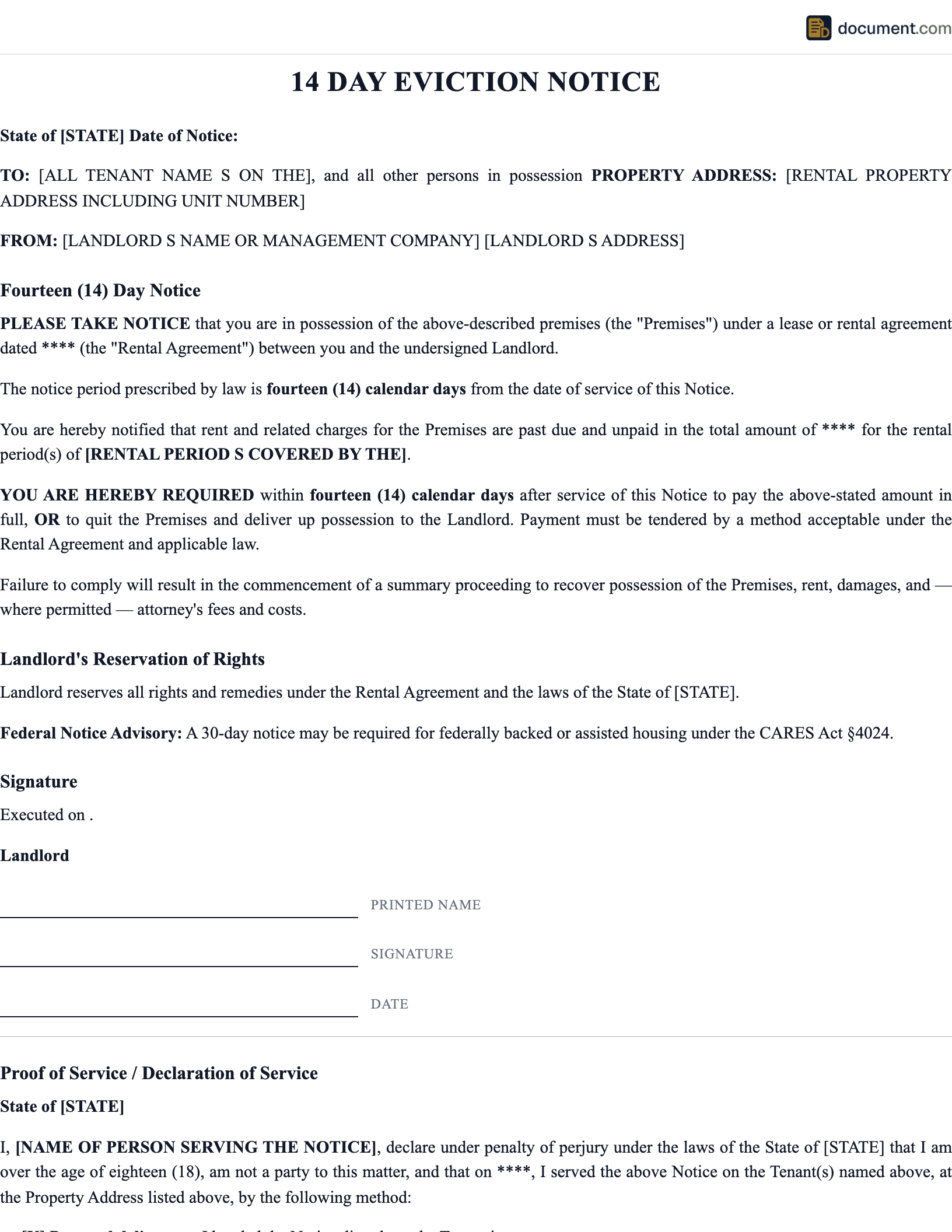
Sample Delaware Eviction Notice
Below is a preview of a Delaware-compliant eviction notice. The generated document includes all elements required under DE law.
7-DAY NOTICE TO CURE LEASE VIOLATION
STATE OF DELAWARE
Pursuant to 25 Del. C. §5502(a)
TO (TENANT):
Name: [Tenant Full Legal Name]
Address: [Delaware Property Address]
VIOLATION / GROUNDS:
[Detailed description of violation with dates]
DEMAND
You have seven (7) days from delivery of this notice to cure the above violation. If you fail to remedy the breach within 7 days, a 30-day termination notice will be served, after which you must vacate the premises. Failure to vacate will result in summary possession proceedings in the Justice of the Peace Court.