
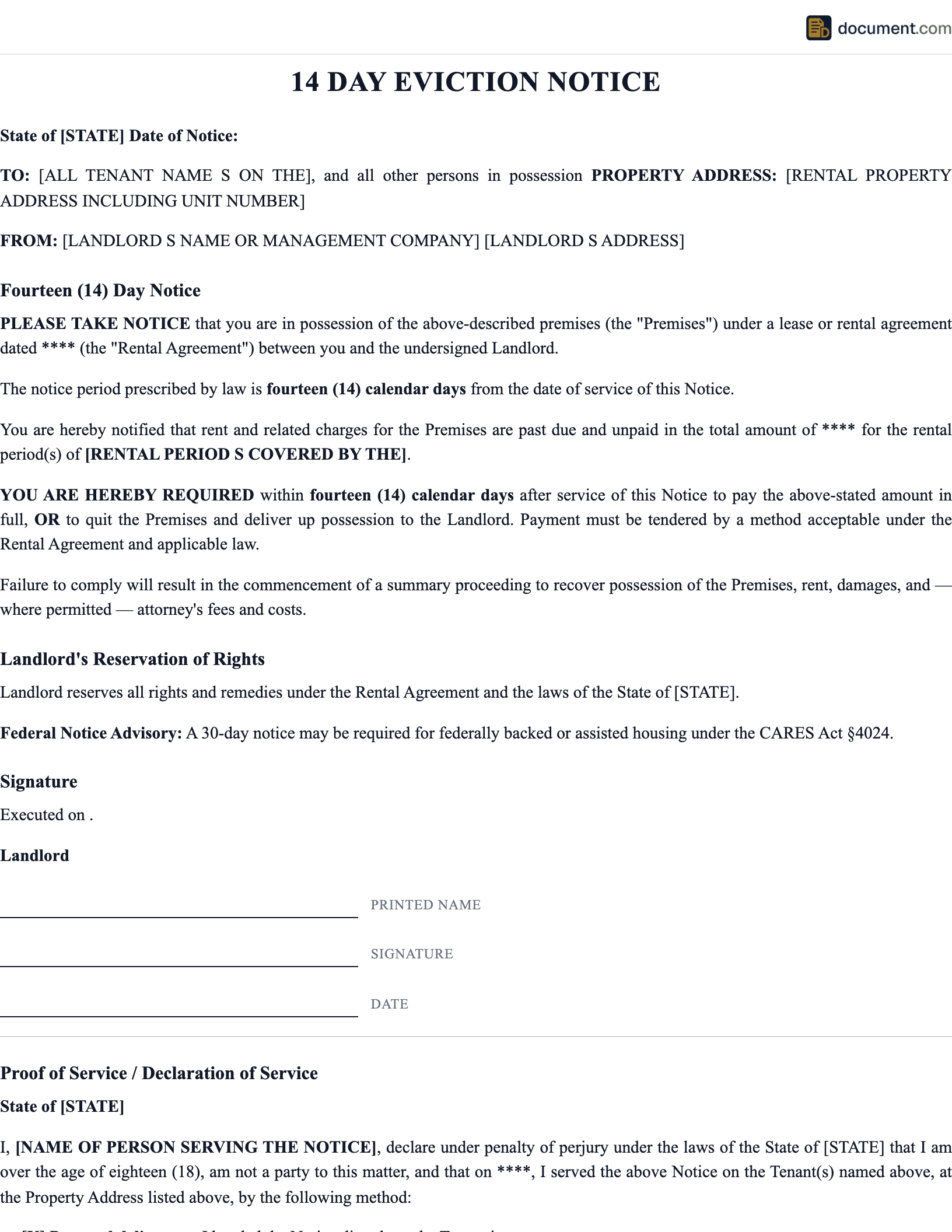



California Eviction Notice Overview
California does not use a 14-day notice for lease violations. Under California Code of Civil Procedure §1161(3), landlords must issue a 3-day notice to cure or quit when a tenant breaches a lease covenant. This is one of the shortest cure periods in the nation. California’s eviction process—called “unlawful detainer”—is handled by Superior Court and has been significantly shaped by the Tenant Protection Act of 2019 (AB 1482), which added just-cause eviction requirements for most residential tenancies.
For landlords searching for a “14-day notice” in California, the correct form is the 3-day notice to perform covenants or quit. Using a 14-day timeline is permissible (you can always give more time than required), but the minimum is 3 days for curable lease violations. Non-payment of rent also requires a separate 3-day notice under CCP §1161(2). California’s tenant protection framework is among the most comprehensive in the country, with additional local ordinances in Los Angeles, San Francisco, Oakland, San Jose, and other cities providing even greater protections.
3 Days
Cure period (violations)
$240–$435
Superior Court filing
Written
Notice required
5–8 Wks
Total process
California’s 3-Day Notice, Not 14
California Code of Civil Procedure §1161(3) requires a 3-day notice when a tenant commits a curable lease violation. The notice must describe the violation with specificity and give the tenant exactly 3 days to cure. Weekends and court holidays do not count toward the 3-day period under CCP §1161. If the tenant cures within 3 days, the tenancy continues.
California Notice Periods
3-day notice to pay rent or quit: Non-payment of rent (CCP §1161(2))
3-day notice to cure or quit: Curable lease violations (CCP §1161(3))
3-day unconditional quit: Nuisance, illegal activity, subletting without consent (CCP §1161(4))
30/60-day termination: No-fault termination of month-to-month (Civil Code §1946.1)
90-day notice: Section 8 tenancies (federal requirement)
Common Violations Addressed by This Notice
- Unauthorized pets violating lease restrictions
- Unauthorized occupants or subletting without landlord approval
- Using residential premises for commercial purposes
- Failure to maintain the unit in compliance with health and safety codes
- Violating noise clauses or disturbing other tenants’ quiet enjoyment
California Legal Requirements
California courts require strict compliance with notice requirements. A deficient notice will result in dismissal of the eviction case, wasting time and filing fees.
- Written Format: California requires all eviction notices in writing. The notice must be served on each named tenant
- Specific Violation: Describe the covenant or condition violated with enough detail for the tenant to understand and cure it
- 3-Day Cure Period: State that the tenant has 3 days to cure. Exclude Saturdays, Sundays, and judicial holidays from the count
- Forfeiture Language: Include a statement that failure to cure will result in forfeiture of the lease—required by CCP §1161(3)
- AB 1482 Compliance: For properties subject to the Tenant Protection Act, state the just-cause reason for the notice
- Local Ordinance Compliance: In rent-controlled cities (LA, SF, Oakland, San Jose, Berkeley), include any locally required disclosures
Serving the Notice in California
Proper service is critical in California. The method of delivery determines when the notice period starts and must be documented for court proceedings.
Personal Service
Hand the notice directly to the tenant. The 3-day period starts the next day. This is the most reliable method in California Superior Court.
Substituted Service
If personal service fails after reasonable diligence, leave the notice with a competent person at the tenant’s home or workplace AND mail a copy. Under CCP §1162(a)(2), this adds time for mailing.
Post and Mail
Only if personal and substituted service are both impossible. Affix to the front door in a sealed envelope AND mail a copy via first-class mail. Adds 5 days for mailing under CCP §1013.
California Eviction Timeline
The complete eviction process in California, from notice to physical removal, follows this general timeline for uncontested cases:
California Eviction Fees & Costs
Below are the typical costs associated with the eviction process in California. Fees may vary by county or court location.
| Cost Item | Amount |
|---|---|
| Superior Court Filing (Unlawful Detainer) | $240 – $435 |
| Sheriff Service of Summons | $40 – $75 |
| Registered Process Server | $50 – $150 |
| Writ of Possession | $40 – $75 |
| Sheriff Lockout Fee | $125 – $250 |
| Attorney Fees (uncontested) | $1,000 – $3,500 |
Sample California Eviction Notice
Below is a preview of a California-compliant eviction notice. The generated document includes all required elements.
3-DAY NOTICE TO PERFORM COVENANTS OR QUIT
STATE OF CALIFORNIA
Pursuant to CCP §1161(3)
TO (TENANT):
Name: [Tenant Name]
Address: [California Property Address]
VIOLATION / GROUNDS:
[Description of violation with dates]
DEMAND
You have three (3) days after service of this notice to cure the above violation. Saturdays, Sundays, and judicial holidays are excluded. If you fail to cure within this period, your lease will be forfeited and you must vacate.