
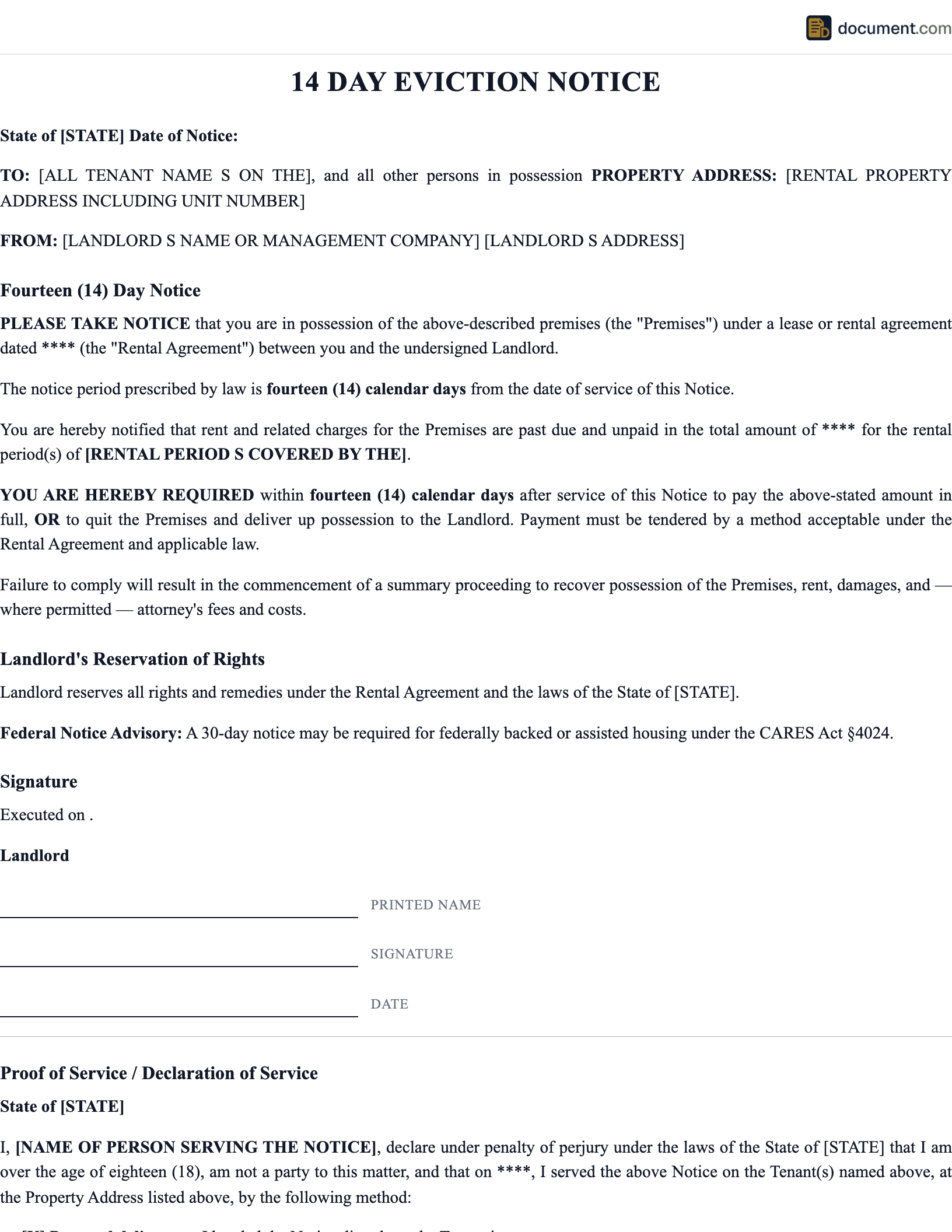



Alaska 14-Day Eviction Notice Overview
Alaska's Uniform Residential Landlord and Tenant Act (AS 34.03.010–34.03.360) does not include a 14-day notice period for any eviction scenario. Instead, Alaska landlords use a 10-day notice to quit for material noncompliance with the rental agreement (AS 34.03.220(a)). This 10-day cure-or-quit notice is the closest equivalent to the 14-day notices used in states like Alabama, Kansas, and Tennessee.
A landlord who issues a 14-day notice in Alaska is not violating any law—providing more time than the statutory minimum is always permissible. However, the landlord cannot enforce a notice period shorter than 10 days for curable violations. Understanding Alaska's actual statutory framework is essential because the courts in Anchorage, Fairbanks, Juneau, and other Alaska communities will evaluate the notice against the 10-day standard in AS 34.03.220.
10 Days
Statutory minimum
$75
FED filing fee
Written
Notice required
5–8 Wks
Total process
Why Alaska Uses 10 Days Instead of 14
Alaska adopted its version of the URLTA in 1974, setting the cure period at 10 days for material noncompliance. Unlike states such as Kansas (K.S.A. §58-2564(a)) or Wisconsin (Wis. Stat. §704.17) that chose 14 days, Alaska's legislature determined that 10 days provides adequate time for tenants to remedy violations while minimizing prolonged disruption for landlords and neighboring tenants.
Alaska Notice Period Summary
10-day cure-or-quit: Material noncompliance with rental agreement (AS 34.03.220(a))
5-day unconditional quit: Repeat violation within 6 months (AS 34.03.220(e))
24-hour quit: Illegal activity or conduct threatening health/safety (AS 34.03.220(a)(2))
14-day non-payment: Not a standard Alaska notice period; rent is typically demanded with shorter timeframes
30-day termination: Month-to-month tenancy without cause (AS 34.03.290(b))
If you arrived at this page searching for an Alaska eviction notice, our generator creates the correct AS 34.03.220-compliant notice for your specific situation. You can use a 14-day window if you prefer to give the tenant extra time, but the notice must still meet all Alaska statutory requirements for content, format, and service.
Alaska Notice Requirements Under AS 34.03.220
Alaska District Courts require strict compliance with the statutory notice elements. A deficient notice will result in dismissal of the forcible entry and detainer (FED) action, wasting time and filing fees.
- Written Format: The notice must be in writing. Alaska does not recognize oral notices for any eviction purpose
- Specific Description of Noncompliance: Detail the exact nature of the violation, including dates, witnesses, and the lease provision breached
- Cure Period Statement: Clearly state that the tenant has 10 days (or 14 if you are providing extra time) to remedy the violation
- Termination Warning: State that the rental agreement will terminate if the violation is not cured within the specified period
- Landlord Identity: Include the landlord's name, address, and telephone number as required by AS 34.03.080
- Property Address: Full street address including unit number, city, and ZIP code within Alaska
Serving the Notice in Alaska
AS 34.03.150 governs notice delivery methods in Alaska. Due to the state's vast geography and remote communities, the legislature included multiple service options. Proper service is essential because Alaska District Courts will dismiss an FED action if service cannot be proven.
Personal Delivery
Hand the notice directly to the tenant. The cure period begins on the date of delivery. In remote Alaska communities where certified mail is unreliable, this is often the only practical method.
Substituted Service
If the tenant is not available, leave the notice with a person of suitable age at the dwelling. Alaska law does not define a minimum age, but courts generally expect the recipient to be at least 16 years old.
Post and Mail
Affix the notice to the main entrance of the dwelling in a conspicuous manner AND send a copy by first-class mail. The notice is considered received when both actions are complete. Add 3 days to the cure period for mailing under Alaska Civil Rule 5(b).
Certified Mail with Return Receipt
Send the notice via USPS certified mail. The return receipt (green card) serves as proof of delivery. Note that some Alaska communities rely on PO boxes, so confirm the tenant's mailing address.
Alaska Eviction Timeline
The complete eviction process in Alaska, from notice to physical removal, typically takes 5 to 8 weeks for uncontested cases. Rural areas may take longer due to court scheduling and limited law enforcement availability.
Alaska Eviction Filing Fees & Costs
Alaska Court System fees are uniform statewide but ancillary costs vary significantly between urban areas (Anchorage, Fairbanks) and remote communities.
| Cost Item | Amount |
|---|---|
| FED Filing Fee (District Court) | $75 |
| Service of Process (peace officer) | $50 – $100 |
| Private Process Server | $65 – $150 |
| Writ of Assistance | $25 – $50 |
| Attorney Fees (Anchorage/Fairbanks) | $1,000 – $3,000 |
Sample Alaska Cure-or-Quit Notice
Below is a preview of an Alaska-compliant notice for material noncompliance. The generated document includes all elements required under AS 34.03.220.
NOTICE TO CURE OR QUIT
STATE OF ALASKA
Pursuant to AS 34.03.220(a)
TO (TENANT):
Name: [Tenant Name]
Address: [Alaska Property Address]
MATERIAL NONCOMPLIANCE:
You are in material noncompliance with your rental agreement, specifically:[Description of violation with dates]
CURE DEMAND
You have ten (10) days from delivery of this notice to remedy the above noncompliance. If you fail to do so, your rental agreement will terminate on [Date].