



North Carolina 10-Day Eviction Notice Overview
North Carolina IS a 10-Day Notice State
Unlike most states on this list, North Carolina actually uses a 10-day notice for non-payment of rent. N.C.G.S. §42-3 specifically requires 10 days' notice before a landlord can file for eviction due to unpaid rent. This is the statutory standard, not a lease provision. North Carolina is one of the primary states where the 10-day eviction notice directly applies.
North Carolina's landlord-tenant law is found primarily in Chapter 42 of the North Carolina General Statutes. The state uses a "Summary Ejectment" process for evictions, filed in Small Claims Court (a division of District Court). North Carolina is considered moderately landlord-friendly with a straightforward eviction process, though the 10-day notice requirement provides tenants with a meaningful opportunity to cure non-payment.
The state has 100 counties, each with a District Court that handles Summary Ejectment cases. The process is designed to be accessible to landlords without attorneys -- Small Claims hearings are informal and conducted by Magistrates. However, the growing cities of Charlotte (Mecklenburg County) and Raleigh (Wake County) have seen increasing case volumes that can affect processing times.
10 Days
Non-payment notice
$96
Filing fee
Required
Written notice
4-5 wks
Typical process
When the 10-Day Notice Applies in NC
The 10-day notice under N.C.G.S. §42-3 applies specifically to non-payment of rent. Here is how it fits into North Carolina's broader notice framework:
| Grounds | Notice Period | Statute |
|---|---|---|
| Non-payment of rent | 10 days (key provision) | N.C.G.S. §42-3 |
| Breach of lease conditions | Per lease terms (reasonable notice) | N.C.G.S. §42-26 |
| Month-to-month (no cause) | 7 days | N.C.G.S. §42-14 |
| Year-to-year (no cause) | 1 month | N.C.G.S. §42-14 |
| Criminal activity | Immediate filing permitted | N.C.G.S. §42-59 |
N.C.G.S. §42-3 Requirements
To be valid, a North Carolina 10-day eviction notice must meet all the following requirements. Courts will dismiss Summary Ejectment cases where the notice was deficient.
Required Notice Content
- Written Form: The notice must be in writing. Verbal demands for rent do not satisfy N.C.G.S. §42-3
- Demand for Rent: State the exact amount of rent owed, broken down by month if multiple months are past due
- 10-Day Period: Clearly state the tenant has 10 days to pay or vacate the premises
- Property Address: Include the full street address and unit number of the rental property
- Tenant Names: List all tenants on the lease by full legal name
- Forfeiture Language: State that the lease will be forfeited if rent is not paid within 10 days
- Landlord Information: Include the landlord's name and contact information
- Date of Service: Record the date the notice is served, which starts the 10-day countdown
How to Serve a 10-Day Notice in North Carolina
Proper service of the 10-day notice is essential. North Carolina courts will dismiss the Summary Ejectment case if the notice was not properly served.
Personal Delivery
Hand deliver the notice directly to the tenant. This is the most reliable method. Bring a witness who can later testify about the date and method of delivery
Post on Door and Mail
If the tenant cannot be found, post the notice on the main entrance door of the unit and mail a copy via first-class mail. NC courts accept this alternative method
Count 10 Full Days
Allow the full 10 calendar days to expire. Do not count the day of service. If the tenant pays all rent owed, the notice is satisfied and you cannot proceed
File Summary Ejectment in Small Claims Court
After 10 days expire, file a Complaint in Summary Ejectment (form AOC-CVM-201) at the District Court for the county where the property is located. Filing fee: $96
Attend Hearing and Obtain Writ of Possession
The Magistrate hears the case (typically within 7-10 days of filing). If you prevail, request a Writ of Possession for the sheriff to execute
North Carolina Eviction Timeline
North Carolina's Summary Ejectment process is designed to be relatively fast. For non-payment: the 10-day notice is followed by filing in Small Claims Court, where the Magistrate hearing is typically scheduled within 7-10 days. After judgment, the landlord requests a Writ of Possession, which the sheriff executes within 5-7 days.
Total time for an uncontested non-payment case: approximately 4-5 weeks from the initial 10-day notice to physical removal. This is moderate compared to other states.
If the tenant appeals to District Court (within 10 days of judgment), the case gets a completely new trial (de novo) before a District Court judge. This adds 2-4 weeks to the process. In Wake County and Mecklenburg County, the higher case volumes mean slightly longer wait times for hearings. The tenant must post a bond for the appeal, typically equal to the amount of rent owed.
North Carolina Filing Fees & Costs
| Fee / Cost | Typical Amount |
|---|---|
| Summary Ejectment Filing Fee | $96 |
| Service of Process (Sheriff) | $30 |
| Writ of Possession Execution | $30 - $60 |
| Attorney Fees (if hired) | $500 - $2,000 |
| Appeal to District Court | $150 + bond |
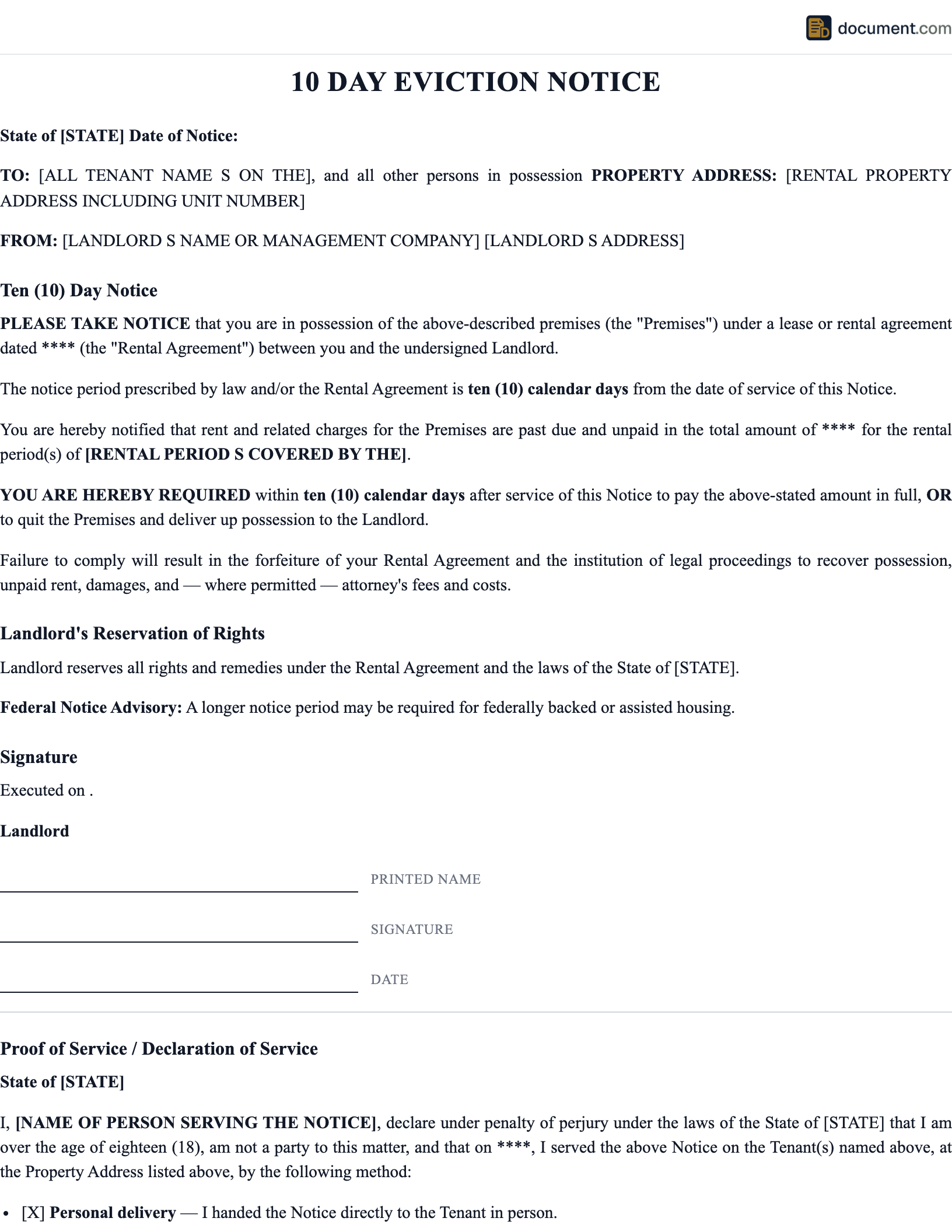
Sample North Carolina 10-Day Notice
Below is a preview of a North Carolina-compliant 10-day notice for non-payment under N.C.G.S. §42-3. This is the actual statutory notice period for NC.
10-DAY NOTICE TO PAY RENT OR QUIT
STATE OF NORTH CAROLINA
Pursuant to N.C.G.S. §42-3
LANDLORD:
Name: [Full Legal Name]
Address: [North Carolina Address]
TENANT:
Name: [Full Legal Name]
Premises: [Rental Address, County, NC]
DEMAND AND NOTICE:
Demand is hereby made for payment of $_____ in unpaid rent. Pursuant to N.C.G.S. §42-3, you are given ten (10) days' notice that unless the rent is paid within 10 days of service of this notice, the lease shall be forfeited and the landlord will pursue Summary Ejectment in North Carolina Small Claims Court.
NORTH CAROLINA LAW -- 10-DAY STATE
This notice complies with N.C.G.S. §42-3 and Chapter 42 of the North Carolina General Statutes. North Carolina is a statutory 10-day notice state for non-payment of rent.