



Indiana 10-Day Eviction Notice Overview
Indiana is one of the key 10-day eviction notice states in the country. Under Indiana Code §32-31-1-6, landlords must provide at least 10 days written notice before filing an eviction for non-payment of rent. This is the primary notice period that applies to the most common eviction scenario in Indiana: a tenant who has fallen behind on rent.
Indiana's 10-day notice is a "pay or quit" notice, meaning the tenant has 10 days to either pay the full amount of rent owed or vacate the premises. If the tenant pays in full within 10 days, the eviction cannot proceed. Marion County (Indianapolis) handles the highest volume of eviction cases in the state, followed by Lake County (Gary/Hammond), Allen County (Fort Wayne), and St. Joseph County (South Bend). Most residential evictions in Indiana are filed in Small Claims Court due to the streamlined process.
10 Days
Non-payment of rent
IC 32-31
Governing statute
$35-$97
Small Claims filing
3-5 Wks
Uncontested timeline
When Indiana Uses a 10-Day Notice
Indiana's 10-Day Notice Is for Non-Payment
Unlike some states where 10-day notices apply to lease violations, Indiana's 10-day notice under IC §32-31-1-6 is specifically for non-payment of rent. For other lease violations, check your lease agreement for contractual notice requirements. Indiana does not have a separate statutory cure period for non-payment violations.
| Situation | Notice Period | Statute |
|---|---|---|
| Non-payment of rent | 10 days to pay or quit | IC §32-31-1-6 |
| Lease violations (other) | Per lease terms (reasonable notice) | IC §32-31-1-8 |
| Month-to-month (tenant < 1 yr) | 30 days | IC §32-31-1-1 |
| Month-to-month (tenant > 1 yr) | 90 days | IC §32-31-1-1 |
| Holdover after lease expiration | Immediate (demand for possession) | IC §32-31-1-8 |
IC 32-31-1 Notice Requirements
Indiana Code Title 32, Article 31 governs landlord-tenant relationships and eviction procedures.
- Written Notice: Must be in writing. Indiana does not accept verbal or text message eviction notices
- 10-Day Period: The tenant must be given at least 10 days to pay the full amount of rent owed
- Amount Specified: State the exact amount of rent due and the period it covers
- Pay or Quit Language: Clearly state that the tenant must pay in full or vacate within 10 days
- Property Address: Full address of the rental property including unit number and county
- Landlord Information: Name and contact information for the landlord or property manager
How to Serve a 10-Day Notice in Indiana
Indiana law allows several methods of service for pre-suit eviction notices.
Personal Delivery
Hand-deliver the notice to the tenant. This is the most reliable method. Use a witness or process server for documentation
Post and Mail
Post the notice on the door AND mail a copy. Indiana courts accept this when personal delivery is not possible
Certified Mail
Send via certified mail with return receipt requested. Retain the green card as proof of service for the court filing
Wait Full 10 Days
Allow the complete 10-day period. If the tenant pays in full within 10 days, the notice is satisfied and you cannot file
File Eviction Complaint
File in Small Claims Court (most common) or Superior/Circuit Court. Marion County Small Claims Court has dedicated eviction dockets
Indiana Court Process
Most Indiana residential evictions are filed in Small Claims Court for efficiency. After the complaint is filed, the court serves notice on the tenant and schedules a hearing, typically within 10 to 21 days. Marion County has dedicated eviction dockets that may schedule hearings somewhat faster.
At the hearing, both parties present evidence. If the landlord prevails, the court enters a judgment for possession. Indiana does not have a mandatory stay of execution period for residential evictions. The sheriff or constable can serve and enforce the order of possession promptly after judgment, typically within 5 to 14 days depending on the county.
Total uncontested timeline: 3 to 5 weeks from initial notice to enforcement. Contested cases: 5 to 8 weeks. Appeals go to the Superior or Circuit Court. In Marion County (Indianapolis), the high volume means enforcement timing can vary, but the county has invested in streamlining the process.
Indiana Filing Fees & Costs
Filing fees for eviction cases in Indiana courts.
| Fee / Cost | Amount |
|---|---|
| Small Claims Filing Fee | $35 - $97 |
| Superior/Circuit Court Filing | $100 - $200 |
| Service of Process (Sheriff) | $25 - $50 |
| Order of Possession Enforcement | $50 - $150 |
| Attorney Fees (if hired) | $500 - $2,000 |
Sample Indiana 10-Day Eviction Notice
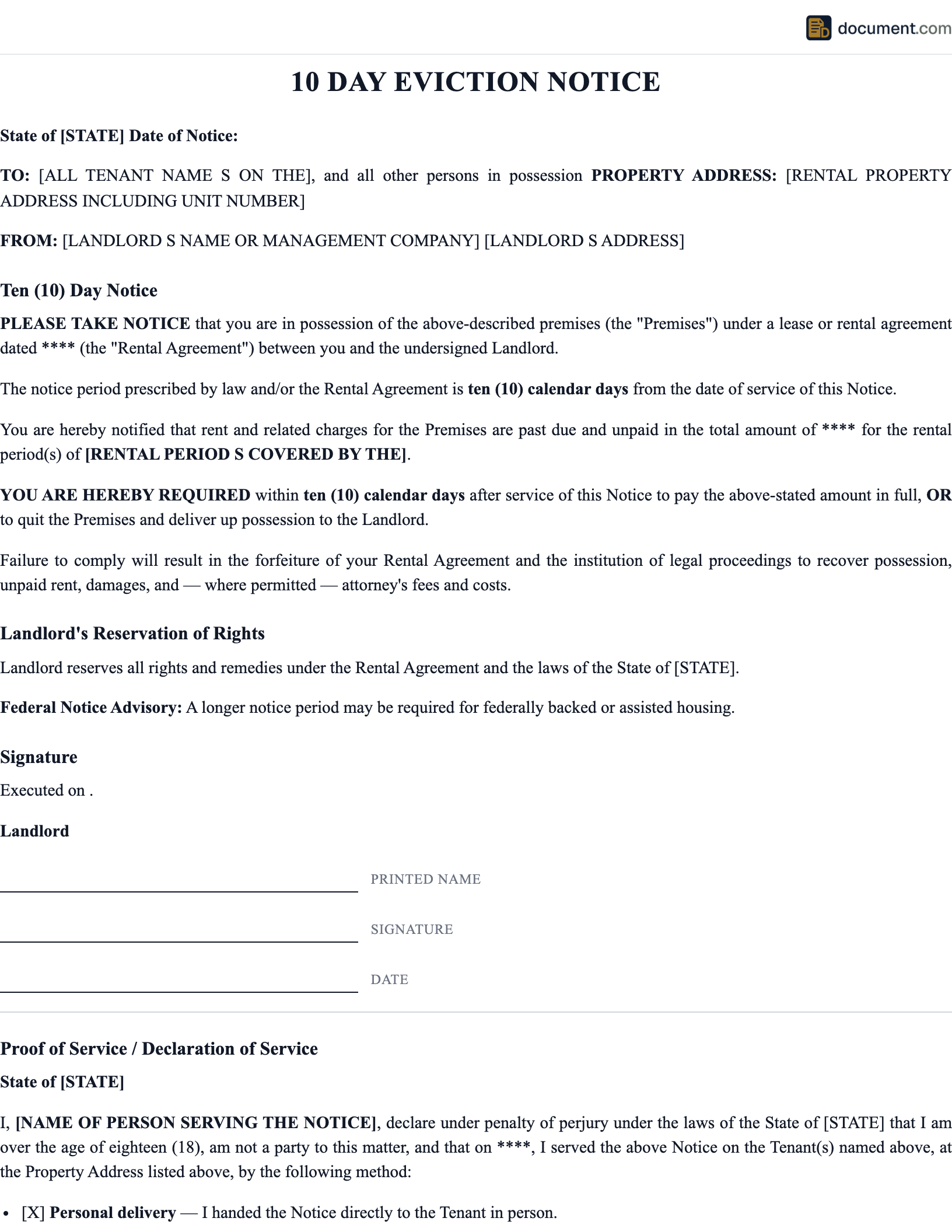
Below is a preview of an Indiana 10-day notice for non-payment of rent under IC §32-31-1-6.
10-DAY NOTICE TO PAY RENT OR VACATE
STATE OF INDIANA
Pursuant to IC §32-31-1-6
TO TENANT(S):
Name: [Full Legal Name]
Property: [Indiana Property Address]
County: [Indiana County]
AMOUNT DUE:
Total rent due: $[amount] for the period of [dates]. Late fees (per lease): $[amount].
DEMAND:
You must pay the total amount owed within TEN (10) DAYS of service of this notice or vacate the premises. If you pay in full within 10 days, this notice is satisfied and your tenancy continues.
NOTICE
If you fail to pay in full or vacate within 10 days, an eviction action will be filed in the [County] Small Claims Court to recover possession and any amounts owed.