
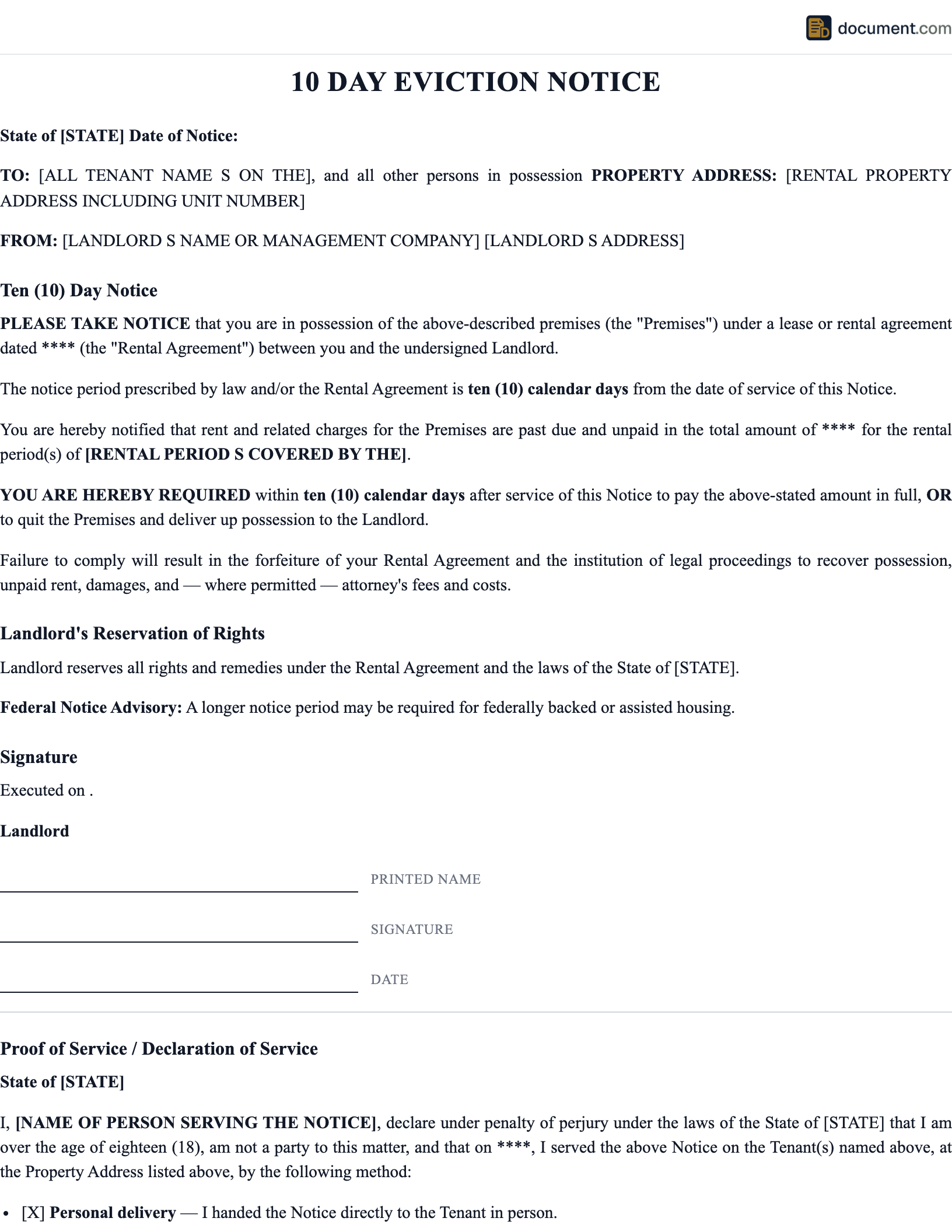



Illinois 10-Day Eviction Notice Overview
Illinois uses a 10-day notice for lease violations under 735 ILCS 5/9-210, making it one of the key 10-day notice states in the country. The 10-day notice applies when a tenant breaches any material term of the lease other than non-payment of rent, which has its own 5-day notice under 735 ILCS 5/9-209. Common violations triggering a 10-day notice include unauthorized occupants, pets in violation of the lease, excessive noise, property damage, unauthorized alterations, and parking violations.
Illinois eviction law is complicated by the fact that Chicago has its own Residential Landlord and Tenant Ordinance (RLTO) with additional requirements, and Cook County adopted a similar ordinance (RTLO) in 2021 that applies to participating suburban municipalities. Landlords must determine which set of rules applies to their property before serving any notice. Using the wrong notice format or failing to include RLTO/RTLO-required language can result in dismissal and potential liability.
10 Days
Lease violations
5 Days
Non-payment of rent
$150-$242
Filing fee
5-8 Wks
Cook County timeline
When Illinois Uses a 10-Day Notice
| Situation | Notice Period | Statute |
|---|---|---|
| Lease violations (non-payment excluded) | 10 days to cure | 735 ILCS 5/9-210 |
| Non-payment of rent | 5 days to pay | 735 ILCS 5/9-209 |
| Month-to-month termination | 30 days | 735 ILCS 5/9-207 |
| Week-to-week termination | 7 days | 735 ILCS 5/9-207 |
Chicago RLTO: Different Rules Apply
Chicago Properties Must Comply with the RLTO
Properties within the City of Chicago must comply with both state law AND the Chicago RLTO (Municipal Code 5-12). The RLTO requires specific notice language, delivery by certified mail or personal service, and includes tenant remedy provisions. Using a state-law-only notice for a Chicago property can result in case dismissal and the landlord owing damages to the tenant. Cook County suburban landlords should also check whether the Cook County RTLO applies to their municipality.
The Chicago RLTO (Residential Landlord and Tenant Ordinance) creates a parallel set of requirements for Chicago landlords. Key differences include: landlords must attach a copy of the RLTO summary to every lease, security deposits must earn interest, the landlord must provide specific disclosures at lease signing, and the notice must include RLTO-specific cure language. Penalties for RLTO violations can include the tenant recovering one month's rent plus attorney fees.
Cook County's RTLO (adopted 2021) extends similar protections to unincorporated Cook County and participating municipalities. As of 2025, a growing number of Cook County suburbs have opted in. Landlords with properties in DuPage, Lake, Kane, Will, or McHenry counties are subject to state law only (735 ILCS 5/9-210) without additional local requirements.
735 ILCS 5/9-210 Notice Requirements
The Illinois Code of Civil Procedure sets the baseline requirements for 10-day notices. Chicago and Cook County RTLO properties have additional requirements.
- Specific Violation: Describe the exact lease violation, referencing the specific lease provision breached
- 10-Day Cure Period: State that the tenant has 10 days to cure the violation or the lease terminates
- Written Form: Must be in writing, signed by the landlord or authorized agent
- Service Method: Personal delivery, leaving at the dwelling with someone of suitable age, or posting and mailing per 735 ILCS 5/9-211
- Chicago RLTO (if applicable): Certified mail or personal delivery, RLTO summary attached, tenant rights language included
- Property Address: Full address of the rental unit including apartment number, city, and county
How to Serve a 10-Day Notice in Illinois
735 ILCS 5/9-211 governs service of eviction notices in Illinois. Service methods differ for Chicago vs. non-Chicago properties.
Personal Service (All Illinois)
Deliver the notice directly to the tenant. This is the preferred method statewide and the required method under the Chicago RLTO (alternative: certified mail for RLTO)
Substitute Service (Non-Chicago)
Leave with a person 13 years or older at the property, or post on the door if no one is available, per 735 ILCS 5/9-211
Certified Mail (Chicago RLTO)
For Chicago properties, send via certified mail with return receipt requested. Retain the green card as proof of service
Wait 10 Days, Then File
After the 10-day period expires without cure, file the eviction complaint in the Circuit Court for the county where the property is located
Court Process
The sheriff serves the summons. The court schedules a hearing. If the landlord prevails, an Order of Possession issues after a 14-day stay period
Illinois Eviction Court Process
After the 10-day notice expires, the eviction complaint is filed in Circuit Court. Cook County has a dedicated Eviction Court at the Daley Center. The summons must be served at least 7 days before the return date. At the initial hearing, if the tenant does not appear, a default judgment is entered. If the tenant appears, the case may proceed to trial or mediation.
After judgment, Illinois provides a mandatory 14-day stay of execution (the "redemption period") before the order of possession can be enforced. The sheriff then schedules the physical eviction. In Cook County, sheriff enforcement can take an additional 7 to 21 days due to volume. Downstate counties typically enforce within 7 to 14 days.
Total Cook County timeline: 5 to 8 weeks uncontested, 2 to 4 months contested. Downstate: 3 to 5 weeks uncontested, 5 to 8 weeks contested. The 14-day stay period is a significant factor in the Illinois timeline compared to states without a mandatory stay.
Illinois Filing Fees & Costs
Filing fees for eviction cases in Illinois Circuit Courts.
| Fee / Cost | Amount |
|---|---|
| Eviction Filing (Cook County) | $242 |
| Eviction Filing (downstate) | $100 - $175 |
| Sheriff Service of Summons | $50 - $80 |
| Order of Possession Enforcement | $60 - $150 |
| Attorney Fees (if hired) | $700 - $3,000 |