



Florida Eviction Notice Overview
Florida's Residential Landlord and Tenant Act (F.S. Chapter 83, Part II) governs all residential evictions in the state. Florida uses two primary notice periods: a 3-day notice for non-payment of rent under F.S. §83.56(3) and a 7-day notice for other lease violations under F.S. §83.56(2). There is no statutory 10-day notice period in Florida law.
Florida is the third most populous state, and its eviction volume is enormous. Miami-Dade, Broward, Palm Beach, Orange (Orlando), and Hillsborough (Tampa) counties handle tens of thousands of eviction filings annually. Florida's 3-day non-payment notice counts only business days, which effectively makes it a 5 to 7 calendar day notice. The 7-day violation notice counts all calendar days. These distinctions are critical for compliance.
3 Days
Non-payment (business)
7 Days
Lease violations
~$185
Filing fee
2-4 Wks
Uncontested timeline
Florida's 3-Day and 7-Day Notice System
Florida Uses 3-Day and 7-Day Notices, Not 10-Day
Florida's 3-day non-payment notice must demand only rent, not late fees, utilities, or other charges. Including non-rent amounts is the single most common mistake in Florida evictions and will get your case dismissed. The 7-day violation notice must specify whether the violation is curable. Using a 10-day notice when 3 or 7 days is required will not invalidate the notice (you can always give more time), but it is unnecessary.
| Situation | Notice Period | Statute |
|---|---|---|
| Non-payment of rent | 3 business days | F.S. §83.56(3) |
| Curable lease violation | 7 calendar days to cure | F.S. §83.56(2)(a) |
| Non-curable violation | 7 calendar days unconditional | F.S. §83.56(2)(b) |
| Month-to-month termination | 15 calendar days | F.S. §83.57 |
F.S. Chapter 83 Notice Requirements
Florida courts strictly enforce the content and form requirements of eviction notices. A defective notice is the most successful tenant defense in Florida eviction cases.
- Rent-Only Demand (3-Day): The 3-day notice must demand only the unpaid rent amount. Do not include late fees, damages, or utility charges
- Specific Violation (7-Day): The 7-day notice must describe the specific noncompliance and state whether it is curable or not
- Business Days (3-Day): The 3-day period excludes the day of delivery, weekends, and legal holidays under F.S. §83.56(3)
- Calendar Days (7-Day): The 7-day period counts all calendar days, not just business days
- Delivery Method: Personal delivery, posting on the door with mailing, or any method reasonably calculated to give notice
- Written Form: Must be in writing. Verbal or text message notices are not sufficient under Florida law
How to Serve an Eviction Notice in Florida
F.S. §83.56(4) allows flexible delivery methods for pre-suit notices, but the method must be documented for the court filing.
Hand Delivery
Deliver directly to the tenant. Use a witness or process server for documentation. This starts the notice period the next day
Post and Mail
Leave the notice at the dwelling in a conspicuous place AND mail a copy to the tenant. This is the most common method in Florida
Wait the Required Period
3 business days for non-payment or 7 calendar days for violations. Do not file the eviction complaint until the full period expires
File Eviction Complaint
File in County Court with the filing fee (~$185). Attach the notice and an affidavit describing the violation and proof of service
Sheriff Service and Court Hearing
The clerk issues a summons. The sheriff serves the tenant, who has 5 days to respond. If no response, request a default judgment and writ of possession
Florida County Court Eviction Process
Florida's eviction process moves through County Court. After the complaint is filed and the summons served, the tenant has 5 days (excluding weekends and holidays) to file a written defense. If the tenant files no response, the landlord moves for a default final judgment.
Once judgment is entered, the clerk issues a Writ of Possession. The sheriff posts a 24-hour notice on the property. After 24 hours, the sheriff returns to physically remove the tenant if they have not left. This 24-hour posting is a Florida-specific requirement that many other states do not have.
If the tenant does file an answer, the case is set for hearing or trial. Under F.S. §83.60(2), the tenant must deposit rent into the court registry as it comes due during the litigation. Failure to pay into the registry allows the landlord to obtain a default judgment. Total contested case timeline is typically 4 to 8 weeks in most counties, but can stretch longer in Miami-Dade and Broward.
Florida Filing Fees & Costs
Filing fees are set by Florida statute and are uniform across counties, with minor variations for additional services.
| Fee / Cost | Amount |
|---|---|
| Eviction Complaint Filing Fee | $185 |
| Sheriff Service of Summons | $30 - $50 |
| Writ of Possession | $90 - $115 |
| Sheriff Lockout (24-hour posting) | Included in writ fee |
| Attorney Fees (if hired) | $500 - $2,500 |
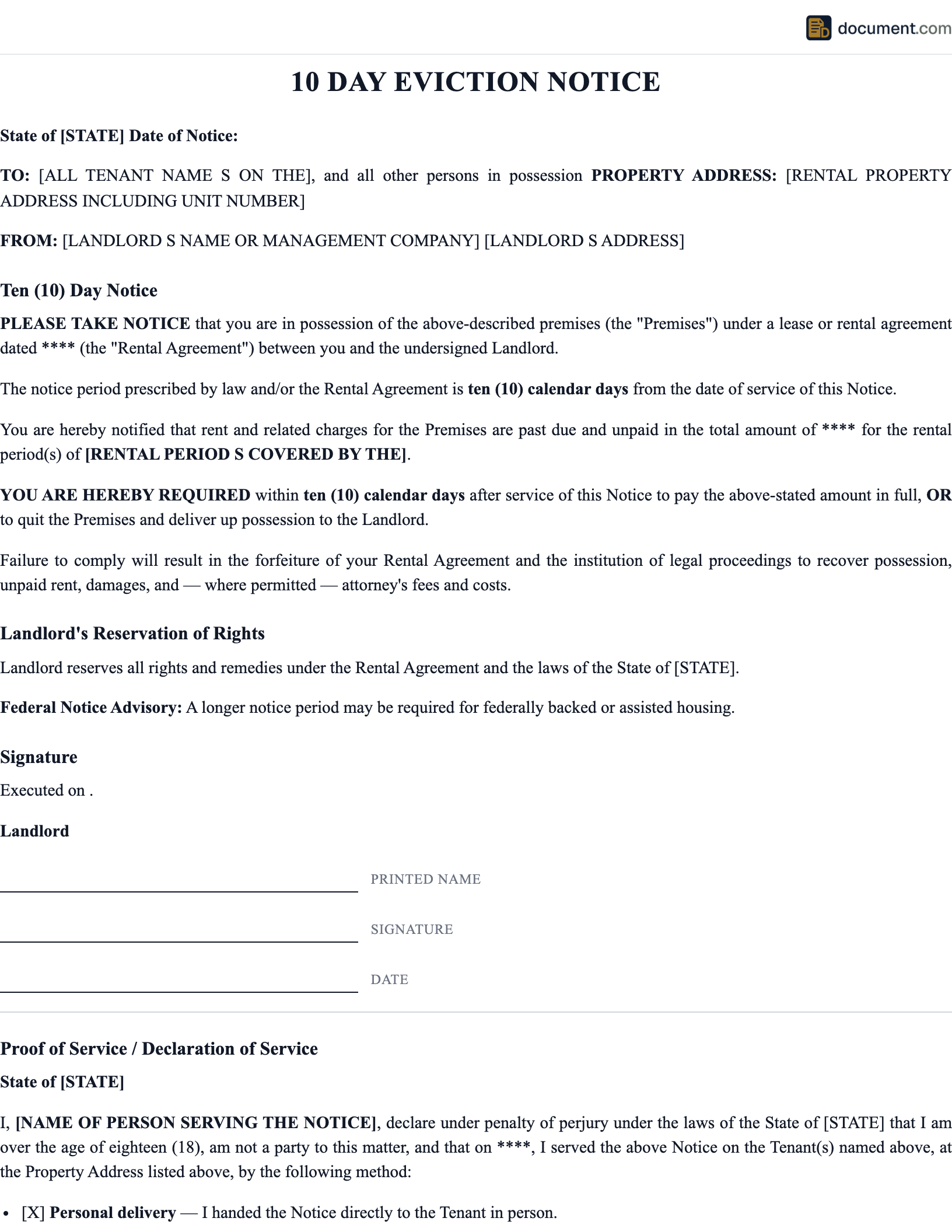
Sample Florida Eviction Notice
Below is a preview of a Florida 3-day notice for non-payment. Remember: demand only rent, not late fees or other charges.
THREE-DAY NOTICE TO PAY RENT OR VACATE
STATE OF FLORIDA
Pursuant to F.S. §83.56(3)
TO TENANT(S):
Name: [Full Legal Name]
Property: [Florida Property Address]
DEMAND FOR RENT:
You are notified that you owe $[rent amount only] in unpaid rent. You must pay this amount within THREE (3) BUSINESS DAYS of delivery of this notice or vacate the premises.
IMPORTANT
This notice demands rent only, as required by F.S. §83.56(3). Late fees and other charges are not included in this demand. The 3-day period excludes weekends, holidays, and the day of delivery.