



Delaware Eviction Notice Overview
Delaware's Residential Landlord-Tenant Code (Title 25, Chapter 55) governs the eviction process across the state's three counties: New Castle, Kent, and Sussex. Delaware uses a 5-day notice for non-payment of rent and a two-step process for lease violations: a 7-day cure notice followed by a 30-day termination notice if the violation is not corrected.
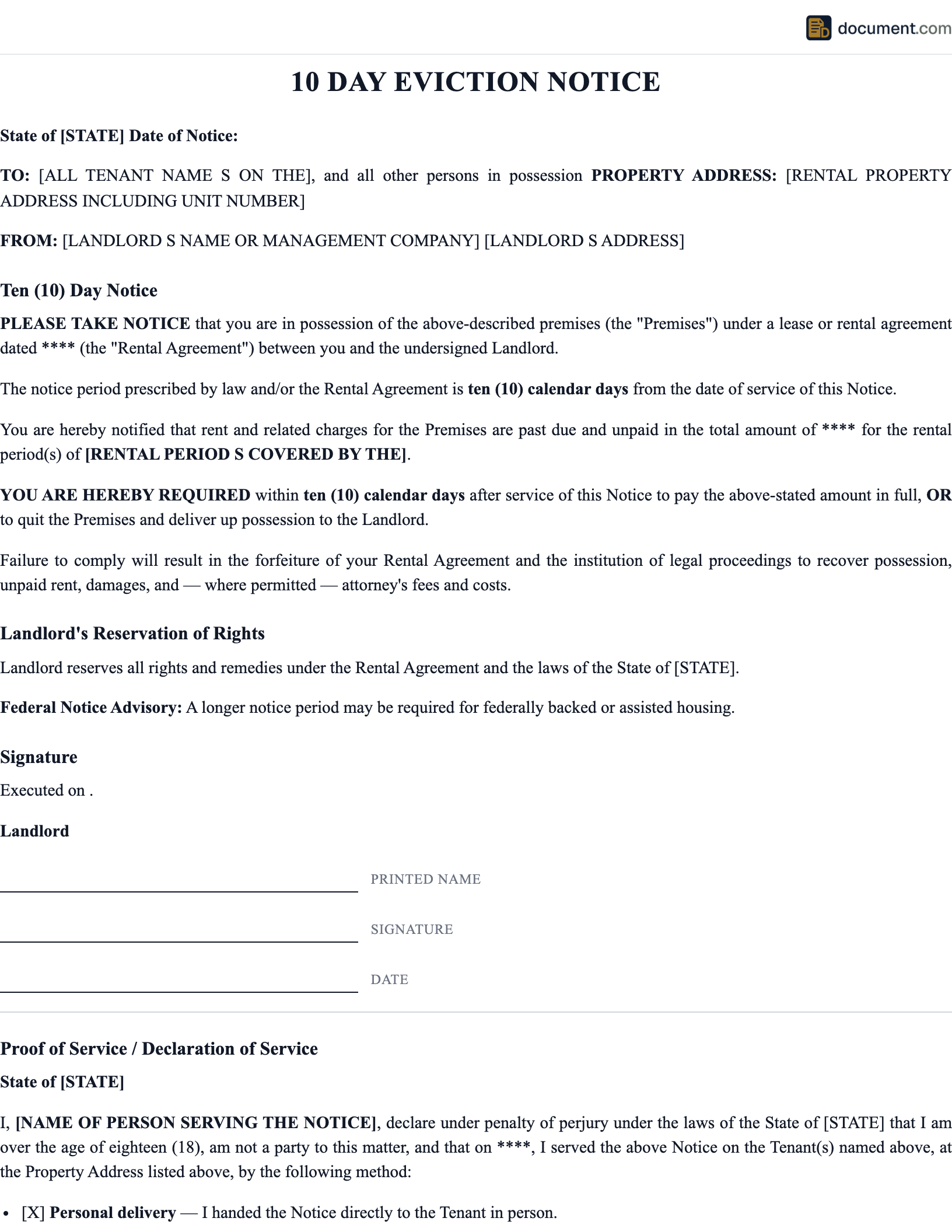
There is no 10-day eviction notice in Delaware's statutory framework. If you are looking for a 10-day notice for Delaware, it would only apply if your lease agreement contractually requires a 10-day notice period. Delaware's Justice of the Peace Courts handle all eviction proceedings through the Summary Possession process. New Castle County (Wilmington, Newark) has the highest volume, while Kent (Dover) and Sussex (Georgetown, Rehoboth Beach) have lower caseloads.
5 Days
Non-payment
7 Days
Cure period
$45-$55
Filing fee
3-5 Wks
Non-payment timeline
Delaware Notice Periods
Delaware Does Not Use a 10-Day Notice
Delaware's eviction framework uses 5-day (non-payment), 7-day (cure), and 30-day (termination) notice periods. A 10-day notice is not part of Delaware statutory law. Use the correct notice period for your situation to avoid having your case dismissed by the Justice of the Peace Court.
| Situation | Notice Period | Statute |
|---|---|---|
| Non-payment of rent | 5-day pay or quit | 25 Del.C. §5502 |
| Lease violation (first) | 7-day cure + 30-day termination | 25 Del.C. §5513 |
| Repeat violation (within 12 months) | 30-day termination (no cure) | 25 Del.C. §5513 |
| Month-to-month termination | 60 days | 25 Del.C. §5106 |
| Criminal/drug activity | Immediate termination | 25 Del.C. §5516 |
Title 25, Chapter 55 Requirements
Delaware's Residential Landlord-Tenant Code sets specific requirements for eviction notices. The Justice of the Peace Courts enforce these strictly.
- Written Notice: All eviction notices must be in writing. Verbal notices are insufficient under Delaware law
- Specific Amount (Non-Payment): For 5-day notices, state the exact amount of rent due and the period it covers
- Specific Violation (Lease Breach): For 7-day cure notices, identify the exact lease provision violated and what the tenant must do to cure
- Delivery Method: Personal delivery or posting on the door AND mailing a copy. Delaware also accepts certified mail
- Landlord ID: Include the landlord or property manager's name and contact information
- Proof of Service: Maintain documentation of when and how the notice was delivered for court filing
How to Serve an Eviction Notice in Delaware
Delaware provides flexibility in how pre-suit eviction notices can be delivered, but the method must be documented for court.
Personal Delivery
Hand-deliver the notice to the tenant. Have a witness present or use a process server. This is the most reliable method for Delaware JP Courts
Post and Mail
Post the notice on the front door of the rental unit AND mail a copy via first-class or certified mail to the tenant's last known address
Wait the Applicable Period
5 days for non-payment, 7 days for cure, or 30 days for termination. Count starts the day after service. Weekends and holidays count
File Summary Possession Action
File in the Justice of the Peace Court for the county where the property is located. Include the notice and proof of service
Attend the Hearing
Present evidence at the JP Court hearing. If you prevail, the court issues a judgment and writ of possession with a 5-day stay
Delaware Justice of the Peace Court Process
All residential eviction cases in Delaware are heard in Justice of the Peace Court. Delaware's three counties each have JP Courts that handle Summary Possession actions. New Castle County has the most JP Court locations (Courts 2, 4, 9, 11, 13, and 20 handle evictions).
After filing, the court schedules a hearing within 5 to 15 days. The constable serves the court summons on the tenant. At the hearing, both parties present evidence. If the landlord prevails, the court enters a judgment for possession. A writ of possession issues with a mandatory 5-day stay period during which the tenant can vacate voluntarily or appeal.
After the 5-day stay expires, the constable enforces the writ, typically within 3 to 7 business days. Total uncontested non-payment eviction timeline is 3 to 5 weeks. Lease violation cases take 6 to 10 weeks due to the 7-day cure plus 30-day termination notice sequence. Appeals go to the Court of Common Pleas and can add 1 to 3 months.
Delaware Filing Fees & Costs
Filing fees for Summary Possession actions in Delaware Justice of the Peace Courts.
| Fee / Cost | Amount |
|---|---|
| Summary Possession Filing Fee | $45 - $55 |
| Constable Service Fee | $25 - $50 |
| Writ of Possession | $20 - $40 |
| Lockout (Constable) | $50 - $150 |
| Attorney Fees (if hired) | $500 - $2,000 |
Sample Delaware Eviction Notice
Below is a preview of a Delaware eviction notice for non-payment. Use the 5-day period for non-payment or the 7-day cure notice for lease violations as required by Title 25.
5-DAY NOTICE TO PAY OR QUIT
STATE OF DELAWARE
Pursuant to 25 Del.C. §5502
TO TENANT(S):
Name: [Full Legal Name]
Property: [Delaware Property Address]
RENT DUE:
You owe $[amount] in unpaid rent for the period of [dates]. You have FIVE (5) DAYS to pay this amount in full or vacate the premises.
NOTICE
If you fail to pay in full or vacate within 5 days, a Summary Possession action will be filed in the Delaware Justice of the Peace Court to recover possession of the premises.