
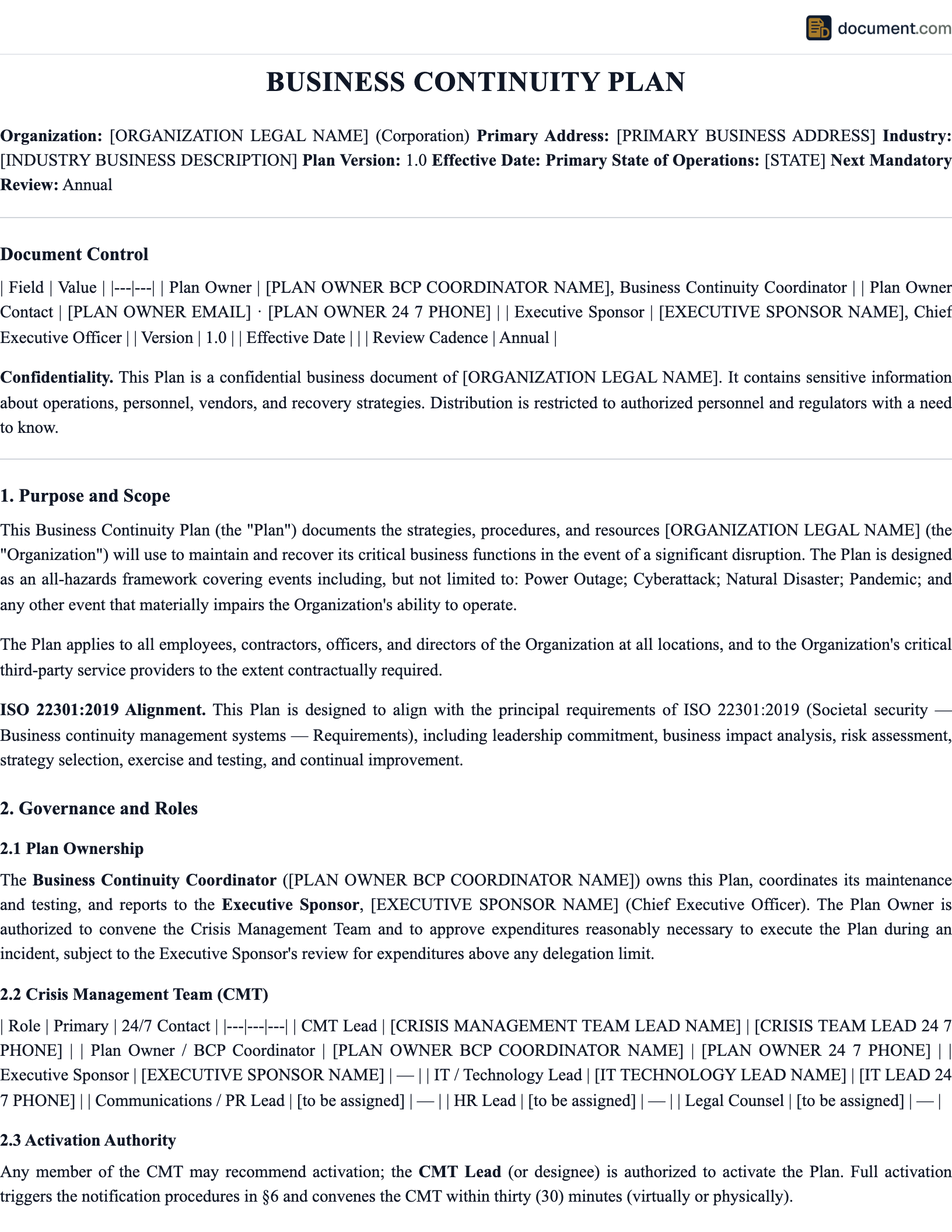



What Is a Business Continuity Plan?
A business continuity plan (BCP) is a documented strategy that defines how an organization will continue delivering its critical products and services during and after a disruption. Unlike a disaster recovery plan — which is narrowly focused on restoring IT infrastructure — a continuity plan covers the whole organization: people, processes, facilities, suppliers, customers, and technology. The goal is not just to come back online after an incident, but to keep the business functioning at an acceptable level the entire time, even when normal operations are impossible.
Every BCP starts from a single premise: bad things will happen, and the question is not whether but when. Floods, fires, ransomware, key supplier bankruptcies, pandemics, power outages, regional internet failures, the loss of a critical employee, an active threat at a facility — any of these can take a business offline. A continuity plan turns the reaction to such events from improvisation into a rehearsed sequence: who decides, who is notified, what gets restored first, where people work, how customers are kept informed, and how the organization gets from the disruption back to normal operations as quickly as possible.
At the heart of every credible BCP is a business impact analysis (BIA) — a structured exercise that catalogs every critical function the business performs, measures the financial and operational damage that would be caused by an outage of each function, and sets explicit targets for how quickly each function must be restored (the recovery time objective, or RTO) and how much data loss is tolerable (the recovery point objective, or RPO). The BIA is what separates a real continuity plan from a wish-list. Without a BIA, recovery investment tends to flow to whatever is loudest or most fashionable rather than to the functions that actually matter most to the business.
A BCP also includes scenario-specific incident playbooks — short, focused documents that someone can pick up at 2 a.m. and follow to handle a specific kind of incident. Common playbook categories include cyberattack and ransomware, fire or facility loss, severe weather, pandemic and widespread illness, key vendor failure, prolonged power or internet outage, and active threat. Each playbook references a shared set of resources — contact trees, escalation procedures, communication templates, alternate work locations, and the results of the BIA — so that the response is consistent regardless of which scenario unfolds first.
Whether you are a small business protecting a single location, a mid-sized company managing distributed operations, or an enterprise pursuing ISO 22301 certification, our templates are built to give you a usable, defensible continuity plan — not a binder that sits on a shelf. Each template includes the BIA worksheets, playbook structures, exercise scripts, and review schedules that turn a written plan into an actual operational capability.
Operational Resilience
Keep critical functions running through fires, floods, cyberattacks, and pandemics
Workforce Protection
Clear protocols for employee safety, remote work, and emergency communication
Audit & Insurance Ready
Aligned with ISO 22301, NIST, FFIEC, and cyber insurance underwriting requirements
BCP Form Preview
Below is a preview of the sections and fields included in our business continuity plan template. Your completed plan will be a fully formatted, professionally structured document with BIA worksheets, scenario playbooks, contact trees, and exercise schedules.
Business Continuity Plan
Aligned with ISO 22301 & NIST SP 800-34
Section 1: Plan Governance
Section 2: Critical Functions (BIA)
Section 3: Risks Addressed
Section 4: Response Team Contacts
Section 5: Testing & Maintenance
Types of Continuity Plans
Continuity planning is not one-size-fits-all. Different organizations and different scenarios call for different plan structures. Choose the type that best matches your scope, your risk profile, and your regulatory environment.
BCP vs Disaster Recovery
Business continuity and disaster recovery are often used interchangeably, but they answer different questions. A business continuity plan is concerned with the entire organization — people, processes, facilities, suppliers, customers, and technology — and asks how the business as a whole will keep functioning during and after a disruption. A disaster recovery plan is a narrower, technology-focused subset that asks how IT systems and data will be restored after an outage. In a well-designed program, the DR plan lives inside the BCP: the BCP defines what business functions must continue and how quickly, and the DR plan specifies how the underlying IT will be brought back online to support those functions.
The two plans should be developed together and tested together. A DR plan that brings systems back online in two hours is meaningless if the BCP shows that the staff who use those systems cannot reach the office or have not been notified. Conversely, a BCP that promises a four-hour recovery for order processing is meaningless if the underlying DR capability cannot deliver it. Aligning RTOs and RPOs across both documents is one of the highest-leverage activities a continuity team can perform.
BCP Covers
- Whole-organization scope
- People, facilities, suppliers
- Customer communication
- Cross-functional governance
DR Plan Covers
- IT systems and infrastructure
- Data backup and restoration
- Network and cloud failover
- Technical recovery procedures
BCP vs Other Plans
Continuity planning sits inside a broader family of resilience and emergency documents. Each plays a distinct role and they are most effective when integrated.
| Document | Primary Focus | When It Applies |
|---|---|---|
| Business Continuity Plan | Keeping critical functions running | During and after a disruption |
| Disaster Recovery Plan | Restoring IT systems and data | After a technical outage |
| Emergency Action Plan | Immediate life-safety response | First minutes of an emergency |
| Incident Response Plan | Containing and investigating an incident | During a security or operational event |
| Crisis Communication Plan | Internal and external messaging | Throughout an incident |
| Risk Assessment | Identifying and rating threats | Continuous and pre-incident |
How to Create a Business Continuity Plan
Building a usable BCP is a structured project — not a one-time write-up. Follow these eight steps to produce a plan that your organization can actually rely on when the next disruption arrives.
Secure Executive Sponsorship
Continuity planning requires resources, decisions, and cross-functional cooperation. Start by securing a C-level sponsor who can break ties, allocate budget, and signal organizational importance.
Define Scope and Governance
Decide which locations, business units, products, and services the plan will cover, name a plan owner, and establish a review cadence. Document the governance structure so it survives staff turnover.
Conduct a Business Impact Analysis
Catalog critical functions, measure the financial and operational damage of an outage, and assign each function an RTO and RPO. The BIA is the single most important input to every other step.
Identify Risks and Threats
Build a risk register covering cyber, natural disasters, pandemic, supply chain, facility, and human-caused threats. Rate each risk by likelihood and impact and prioritize accordingly.
Develop Recovery Strategies
For each critical function, define how it will be restored within its RTO — alternate sites, manual workarounds, cloud failover, mutual-aid agreements, or pre-positioned vendor contracts.
Write Scenario Playbooks
Create short, focused playbooks for the most likely incident types: cyberattack, fire, severe weather, pandemic, key vendor failure. Each should reference shared resources like contact trees and escalation procedures.
Train and Test
Distribute the plan, train every named role, and run regular exercises — quarterly tabletops, semi-annual functional tests, and an annual full-scale exercise. Untested plans almost always fail in real incidents.
Maintain and Improve
Review the plan at least annually and after any significant change — new system, new location, major staff turnover, or a real incident. Capture lessons learned and update the plan accordingly.
Key Components of a BCP
A complete business continuity plan includes the following building blocks. The exact depth varies by organization, but every BCP worth the name covers all of these areas.
Plan Governance
Plan owner, executive sponsor, version history, distribution list, and review schedule.
Scope and Objectives
Locations, business units, services covered, and the concrete goals the plan is intended to achieve.
Business Impact Analysis
Catalog of critical functions with assigned RTO, RPO, and dependency mapping.
Risk Register
Identified threats with likelihood and impact ratings and prioritized mitigation.
Recovery Strategies
Pre-defined approaches for restoring each critical function within its RTO.
Incident Playbooks
Scenario-specific response procedures for cyber, weather, pandemic, and other incident types.
Contact Trees and Roles
Named primary and alternate contacts for every response role with current phone numbers.
Communication Templates
Pre-drafted messages for employees, customers, suppliers, regulators, and media.
Testing and Exercise Schedule
Defined cadence of tabletop, functional, and full-scale exercises with success criteria.
Business Impact Analysis (BIA)
The business impact analysis is the analytical foundation of every continuity plan. It is the structured exercise of identifying every critical function the business performs, measuring the financial and operational damage that an outage of each function would cause, and translating that damage into concrete recovery objectives. The BIA answers the question that every other part of the BCP depends on: what must we restore, in what order, and how fast?
A typical BIA is conducted through structured interviews with business unit leaders. For each function, the analyst captures: what it does, who depends on it (internal and external), what systems and people it requires, what the financial impact of one hour, one day, and one week of downtime would be, what the operational and reputational impact would be, and any regulatory deadlines that apply. The output is a prioritized list of functions, each with an RTO, an RPO, and a clear description of the dependencies that must be restored alongside it.
The BIA should be refreshed at least annually and after any significant organizational change. New product launches, mergers, system migrations, and reorganizations all change the dependency map and can quietly invalidate previously sound recovery objectives. A stale BIA is one of the most common reasons real incidents reveal that the plan was protecting yesterday's business rather than today's.
RTO and RPO Explained
Recovery time objective (RTO) and recovery point objective (RPO) are the two numbers that drive every continuity decision. Setting them realistically is one of the hardest parts of the entire BCP process.
Recovery Time Objective (RTO)
The maximum acceptable amount of time a business function or system can be unavailable before the disruption causes unacceptable harm. RTO drives investment in alternate sites, redundant infrastructure, and standby capacity.
Recovery Point Objective (RPO)
The maximum acceptable amount of data loss measured in time. An RPO of 15 minutes means the business can tolerate losing at most the last 15 minutes of data. RPO drives backup frequency and replication strategy.
Testing and Maintenance
An untested continuity plan is essentially a hypothesis. Testing converts the hypothesis into a verified capability and surfaces gaps before they matter. Industry best practice and most regulatory frameworks call for at least annual full-scale testing, with more frequent testing of higher-risk components.
Tabletop Exercises
Discussion-based walkthroughs of a scenario with the response team. Quarterly cadence is typical. Inexpensive and very effective at identifying gaps in roles, decisions, and communication.
Functional Tests
Hands-on exercises of specific recovery procedures — restoring a backup, failing over to a secondary site, exercising the contact tree. Semi-annual cadence is common.
Full-Scale Exercises
End-to-end simulations of a real disruption involving multiple teams, systems, and locations. Annual cadence is the minimum standard for mature programs.
Sample Business Continuity Plan
Below is a condensed preview of our BCP template. This sample illustrates the structure and language used in our consultant-reviewed plans. Your completed BCP will be fully customized for your organization, scope, and risk profile.
BUSINESS CONTINUITY PLAN
Northbridge Manufacturing, Inc.
Version 4.2 — Effective March 1, 2026
1. PURPOSE AND SCOPE
This Business Continuity Plan establishes the policies, procedures, and responsibilities for maintaining and restoring the critical functions of Northbridge Manufacturing, Inc. during and after any disruption. The plan covers all U.S. facilities, all employees, and all customer-facing services...
2. PLAN OBJECTIVES
- Protect the safety of all personnel and visitors
- Maintain delivery of critical customer commitments
- Restore critical functions within established RTOs
- Minimize financial, operational, and reputational damage
- Comply with all applicable regulatory and contractual obligations
3. CRITICAL FUNCTIONS AND RECOVERY OBJECTIVES
The following functions have been identified through the Business Impact Analysis as critical to the organization. Each function has been assigned a recovery time objective (RTO) and recovery point objective (RPO)...
4. RESPONSE ORGANIZATION
Upon activation of this plan, the Incident Commander assumes overall authority for the response. The Incident Commander is supported by Function Leads for IT, Facilities, Communications, HR, Legal, and each affected business unit...
5. ACTIVATION CRITERIA
This plan is activated when any of the following occurs: (a) a critical function is unavailable for longer than its RTO; (b) a confirmed cyber incident has impacted production systems; (c) a facility is unsafe or inaccessible; (d) the Incident Commander, in consultation with the Executive Sponsor, determines that activation is warranted...
6. COMMUNICATION PROTOCOLS
Internal notifications follow the contact tree in Appendix B. External communications — to customers, suppliers, regulators, and media — are coordinated by the Communications Lead using the templates in Appendix C...
7. TESTING AND MAINTENANCE
This plan is tested through quarterly tabletop exercises, semi-annual functional tests, and an annual full-scale exercise. Results of each test are documented and used to improve the plan. The plan is reviewed and updated at least annually and after any significant change to the organization...
Frequently Asked Questions
Answers to the most common questions about business continuity planning, BIA, RTO and RPO, testing, and the relationship between BCP, DR, and incident response.
Official Resources
For authoritative guidance on business continuity, disaster recovery, and incident response, consult these official and industry resources.
Ready.gov - Business Continuity
FEMA's official small business continuity planning toolkit and templates
ISO 22301 Standard
International standard for business continuity management systems
NIST SP 800-34
Contingency Planning Guide for Federal Information Systems
NIST SP 800-61
Computer Security Incident Handling Guide
CISA - Business Continuity Suite
Cybersecurity and Infrastructure Security Agency planning tools
SBA - Prepare for Emergencies
Small Business Administration emergency preparedness resources
FFIEC Business Continuity Booklet
Federal financial institution continuity examination handbook
DRI International
Continuity professional certification and Professional Practices for BCM
Create your Business Continuity Plan in under 10 minutes.
Answer a few questions and download a compliant, attorney-drafted document ready for your state.