



What Is a Birth Plan?
A birth plan is a written document that outlines your preferences for labor, delivery, and the immediate postpartum period. It is shared with your obstetrician, midwife, labor and delivery nurses, anesthesiologist, and pediatric team so that everyone caring for you understands your wishes for pain management, labor environment, support people, delivery positions, newborn care, and contingencies for unexpected complications. While not a legal contract, a birth plan is a powerful communication tool that helps align your care team around your values and reduces the need for high-stakes decisions during active labor.
Birth plans first became common in the 1980s as part of a broader movement toward patient-centered maternity care. Today, most major hospitals and birth centers welcome birth plans and many provide their own templates. The most effective birth plans are short (one to two pages), prioritized by importance, written collaboratively with your provider, and flexible enough to accommodate the realities of childbirth. Our templates give you a structured starting point and let you customize each section to your situation.
A well-prepared birth plan does not guarantee a particular birth experience, but it does give you a meaningful voice in the process. By thinking through your preferences in advance, discussing them with your provider, and sharing them with the team that will be in the room with you, you create the conditions for a more informed, more respectful, and more satisfying childbirth experience — even if the day itself takes unexpected turns.
Communicate Preferences
Share your wishes for labor, delivery, and newborn care with your entire medical team
Empower Your Support Team
Give your partner or doula a clear roadmap for advocating on your behalf
Reduce Decision Fatigue
Make key choices in advance so labor isn't interrupted by decision-making
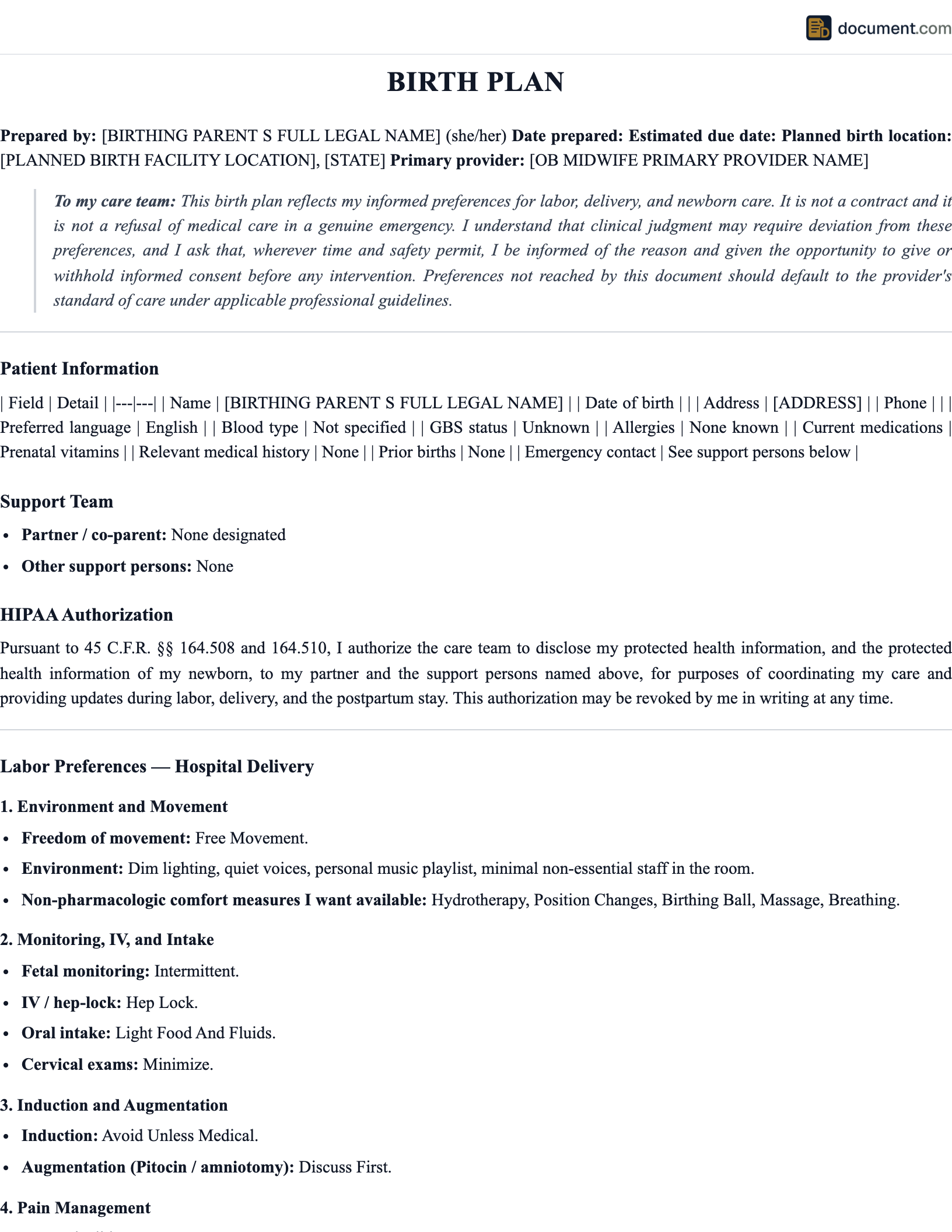
Birth Plan Form Preview
Below is a visual preview of the sections included in our standard birth plan template. Your completed plan will be fully formatted and customized for your delivery setting and personal preferences.
Birth Plan
Labor, Delivery, and Newborn Care Preferences
Section 1: Patient & Provider Information
Section 2: Labor Preferences
Section 3: Pain Management
Section 4: Delivery & Newborn Care
Types of Birth Plans
Different birth settings call for different planning considerations. Choose the template that matches your delivery setting and risk profile.
How to Create a Birth Plan
Drafting a birth plan is straightforward when you break it into a few focused steps. Start during your second trimester and refine the document as you learn more about your provider's practice and your delivery facility's policies.
- 1
Take a childbirth education class
Learn about labor stages, pain management options, and common interventions so you can make informed choices.
- 2
Tour your hospital or birth center
Ask about default policies on monitoring, mobility, food, and visitors so your plan reflects what is realistically available.
- 3
Discuss preferences with your partner
Talk through pain management, support person roles, and newborn care choices together before drafting the plan.
- 4
Draft the plan using a template
Use a structured form to make sure you cover labor, delivery, postpartum, newborn care, and contingencies.
- 5
Review with your provider
Bring the draft to a prenatal appointment around 34 to 36 weeks for feedback and revisions.
- 6
Print copies for your hospital bag
Bring at least three printed copies — one for your chart, one for your nurse, and one for your support person.
Key Components of a Birth Plan
A complete birth plan covers the patient and provider details, labor environment, monitoring preferences, pain management, delivery positions, support team, newborn care, and contingencies for unexpected events. Each section should be specific enough to be actionable but flexible enough to allow your medical team to respond to changing conditions.
Sample Birth Plan
Below is a condensed preview of our standard birth plan template. Your finished document will be fully customized to your preferences and delivery setting.
BIRTH PLAN
For [Patient Name] — Due [Date]
ABOUT US
My name is [Name], and my support person is [Partner / Doula]. We are looking forward to a calm, respectful birth experience and appreciate your collaboration in honoring the preferences below whenever medically appropriate.
1. LABOR ENVIRONMENT
I would like the freedom to move, walk, and change positions during labor. Please dim the lights when possible, keep the room quiet, and limit non-essential staff. I would prefer intermittent rather than continuous fetal monitoring if my labor remains low risk.
2. PAIN MANAGEMENT
I plan to start with non-medicated techniques including hydrotherapy, breathing, and position changes. Please do not offer pain medication unless I specifically request it. If I ask for an epidural, please honor the request without delay.
3. DELIVERY
I would like to push in whatever position feels right at the time. Please avoid routine episiotomy. After delivery, I want immediate skin-to-skin contact and delayed cord clamping for at least 60 seconds.
4. NEWBORN CARE
I plan to exclusively breastfeed. Please delay the first bath, vitamin K, and eye ointment until after our first hour of skin-to-skin and the first feeding. We would like to room-in throughout our stay.
5. IF A CESAREAN BECOMES NECESSARY
Please explain what is happening and why. I would like my partner present, a clear drape if possible, and skin-to-skin contact in the operating room or recovery as soon as it is safe. If the baby needs to go to the NICU, my partner will accompany the baby.
Frequently Asked Questions
Common questions about birth plans, hospital policies, pain relief, and what to do when labor takes an unexpected turn.
Official Resources
Reputable resources for evidence-based information on childbirth, pain management, and newborn care.
ACOG - Patient Resources
American College of Obstetricians and Gynecologists patient education
CDC - Pregnancy & Childbirth
Centers for Disease Control reproductive health resources
March of Dimes
Pregnancy, labor, and newborn care information from a leading nonprofit
WHO - Maternal Health
World Health Organization recommendations on intrapartum care
Lamaze International
Healthy birth practices and childbirth education resources
Evidence Based Birth
Peer-reviewed research summaries for expectant parents and providers
Create your Birth Plan in under 10 minutes.
Answer a few questions and download a compliant, attorney-drafted document ready for your state.