



New Mexico's UPOAA in a State of Legal Crossroads
Few states present the layered legal complexity that a power of attorney must navigate in New Mexico. The state adopted the Uniform Power of Attorney Act (UPOAA) under NMSA 1978, Sections 45-5B-101 through 45-5B-403, creating a modern statutory foundation that presumes durability, mandates good-faith conduct by agents, and requires third-party acceptance. But the statute is only the starting point. New Mexico is a community property state, home to 23 federally recognized tribal nations, and contains more federal land than most people realize — roughly 34% of the state is managed by the Bureau of Land Management, the U.S. Forest Service, or other federal agencies.
What this means for anyone drafting a POA in New Mexico is that a single document may need to work across three distinct legal systems: state courts applying the UPOAA, tribal courts operating under sovereign law, and federal agencies following their own regulatory frameworks. An agent authorized to sell a house in Albuquerque under state law may have no authority whatsoever to manage grazing rights on the Jicarilla Apache reservation or sign a BLM right-of-way application near Farmington.
The multicultural heritage of New Mexico — with deep Hispanic, Native American, and Anglo roots — also shapes practical POA usage. Bilingual execution is common. Family structures sometimes involve community decision-making traditions that do not map neatly onto the UPOAA's single-agent model. Understanding these realities is essential to drafting a POA that actually works on the ground in the Land of Enchantment.
UPOAA
Ch. 45 Art. 5B
Notary
Required
None
Witnesses needed
Community
Property state
Community Property and Your New Mexico POA
New Mexico's community property system creates a fundamental constraint on what any power of attorney can accomplish. Under NMSA §40-3-8, property acquired during marriage through the labor or efforts of either spouse belongs equally to both spouses. This means an agent operating under one spouse's POA can only act on that spouse's undivided one-half interest in community assets — they cannot unilaterally sell the family home, empty a joint bank account, or transfer community investment holdings without the other spouse's consent or a separate authorization.
Separate property — assets owned before marriage, inherited property, and gifts received individually — remains under the sole control of the owning spouse and can be managed freely by an agent under a POA. However, tracing separate property through years of commingling is one of the most contentious issues in New Mexico family law, and an agent who disposes of disputed assets may face personal liability.
The practical advice for married couples in New Mexico: both spouses should execute their own powers of attorney simultaneously, naming either the same agent or coordinated agents who can work together. If one spouse becomes incapacitated, having both POAs in place avoids the need for a guardianship proceeding in the New Mexico district court — a process that can take months and cost thousands of dollars in Bernalillo County or Santa Fe County probate divisions.
Tribal Land, Federal Land, and Jurisdictional Boundaries
New Mexico is home to 19 Pueblos, the Navajo Nation (whose reservation sprawls across the northwest corner of the state), the Mescalero Apache Tribe, and the Jicarilla Apache Nation. Each of these sovereign nations operates its own court system, land tenure rules, and governance structures. A power of attorney executed under NMSA §45-5B has no inherent authority within tribal jurisdiction. If your assets include interests in tribal trust land, allotted land, or businesses operating under tribal lease agreements, you will likely need to work with tribal legal counsel to create a parallel authorization that the tribal government will accept.
Federal land adds another layer. The Bureau of Land Management's New Mexico State Office in Santa Fe oversees approximately 13.4 million surface acres. The U.S. Forest Service manages five national forests: Carson, Cibola, Gila, Lincoln, and Santa Fe. If you hold a federal grazing permit, mining claim, right-of-way, or recreation permit, your agent may need to present both the state POA and additional federal authorization forms. The BLM generally accepts a state-law POA as evidence of authority, but individual field office managers have discretion to require supplemental documentation.
For ranchers and farmers in counties like Catron, Cibola, and Rio Arriba — where state, federal, and tribal lands can literally share a fence line — a comprehensive POA strategy may involve three coordinated documents: a state UPOAA POA, a tribal authorization, and federal agency forms. Working with an attorney who practices in these overlapping jurisdictions is strongly recommended.
Nine POA Types Under New Mexico Law
The UPOAA framework recognizes that different situations demand different levels of agent authority. In New Mexico, the choice of POA type is influenced not just by personal circumstances but by geography — a rancher in Harding County faces very different needs than a tech worker in Albuquerque or a retiree in Santa Fe. Each type below links to a state-specific page with detailed guidance.
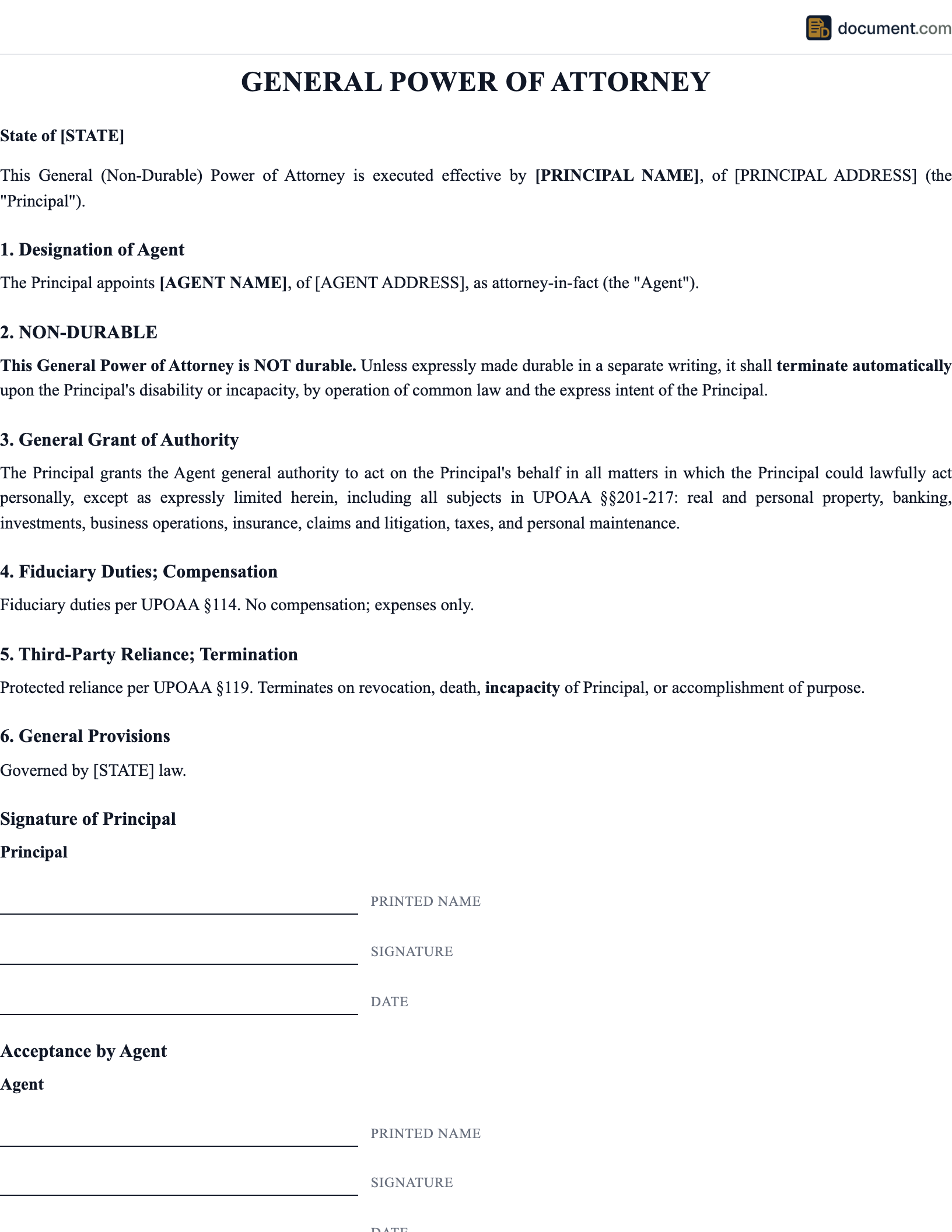
General Power of Attorney
Broad authority across financial and legal matters — critical in NM for managing community property interests and multi-jurisdictional assets
Durable Power of Attorney
Survives principal incapacity under NMSA §45-5B-104 — presumed durable by default in New Mexico unless expressly limited
Limited/Special Power of Attorney
Commonly used in NM for one-time oil/gas lease signings, BLM permit transfers, or single real estate closings
Medical/Healthcare Power of Attorney
Appoints a healthcare agent under NM's Uniform Health-Care Decisions Act — vital for rural residents far from major hospitals
Financial Power of Attorney
Covers banking, investments, and tax filings — especially important for managing mineral royalties and community property accounts
Springing Power of Attorney
Activates only upon a triggering event like incapacity — permitted under NMSA §45-5B-109 with physician certification
Minor Child Power of Attorney
Delegates temporary parental authority — widely used by NM military families at Kirtland AFB and Holloman AFB during deployments
Real Estate Power of Attorney
Authorizes property transactions recorded with the county clerk — must account for community property ownership in NM
Vehicle Power of Attorney
Handles NM MVD transactions including title transfers, registration renewals, and sales — commonly used across remote counties
Execution Requirements Under NMSA §45-5B
New Mexico's requirements are relatively streamlined compared to states like New York, but the details matter. A document that fails any of these steps may be refused by banks, title companies, the Motor Vehicle Division, or county clerk offices statewide.
Competent Adult Principal
The principal must be 18 or older and mentally capable of understanding the nature of the authority being delegated. New Mexico courts have held that the capacity standard for a POA is the same as for executing a contract — the principal must understand the transaction and its consequences.
Written Instrument
The POA must be in writing and clearly identify both the principal and agent by full legal name. Oral delegations of authority are not enforceable under New Mexico law. The document should describe the scope of authority with enough specificity to avoid disputes.
Notarization by a NM Notary Public
The principal's signature must be acknowledged before a notary commissioned by the New Mexico Secretary of State. Remote online notarization (RON) is permitted in New Mexico for principals who cannot appear in person — the NM Secretary of State regulates approved RON platforms.
No Witness Requirement
New Mexico does not require witnesses for a financial power of attorney. Notarization alone satisfies the execution requirements under NMSA §45-5B-105. However, NM's healthcare advance directive statute has separate witness provisions — do not confuse the two.
County Clerk Recording for Real Property and Minerals
If the agent will handle real estate transactions or mineral interests, the POA must be recorded with the county clerk where the property or minerals are located. In oil-producing counties like Lea and Eddy, this step is non-negotiable — operators and title companies will not accept an unrecorded POA.
Presumed Durable Unless Limited
Under NMSA §45-5B-104, every New Mexico POA is durable by default — it survives the principal's incapacity unless the document expressly states otherwise. This is a major departure from the older common-law rule and a key protection for NM residents doing long-term estate planning.
How to Build Your New Mexico POA
Our guided builder walks you through each decision point and generates a document aligned with the UPOAA. Here is the process from start to finish.
Select Your POA Type and Define the Scope
Pick the type that matches your situation — general for broad control, limited for a single transaction, medical for healthcare decisions, or financial for banking and tax matters. Identify your agent and any successor agent. If you are married, consider whether your spouse needs a parallel POA for community property coverage.
Review the Generated Document
Examine every provision. Verify that the powers granted match your intent, that community property limitations are addressed if applicable, and that any mineral rights or real estate authority is described with specificity. Download in PDF or Word format for printing.
Execute Before a New Mexico Notary
Sign the document in the presence of a NM-commissioned notary public. No witnesses are required for financial POAs. Distribute copies to your agent, your bank, your financial advisor, and any relevant institution. If the POA covers real estate or minerals, record it with the appropriate county clerk. Keep the original in a secure location — a safe deposit box or with your estate planning attorney.
Sample New Mexico UPOAA Power of Attorney
This abbreviated preview shows the structure of a New Mexico POA incorporating UPOAA provisions, community property acknowledgments, and mineral rights authority. Your completed document will include all required sections, full notarial language, and county-clerk-ready formatting.
STATUTORY POWER OF ATTORNEY — STATE OF NEW MEXICO
Executed Pursuant to NMSA 1978, §45-5B-101 et seq. (Uniform Power of Attorney Act)
SECTION 1: PRINCIPAL AND AGENT
I, _________________________ ("Principal"), a resident of _____________ County, State of New Mexico, designate _________________________ ("Agent"), residing at _________________________, as my attorney-in-fact.
SECTION 2: COMMUNITY PROPERTY ACKNOWLEDGMENT
I acknowledge that New Mexico is a community property state. The authority granted herein extends only to my interest in community property and to my separate property. This POA does not authorize my Agent to act on behalf of my spouse's community property interest.
SECTION 3: GRANT OF AUTHORITY
I grant my Agent authority over the following subjects as marked:
[ ] Real Property [ ] Tangible Personal Property [ ] Financial Institutions
[ ] Oil, Gas & Mineral Interests [ ] Business Operations [ ] Insurance
[ ] Estates, Trusts & Beneficial Interests [ ] Claims and Litigation
[ ] Government Benefits [ ] Tax Matters [ ] All Subjects Listed
SECTION 4: DURABILITY
This power of attorney is durable and shall not terminate upon my disability or incapacity, as provided by NMSA §45-5B-104.
Principal Signature: _________________________ Date: _____________
STATE OF NEW MEXICO, COUNTY OF _________________________
Acknowledged before me on _____________ by _________________________.
Notary Public: _________________________ Commission Expires: _____________
New Mexico POA Questions Answered
These are the questions we hear most from residents across New Mexico — from mineral rights owners in the Permian Basin to families navigating tribal jurisdiction on the Navajo Nation.
Official New Mexico Government Resources
These government agencies and legal references provide authoritative guidance on POA execution, recording, and enforcement in New Mexico.
NMSA Chapter 45, Article 5B
Full text of NM's Uniform Power of Attorney Act
New Mexico Courts
Judiciary self-help forms and probate division
NM Secretary of State — Notary Division
Notary search, RON providers, and commission info
BLM New Mexico State Office
Federal land permits, grazing rights, and ROW forms
NM Aging & Long-Term Services Dept.
Elder law, POA abuse prevention, and caregiver resources
NM Oil Conservation Division
Oil and gas regulatory filings and mineral rights info
Other New Mexico Legal Documents
NM Durable Power of Attorney
Presumed durable under UPOAA — survives incapacity
NM Healthcare Power of Attorney
Critical for rural NM — telehealth and air ambulance authorization
NM Financial Power of Attorney
Banking, mineral royalties, and community property accounts
NM Notary Acknowledgment
Notarize your New Mexico POA and legal documents
Create your New Mexico Power of Attorney in under 5 minutes.
Answer a few questions and download a New Mexico-compliant document, ready for the state agency.