



Nebraska's UPOAA: A Clean Framework for a Practical State
Nebraska adopted the Uniform Power of Attorney Act and codified it in Neb. Rev. Stat. Chapter 30, Article 40. The result is one of the more straightforward POA statutes in the country — fitting for a state whose unicameral legislature (the only one in the nation) was designed to cut through bureaucracy and get things done. Whether you are a corn and soybean farmer in the eastern river valleys, a cattle rancher in the Sandhills, or a financial professional in Omaha's insurance district, the same clear set of rules governs your power of attorney.
Under Neb. Rev. Stat. §30-4004, every Nebraska POA is presumed durable unless you state otherwise. That single default rule eliminates a problem that trips up residents of non-UPOAA states: forgetting to include durability language and discovering — at the worst possible moment — that the document died along with the principal's capacity. In Nebraska, durability is baked in. Your agent's authority to pay your operating note at Farm Credit Services, manage your crop insurance election, or authorize emergency surgery at Nebraska Medicine continues without a gap.
The act also imposes strong accountability on agents. Neb. Rev. Stat. §30-4014 spells out fiduciary duties in plain terms: act in the principal's best interest, avoid conflicts, keep property separate, maintain records. For a state where agricultural operations can involve millions of dollars in land, equipment, livestock, and commodity contracts, these protections are not abstract — they are the guardrails that keep the system honest.
Required
Notarization
Not Required
Witnesses
UPOAA
Chapter 30, Art. 40
93 Counties
Register of Deeds filing
Farm Operations & POA: Managing Nebraska's Agricultural Backbone
Nebraska ranks third nationally in agricultural cash receipts, behind only California and Iowa. The state is the nation's top producer of red meat, a major corn and soybean producer, and home to one of the densest concentrations of cattle feedlots in the world. Running a farm or ranch here is a year-round, capital-intensive operation — and it does not pause because the owner is in the hospital, traveling, or deployed overseas.
A well-drafted Nebraska POA for agricultural operations should address several layers. First, the day-to-day: paying feed bills, managing hired labor, negotiating with grain elevators, signing delivery tickets, and handling irrigation district assessments. Second, the seasonal: enrolling in crop insurance before the deadline, certifying acreage with the county FSA office, marketing grain through forward contracts, and filing for disaster assistance when hail or drought hit. Third, the structural: making payments on Farm Credit System operating loans, managing co-op equity retirements, and handling tax filings related to farm income, depreciation, and capital gains.
Nebraska's UPOAA grants broad default authority under Neb. Rev. Stat. §30-4024 ("operation of entity or business") and §30-4021 ("tangible personal property" — which includes grain, livestock, and equipment). But given the complexity and high dollar values involved, most agricultural attorneys in Nebraska recommend spelling out specific farming powers in detail rather than relying entirely on statutory defaults. This is especially true for agents who will interact with the local FSA office, the Natural Resources Conservation Service, the county assessor, and lending institutions — each of which may want to see explicit language in the POA before working with your agent.
FSA Filing Requirement
Even with a valid Nebraska state-law POA, most USDA Farm Service Agency county offices require a separate Form FSA-211 (Power of Attorney) on file before your agent can sign FSA documents. File both your state POA and the FSA-211 with the county FSA office to prevent delays during critical enrollment periods for ARC/PLC, crop insurance, and emergency programs.
Nebraska Power of Attorney Types
All nine types are governed by Neb. Rev. Stat. Chapter 30, Article 40 and benefit from the UPOAA's default durability, agent accountability provisions, and third-party acceptance rules. Select the type that matches your situation, or create multiple POAs to cover different aspects of your life in Nebraska.
General Power of Attorney
Broad authority over finances, farm accounts, property, and legal matters — ideal for Nebraska landowners with diversified operations
Durable Power of Attorney
Presumed durable under Neb. Rev. Stat. §30-4003 — your agent's authority persists through incapacity without interruption
Limited / Special Power of Attorney
Confines authority to a single transaction: closing on a quarter section, managing one harvest season, or handling a specific FSA filing
Medical / Healthcare Power of Attorney
Designates a healthcare proxy for medical decisions — particularly important for rural Nebraskans far from regional hospitals
Financial Power of Attorney
Covers banking with Nebraska institutions, crop insurance claims, Farm Credit System loans, and investment accounts
Springing Power of Attorney
Lies dormant until a specified event — such as physician-certified incapacity — triggers your agent's authority to act
Minor Child Power of Attorney
Grants temporary guardianship for children when parents travel for harvest, cattle sales, or business in Omaha or Lincoln
Real Estate Power of Attorney
Authorizes farmland transactions, CRP enrollments, and filings with the county Register of Deeds across Nebraska's 93 counties
Vehicle Power of Attorney
Handles Nebraska DMV transactions, farm truck titles, trailer registrations, and equipment transfers on your behalf
What Nebraska Law Requires for a Valid POA
Nebraska's UPOAA keeps execution requirements sensible and clear. Here is what you need to produce a POA that will be accepted across the state's 93 counties and by Nebraska's financial institutions, healthcare systems, and government agencies.
- Age and Competency: The principal must be 18 or older and possess the mental capacity to understand the authority being granted — a factual determination at the time of signing
- Written and Signed: Must be a written document signed by the principal or by another person in the principal's conscious presence at the principal's direction
- Notarization: Required under Neb. Rev. Stat. §30-4005 — acknowledgment before a notary public validates the principal's identity and voluntary execution
- Witnesses: Not required by statute — notarization alone satisfies Nebraska's execution requirements
- Durable by Default: Under §30-4004, durability is presumed unless the document expressly states otherwise — no special language needed to make it durable
- Recording: Required for real estate transactions — file with the Register of Deeds in the county where the property is located (fees typically $10 first page, $6 additional)
- Agent Certification: Under §30-4013, agents can provide a certified statement of authority that third parties are entitled to rely on
How to Create Your Nebraska Power of Attorney
From the Platte River valley to the Pine Ridge, the process is the same. What makes your POA unique is the specific powers, agent selections, and limitations you build into it.
Map Your Assets and Needs
Nebraska residents often hold a mix of agricultural assets, real property, financial accounts, and business interests. Start by listing everything that would need management if you were unavailable: farmland (deeded and leased), irrigation equipment, grain in storage, livestock, bank accounts at First National or Union Bank, Farm Credit operating loans, crop insurance policies, co-op memberships, CRP contracts, and any mineral or wind energy leases. Then determine which POA type (or combination) covers the full picture. Many Nebraskans use a durable financial POA for business and farming operations and a separate healthcare POA for medical decisions.
Choose an Agent Who Understands Nebraska Agriculture
If your POA covers farm operations, pick someone who knows the rhythm of Nebraska agriculture — planting and harvest timelines, crop insurance deadlines, FSA reporting requirements, and how to work with the local elevator. If your POA is primarily financial, an agent comfortable with Omaha's institutional landscape is valuable. Name a successor agent, because your primary choice may not be available when the need arises. Your agent does not need to be a Nebraska resident, but familiarity with the state's agricultural and business environment is a meaningful advantage.
Sign, Record, and Distribute
Execute the document before a Nebraska notary — most bank branches in the state (First National Bank of Omaha, Pinnacle Bank, Platte Valley Bank) offer free notary services to customers. Record with the Register of Deeds if real estate is involved. Distribute copies to your agent, financial institutions, the county FSA office (along with Form FSA-211), healthcare providers, and your attorney. Keep the original in a secure but accessible location — a safe deposit box works, but make sure your agent has access authorization.
Sample Nebraska Power of Attorney
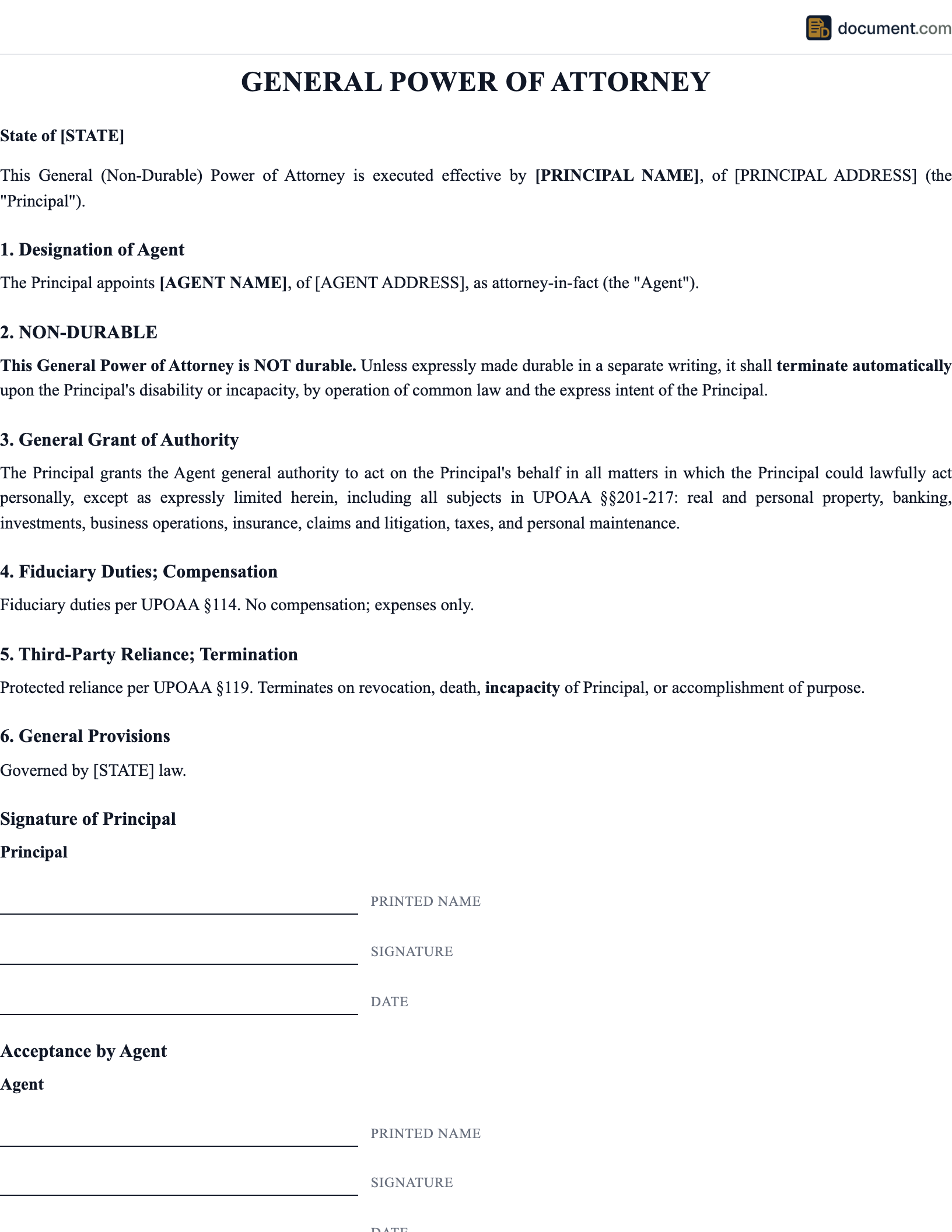
This preview reflects the structure of a POA built under Neb. Rev. Stat. Chapter 30, Article 40. Your final document will be customized with the specific agent designations, powers, and limitations you select.
STATE OF NEBRASKA
STATUTORY POWER OF ATTORNEY
Pursuant to Neb. Rev. Stat. Chapter 30, Article 40 (UPOAA)
PRINCIPAL:
Name: [Principal Name]
Address: [Nebraska Address]
County: [County]
AGENT (Attorney-in-Fact):
Name: [Agent Name]
Address: [Agent Address]
DURABILITY (§30-4004 default applies)
"This power of attorney is durable and shall not be affected by my subsequent disability or incapacity."
POWERS GRANTED
[As selected during document creation]
Nebraska Power of Attorney: Frequently Asked Questions
Real questions from Nebraska residents — covering agricultural operations, financial institutions, rural healthcare, and the practical details of working within the UPOAA framework.
Official Nebraska Resources
Access Nebraska statutes, find your county Register of Deeds, and connect with state and federal agricultural agencies.
Create your Nebraska Power of Attorney in under 5 minutes.
Answer a few questions and download a Nebraska-compliant document, ready for the state agency.