



Tennessee Venue Rental Agreement Overview
Tennessee's event venue market is anchored by Nashville, which has become one of the most in-demand event destinations in the Southeast. Nashville's rapid growth has produced a diverse venue landscape spanning historic Union Station and Cannery Row spaces, rooftop venues overlooking the Cumberland River, converted industrial buildings in the Gulch, and purpose-built event centers. Memphis anchors a separate regional market with its own distinct cultural identity, blues and soul music heritage, and wedding venue scene. East Tennessee's Smoky Mountains corridor draws destination weddings and corporate retreats to Gatlinburg, Pigeon Forge, and Sevier County properties.
Tennessee's TABC-administered liquor licensing framework, Nashville's multi-agency special event permit process, the state's tornado risk zone, and the 9.75% combined sales tax in Davidson County all shape venue rental agreements in ways that differ from other states. A Tennessee venue rental agreement needs to address TABC coverage terms, Nashville's Special Events Committee requirements, severe weather force majeure provisions, and the Smoky Mountains outdoor permitting considerations that apply to East Tennessee events.
$10
Recording fee
$0.37 per $100
Transfer tax
Required
Notarization
0
Witnesses required
Tennessee Requirements
Tennessee venue rental agreements need to address TABC alcohol licensing terms, Nashville's multi-agency permit process, tornado and severe weather cancellation provisions, and the East Tennessee outdoor permitting considerations for Smoky Mountains events. Getting these terms clear in the agreement reduces the disputes that are most common in Tennessee's active venue markets.
Tennessee TABC License Coverage Note
Tennessee TABC licenses are premises-specific, and the TABC has historically maintained complex rules around liquor-by-the-drink licensing that vary by county and municipality. Some Tennessee counties are still dry or partially dry for certain license types. Nashville has wet status and a robust venue alcohol service market, but TABC rules still govern what types of service are permitted under each license category. Events where outside vendors want to serve alcohol need to confirm TABC compliance with the venue before finalizing the rental agreement.
Venue Agreement Requirements
- TABC Alcohol Service Terms: Specify license category, who holds service authorization, and TABC rules for outside vendor service at the premises
- Nashville Special Events Permit: For Nashville events, address Metro Special Events Committee requirements, Metro Police coordination, and noise ordinance compliance
- Tornado and Severe Weather Force Majeure: Define triggering conditions, rescheduling cost allocation, and notification timelines for tornado warnings and severe weather events
- Smoky Mountains Outdoor Permitting: For East Tennessee events near NPS land, address federal permit requirements and assign responsibility between venue and renter
- Insurance Requirements: Event liability insurance naming venue as additional insured, plus liquor liability for events with alcohol service
- Catering and Vendor Policies: Specify outside caterer permissions and required Tennessee Department of Health food service licensing
How to Execute a Tennessee Venue Rental Agreement
Executing a Tennessee venue rental agreement requires confirming TABC license status, reviewing Nashville Metro permitting requirements for larger events, and addressing severe weather force majeure provisions. Smoky Mountains events require additional attention to NPS land proximity and Sevier County outdoor permits. Follow these steps.
Confirm TABC License Status, Occupancy, and Dry Status
Ask the venue for its current TABC license documentation and confirm the license category covers your event type. Review the certificate of occupancy for maximum assembly capacity. Confirm the venue's county wet or dry status if the event is outside Nashville, since some Tennessee counties and municipalities still have restrictions on liquor-by-the-drink service that affect what the venue's TABC license permits.
Inspect the Space and Confirm Outdoor and Vendor Access
Walk the venue to confirm it meets your event requirements, check outdoor access and weather contingency options for Tennessee's tornado-prone spring and summer climate, and confirm vendor loading and parking arrangements. For Nashville events, ask whether the venue has experience with Metro's Special Events Committee permit process and what lead time is required for outdoor components.
Negotiate TABC, Nashville Permit, Noise, and Weather Terms
Finalize the agreement with TABC alcohol service authorization terms, Nashville noise ordinance compliance obligations with specific cutoff times, Nashville Metro special event permit responsibilities, and tornado/severe weather force majeure provisions. For Gatlinburg or Pigeon Forge events, confirm Sevier County special event permit requirements and any NPS proximity restrictions for outdoor configurations near Great Smoky Mountains National Park land.
Execute the Agreement and Obtain Event Insurance
Sign the rental agreement and obtain event liability insurance naming the venue as additional insured. If alcohol will be served, obtain liquor liability coverage as well. Nashville venues at popular event properties often require insurance certificates 30 days in advance, so confirm the venue's timeline requirement when finalizing the agreement.
Confirm All Permits and Complete Pre-Event Logistics
Confirm that all required permits are approved, deliver copies to the venue, and finalize catering and vendor access schedules. Confirm damage deposit terms and document the venue's condition with photos before setup. Review the tornado season cancellation policy and confirm what weather monitoring procedure the venue uses for severe weather alerts on event day.
Tennessee Venue Fees & Costs
Tennessee venue costs vary significantly between Nashville's premium market, the Smoky Mountains destination segment, and mid-market facilities in Memphis, Knoxville, and Chattanooga. Nashville's rapid growth as a national event destination has pushed venue pricing upward, particularly for properties with rooftop access, live music integration, or historic character. Tennessee's 9.75% combined sales tax in Davidson County is higher than most competing Southeast states and applies to catering and other taxable services.
| Fee / Cost | Typical Range |
|---|---|
| Nashville Venue Rental Rates | $1,000 - $12,000 per event (rooftop and historic venues at top of range) |
| Smoky Mountains and East TN Venue Rental Rates | $800 - $8,000 per event (destination resort properties higher) |
| Memphis and Mid-TN Venue Rental Rates | $500 - $5,000 per event |
| Event Liability Insurance | $150 - $700 per event |
| Liquor Liability Coverage | $100 - $500 per event (required when alcohol is served) |
| Attorney Review (optional) | $200 - $600 for Nashville high-value or multi-event agreements |
Tennessee Tax Implications
Tennessee has no state income tax on wages and salary, and historically had a Hall income tax on investment income that was fully phased out in 2021. Venue operators reporting event rental income in Tennessee pay no state income tax on that revenue, which is a meaningful cost advantage compared to neighboring states like North Carolina and Georgia. This makes Tennessee's tax environment genuinely favorable for venue businesses and is often noted by venue operators comparing their operating costs to out-of-state competitors.
Tennessee imposes a 7% state sales tax, and local governments can add additional rates. The total combined rate in Davidson County (Nashville) is 9.75%, which is among the higher combined rates for major event markets. Prepared food and beverages served at events are subject to Tennessee sales tax. Equipment rentals included in event packages are also taxable. Venue rental fees themselves are typically not subject to sales tax when structured as pure space rentals, but bundled service packages create taxable components that need to be itemized in the invoice.
Tennessee also has a franchise and excise tax that applies to corporate entities and most non-individual taxpayers operating in the state. Venue businesses organized as LLCs taxed as corporations, S corporations, or C corporations pay Tennessee franchise and excise tax on their Tennessee income. Pass-through entities operating event venues should confirm their Tennessee tax filing obligations with a state tax professional, since the franchise tax minimum assessment applies regardless of actual income.
Sample Tennessee Venue Rental Agreement
Preview of our Tennessee-specific template. Your document will include all fields required for recording in any Tennessee county.
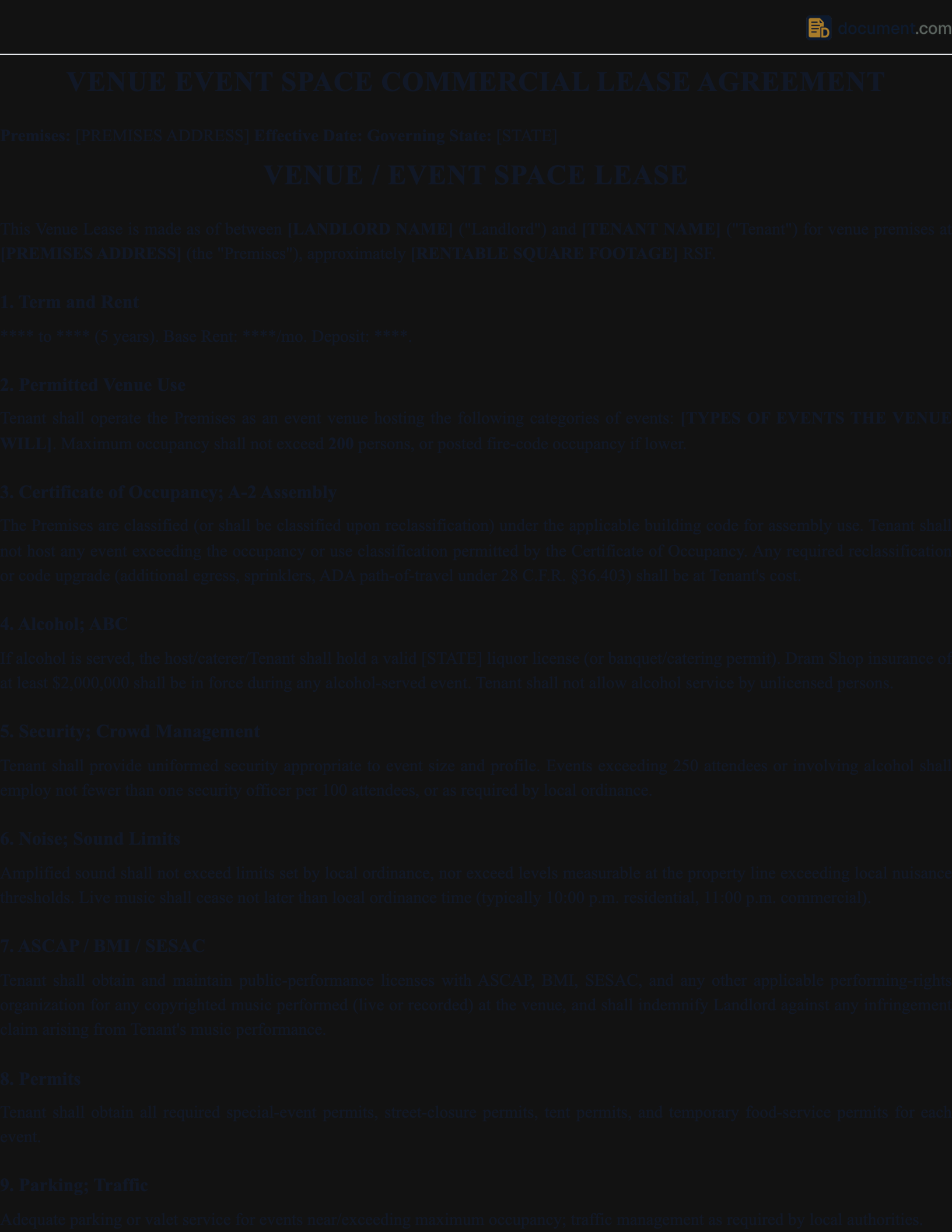
VENUE/EVENT SPACE RENTAL AGREEMENT
STATE OF TENNESSEE
Legal Document
PARTY INFORMATION
Name: [Full Legal Name]
Address: [Tennessee Address]
County: [County]
PROPERTY DESCRIPTION
County: [County] State: Tennessee
Legal Description: [Per Recorded Plat]
Parcel No.: [APN]
Tennessee Venue Rental Agreement FAQ
Common questions about filing in Tennessee, including requirements, fees, and tax implications.
Official Tennessee Resources
Official state resources for verifying requirements and finding your local recording office.
Nashville Metro Permitting and TABC Compliance
Nashville's explosive growth as an event destination has made its Metro permitting process more complex and higher-stakes than most comparable Southern cities. The Nashville Metro Special Events Committee coordinates large outdoor events, and applications for events that involve street closures, park use, or more than a few hundred attendees require lead time and coordination with multiple Metro departments. Venue rental agreements for Nashville events should address who is responsible for Special Events Committee applications and what the agreement provides if permit approval is delayed or conditioned in ways that affect the event format.
Tennessee TABC compliance involves understanding not just whether a venue holds a license, but whether that license category covers the specific service arrangement for your event. Tennessee has had a layered licensing history, and some TABC license categories have restrictions on service hours, types of alcohol, or guest configurations that may not be obvious from the license number alone. Events where a renter wants to bring outside bar staff or a caterer intends to serve under a separate catering authorization need to confirm the TABC compliance picture with the venue before the agreement is finalized.
Tennessee sits at the intersection of the Southeast's tornado belt, and spring event seasons in Nashville and Memphis carry meaningful severe weather risk. Tornado warnings can force events indoors or cause complete cancellations on short notice. Force majeure clauses should define what weather events trigger cancellation rights, who bears vendor deposit losses and rescheduling fees, and what the notification procedure is. The clause should also cover East Tennessee wildfire smoke events that can affect outdoor Smoky Mountains venue conditions.
Tennessee Venue Compliance Note
Tennessee venue agreements for Nashville high-value events, TABC alcohol service arrangements with outside vendors, or Smoky Mountains destination events benefit from review by a Tennessee hospitality attorney. Nashville attorneys familiar with Metro Special Events permitting and TABC licensing rules can identify compliance gaps and draft indemnification provisions that allocate liability correctly between venue and renter.
Related Documents
Depending on your situation, you may need additional documents alongside this one. Below are commonly related documents that are frequently used together in real estate transactions.
Tennessee Venue Agreement Practical Considerations
Nashville's competitive venue market creates conditions where the most desirable properties book well in advance, and cancellation terms at premium venues are often less flexible than standard commercial practices. Agreements for Nashville rooftop venues, historic properties, and waterfront spaces should document the cancellation and deposit forfeiture schedule clearly, since these venues can rebook on short notice and may apply cancellation fees that are not obvious from a cursory reading of the agreement.
Tennessee's dram shop act creates liability exposure for venues that continue to serve alcohol to visibly intoxicated guests who later cause harm. TABC compliance, including responsible server training requirements, reduces that risk. Rental agreements should specify who is responsible for alcohol service compliance, what server training requirements apply, and which party carries liquor liability insurance. These provisions are particularly important at Nashville events where open bars are standard and service periods are long.
For recurring Nashville event relationships such as annual corporate retreats, corporate holiday parties, or multi-year music industry events, a master agreement framework is more practical than executing a new full agreement each year. A master agreement can establish TABC terms, insurance requirements, Metro permitting responsibilities, and dispute resolution provisions once, with per-event addenda covering the specific dates, configurations, and pricing for each event.
Documentation and Recordkeeping
Retain the executed rental agreement, all permit approvals, TABC documentation, insurance certificates, and pre- and post-event photo documentation. For Nashville events involving Metro Special Events Committee permits, maintain a complete file of all Metro correspondence and permit approvals. Digital copies stored securely are recommended as backup for all Tennessee venue event documentation.
Related Documents
Depending on your situation, you may need additional documents alongside this one. Below are commonly related documents that are frequently used together in real estate transactions.
Create your Tennessee Commercial Venue Event Space Lease Agreement in under 5 minutes.
Answer a few questions and download a Tennessee-compliant document, ready for the state agency.