
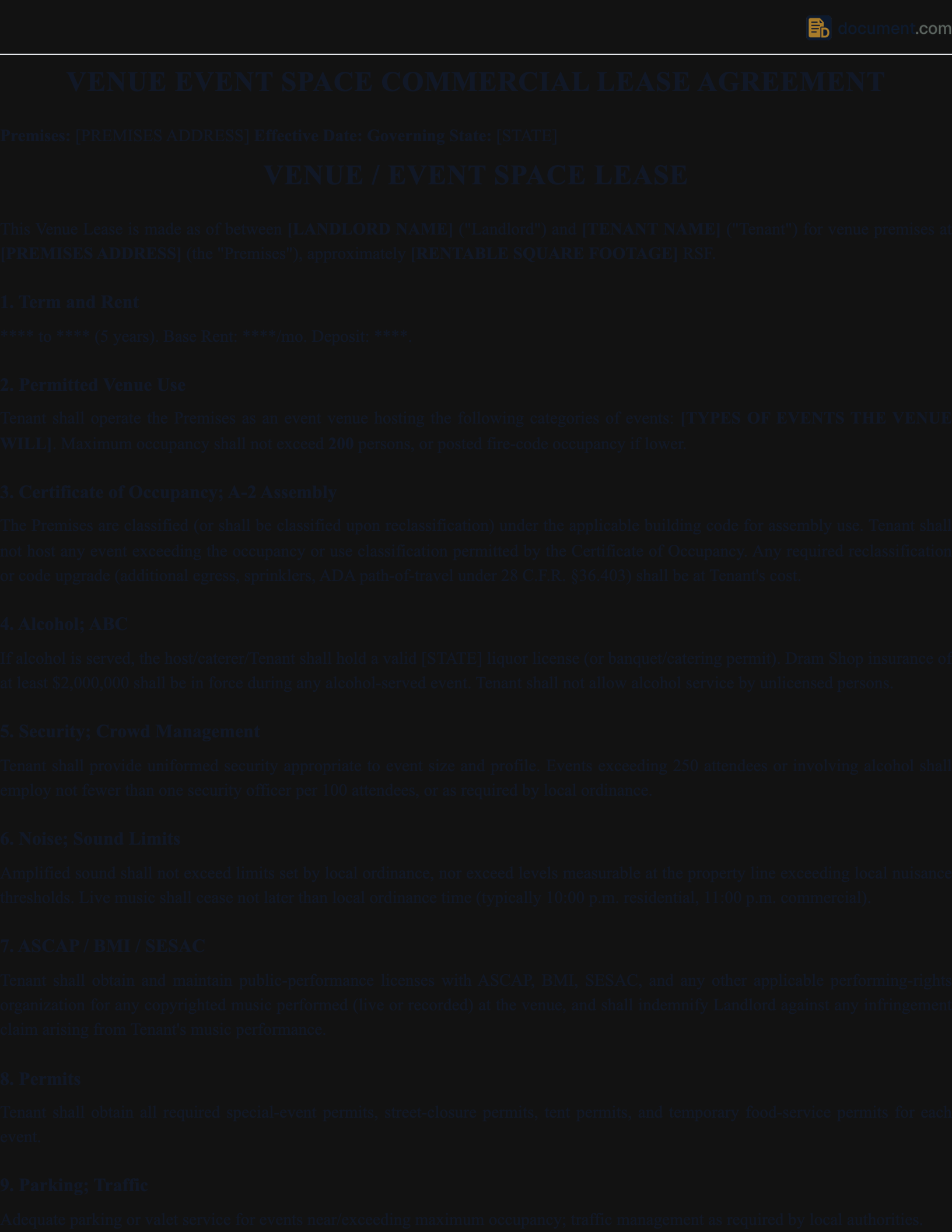



South Carolina Venue Rental Agreement Overview
South Carolina has one of the most active event venue markets on the East Coast, driven largely by Charleston's standing as one of the country's most popular wedding destinations. The Charleston Peninsula and the surrounding Lowcountry offer historic plantations, antebellum ballrooms, waterfront properties, and converted industrial spaces that draw events from across the Southeast and beyond. Myrtle Beach anchors a large corporate and hospitality events market along the Grand Strand. Hilton Head and Kiawah Island attract high-end resort and conference business, while Greenville and Columbia serve the state's inland corporate and civic event demand.
South Carolina's SCDOR-administered alcohol licensing system, Charleston's historic district overlay requirements, and the state's hurricane exposure all shape venue rental agreements in ways that are specific to this market. A South Carolina venue rental agreement needs to address SCDOR alcohol coverage, Charleston Board of Architectural Review requirements for outdoor structures, sales tax on catering and services, and weather contingency provisions that reflect the state's coastal risk profile.
$10
Recording fee
$1.85 per $500
Transfer tax
Required
Notarization
0
Witnesses required
South Carolina Requirements
South Carolina venue rental agreements need to address SCDOR alcohol licensing coverage, Charleston's historic district overlay requirements, hurricane season force majeure provisions, and DHEC food service requirements for catered events. Addressing these elements upfront reduces the most common disputes that arise in South Carolina's active events market.
South Carolina SCDOR License Coverage Note
South Carolina SCDOR alcohol licenses are premises-specific and tied to the license holder. A venue's license covers service within the licensed premises under its specific license category. Events where a renter brings outside bar staff or a caterer wants to serve under their own authorization require coordination with the venue and confirmation of SCDOR requirements. Charleston venues in historic districts must also comply with Board of Architectural Review requirements for temporary outdoor structures.
Venue Agreement Requirements
- SCDOR Alcohol Service Terms: Specify who holds service authorization, applicable license category, and SCDOR server certification requirements
- Charleston Historic District Compliance: For Charleston Peninsula venues, address Board of Architectural Review requirements for tents, outdoor staging, and lighting
- Hurricane and Severe Weather Force Majeure: Define triggering conditions, cancellation rights, rescheduling cost allocation, and notice timelines for coastal storm events
- Noise Ordinance Compliance: Specific amplified sound cutoff times aligned with Charleston, Myrtle Beach, or Hilton Head ordinances
- Insurance Requirements: Event liability insurance naming venue as additional insured, plus liquor liability coverage for events with alcohol service
- DHEC Food Service Compliance: Specify catering license and food handling requirements for events with outside caterers
How to Execute a South Carolina Venue Rental Agreement
Executing a South Carolina venue rental agreement requires confirming SCDOR alcohol coverage, reviewing Charleston historic district requirements if applicable, and addressing hurricane season cancellation provisions. Charleston events demand additional lead time for Board of Architectural Review permits when outdoor structures are involved. Follow these steps.
Confirm SCDOR License Status, Occupancy, and Charleston Historic District Status
Ask the venue for its current SCDOR license documentation and confirm the license category covers your event type. Review the certificate of occupancy for maximum assembly capacity. For Charleston Peninsula venues, confirm whether the property is within a Board of Architectural Review jurisdiction, which affects tent, staging, and outdoor lighting permits.
Inspect the Space and Assess Outdoor Configuration
Walk the venue to confirm it meets your event requirements, assess outdoor access and tent or canopy placement options, and confirm vendor loading and parking arrangements. Ask about the venue's experience with Charleston noise ordinance compliance and whether any neighboring properties have raised concerns. For hurricane season events, confirm the venue's policy for weather postponements and what the backup indoor configuration looks like.
Negotiate SCDOR, Noise, Hurricane, and Permit Terms
Finalize the agreement with clear SCDOR alcohol service authorization terms, amplified sound cutoff times, and assignment of responsibility for any Charleston Board of Architectural Review permit applications. Include hurricane season force majeure language that defines triggering conditions, rescheduling cost allocation, and notice requirements. For Hilton Head events, confirm the venue's compliance with Town of Hilton Head Island noise ordinance requirements.
Execute the Agreement and Obtain Event Insurance
Sign the rental agreement and obtain event liability insurance naming the venue as additional insured. If alcohol will be served, obtain liquor liability coverage as well. Deliver your insurance certificate to the venue before the access date. Charleston wedding venues often require insurance certificates 30 days in advance, so confirm the venue's timeline requirement when finalizing the agreement.
Confirm All Permits and Complete Pre-Event Logistics
Confirm that all Board of Architectural Review permits, special event permits, and SCDOR documentation are in order and provide copies to the venue. Finalize catering and vendor access schedules, confirm damage deposit terms, and document the venue's condition with photos before setup. Review the cancellation policy one final time and confirm weather monitoring and notification procedures for hurricane season events.
South Carolina Venue Fees & Costs
South Carolina venue costs vary significantly between Charleston's premium wedding and event market, the resort venues on Hilton Head and Kiawah Island, and the more mid-market facilities in Myrtle Beach, Columbia, and Greenville. Charleston plantation and historic property venues are among the most expensive in the Southeast, driven by high national demand and limited inventory. South Carolina's 6% state sales tax and local add-ons apply to catering and taxable services associated with events.
| Fee / Cost | Typical Range |
|---|---|
| Charleston Plantation and Historic Venue Rental Rates | $3,000 - $18,000 per event (flagship properties at top of range) |
| Hilton Head and Kiawah Resort Venue Rental Rates | $2,000 - $12,000 per event |
| Myrtle Beach and Inland SC Venue Rental Rates | $500 - $5,000 per event |
| Event Liability Insurance | $150 - $700 per event |
| Liquor Liability Coverage | $100 - $500 per event (required when alcohol is served) |
| Attorney Review (optional) | $250 - $700 for Charleston high-value or multi-event agreements |
South Carolina Tax Implications
South Carolina imposes a 6% state sales tax on taxable sales of tangible personal property and certain services. Local counties and municipalities can add up to 1% on top of the state rate, bringing the combined rate to 7% or higher in some jurisdictions. Prepared food and catering services at events are generally subject to South Carolina sales tax. Equipment rentals included in event packages are also taxable. The venue rental fee itself is typically not subject to sales tax when structured as a pure space rental, but service bundles that include catering or equipment rental create taxable components that should be separately itemized.
South Carolina has a 5% accommodation tax that applies to charges for lodging, and properties that rent both event spaces and overnight accommodations should structure their agreements to clearly separate the lodging and event components. The accommodation tax does not apply to pure event space rentals, but conflating the two revenue streams in billing can create unintended exposure. Charleston and Beaufort County beach and resort properties that host destination events frequently encounter this question.
Venue operators reporting event rental income in South Carolina pay state income tax at a flat 6.5% rate for corporations or at individual rates up to 7% for pass-through entities. South Carolina has no tax on Social Security income but applies standard income tax treatment to business rental income. Venue businesses operating in multiple South Carolina counties may also face local business license fees that vary by county and municipality.
Sample South Carolina Venue Rental Agreement
Preview of our South Carolina-specific template. Your document will include all fields required for recording in any South Carolina county.
VENUE/EVENT SPACE RENTAL AGREEMENT
STATE OF SOUTH CAROLINA
Legal Document
PARTY INFORMATION
Name: [Full Legal Name]
Address: [South Carolina Address]
County: [County]
PROPERTY DESCRIPTION
County: [County] State: South Carolina
Legal Description: [Per Recorded Plat]
Parcel No.: [APN]
South Carolina Venue Rental Agreement FAQ
Common questions about filing in South Carolina, including requirements, fees, and tax implications.
Official South Carolina Resources
Official state resources for verifying requirements and finding your local recording office.
Charleston Historic District and SCDOR Compliance Considerations
Charleston's Board of Architectural Review (BAR) has jurisdiction over structures and modifications visible from public rights-of-way within the historic district, which encompasses much of the Charleston Peninsula where many of the state's most desirable event venues are located. Tents, canopies, temporary stages, and outdoor lighting installations at these venues may require BAR approval before city building permits can be issued. Venue rental agreements for outdoor-intensive events at Charleston Peninsula properties should confirm who is responsible for BAR review applications and what happens if the BAR conditions or denies a proposed outdoor configuration.
SCDOR alcohol license compliance involves more than just confirming that the venue holds a license. South Carolina requires that servers at licensed premises complete responsible vendor training, and venues can face enforcement action if untrained staff serve alcohol during an event. If a renter is bringing outside bar staff, the rental agreement should specify that all servers must hold current South Carolina responsible vendor certifications and that the venue's license remains responsible for service within the licensed premises.
South Carolina's hurricane season runs June through November, which overlaps with a significant portion of the state's outdoor event calendar. Charleston and the Lowcountry coastal communities have experienced direct and indirect hurricane impacts that have forced mass event cancellations. Force majeure clauses should address the triggering threshold, the notification timeline, rescheduling deposit treatment, and vendor pass-through costs, since Charleston brides and corporate event planners have learned through experience that a vague force majeure clause creates more problems than it solves.
South Carolina Venue Compliance Note
South Carolina venue agreements for Charleston historic district events, SCDOR alcohol service arrangements with outside vendors, or high-value destination weddings and corporate events benefit from review by a South Carolina hospitality or event attorney. Charleston attorneys familiar with BAR review timelines and SCDOR regulations can identify compliance gaps and draft indemnification provisions that allocate liability correctly between venue and renter.
Related Documents
Depending on your situation, you may need additional documents alongside this one. Below are commonly related documents that are frequently used together in real estate transactions.
South Carolina Venue Agreement Practical Considerations
Charleston's damage deposit practices at high-end historic properties reflect the irreplaceable nature of antebellum structures and landscaping. Deposits at Charleston plantation and mansion venues can be substantial, and the inspection process is typically more detailed than at standard commercial event spaces. Agreements should define who conducts the pre-event and post-event assessments, what documentation is used, and the timeline for deposit return. Dated photo documentation before setup and after cleanup is standard practice at Charleston premium venues and protects both parties.
South Carolina's dram shop law creates liability exposure for venues that serve alcohol to visibly intoxicated individuals who later cause injuries. This is particularly relevant at weddings and large corporate events where alcohol is served over extended periods. Rental agreements should clearly assign responsibility for alcohol service compliance, specify training requirements for servers, and ensure that insurance coverage addresses SCDOR-related liability scenarios.
For destination weddings and recurring corporate event relationships, South Carolina venues often benefit from a master agreement framework. Charleston venues that host the same corporate client for an annual retreat or gala can use a master agreement to establish the SCDOR alcohol terms, insurance requirements, BAR review procedures, and hurricane force majeure provisions once, with per-event addenda covering the specific dates, configurations, and pricing for each event.
Documentation and Recordkeeping
Retain the executed rental agreement, all permit approvals, SCDOR documentation, BAR approval correspondence, insurance certificates, and event photos. For Charleston historic district events, maintain a complete file of BAR communications and permit approvals, since these may be needed to respond to post-event inquiries from city or state authorities. Digital copies stored securely are recommended as backup for all event documentation.
Related Documents
Depending on your situation, you may need additional documents alongside this one. Below are commonly related documents that are frequently used together in real estate transactions.
Create your South Carolina Commercial Venue Event Space Lease Agreement in under 5 minutes.
Answer a few questions and download a South Carolina-compliant document, ready for the state agency.