
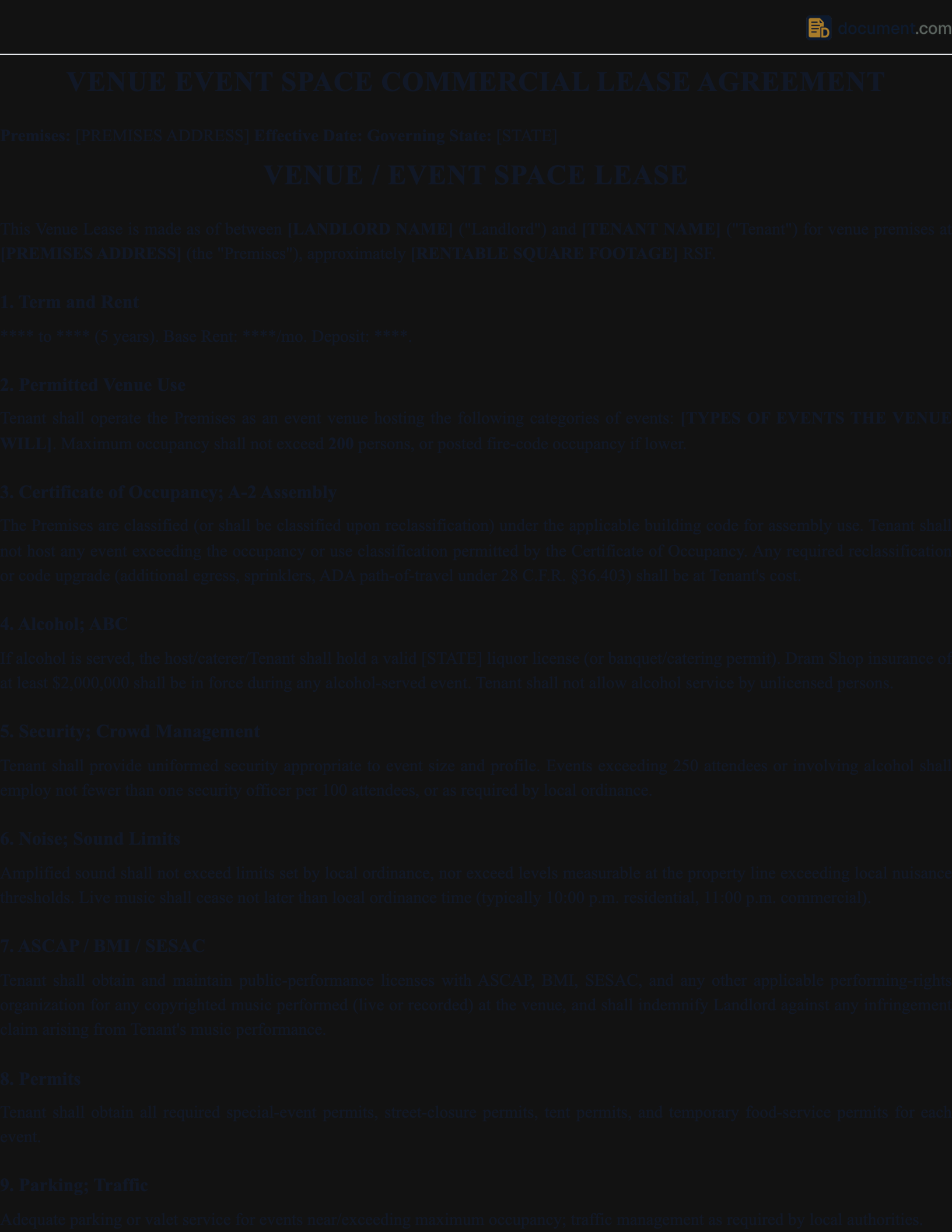



Rhode Island Venue Rental Agreement Overview
Rhode Island's small geography belies a surprisingly varied event venue market. Newport is the state's flagship venue destination, drawing weddings, corporate retreats, and social events to its historic mansions, waterfront properties, and harbor-view estates that compete with luxury venues in any East Coast market. Providence anchors the urban venue segment with a strong arts-oriented event economy, converted industrial spaces in the Jewelry District, and university-adjacent venues that host conferences and cultural events. The rest of the state features a mix of rural farm venues, coastal properties with water views, and mid-market banquet facilities serving local communities.
Rhode Island's Department of Business Regulation oversees liquor licensing, and venue rental agreements need to address DBR compliance, the state's 7% sales tax on food and beverage services, Newport's historic district overlay requirements, and the coastal weather risks that affect outdoor events throughout the year. The state's compact size means that most permit offices and licensing agencies are accessible, but Newport's premium market means that venue agreements there routinely involve more negotiation and higher stakes than comparable agreements in other small states.
$30
Recording fee
$2.30 per $500
Transfer tax
Required
Notarization
0
Witnesses required
Rhode Island Requirements
Rhode Island venue rental agreements need to address DBR liquor licensing coverage, occupancy and fire code compliance, and the specific permitting requirements that apply in Newport versus Providence versus smaller Rhode Island cities. Getting the alcohol service terms and outdoor permit responsibilities resolved in the agreement avoids the most common enforcement issues.
Rhode Island DBR License Coverage Note
Rhode Island DBR liquor licenses are premises-specific and tied to the license holder. A venue's license covers service within the licensed premises under its specific license category. Events where a renter wants to supply their own alcohol or use an outside bar service require coordination with the venue and possibly a caterer's permit. Newport venues with historic district design review requirements may also face additional restrictions on tent structures and outdoor lighting that need to be addressed in the rental agreement.
Venue Agreement Requirements
- DBR Liquor License Terms: Specify who holds alcohol service authorization, applicable DBR rules, and responsible server requirements
- Newport Historic District Compliance: For Newport venues, address historic district design review requirements for tents, structures, and outdoor lighting
- Occupancy and Fire Code: Confirm the venue's certificate of occupancy capacity limits and Rhode Island fire marshal requirements for event configurations
- Coastal Weather Contingency: Include force majeure provisions covering nor'easters, coastal storms, and harbor authority closures affecting Newport waterfront venues
- Insurance Requirements: Event liability insurance naming venue as additional insured, plus liquor liability coverage for events with alcohol service
- Noise Ordinance Compliance: Specific amplified sound cutoff times aligned with Newport or Providence ordinances, with enforcement responsibility assigned
How to Execute a Rhode Island Venue Rental Agreement
Executing a Rhode Island venue rental agreement requires confirming DBR licensing, reviewing occupancy permits, and addressing the specific permit requirements that apply to your venue's location. Newport events require additional review for historic district compliance and harbor access. Follow these steps.
Confirm DBR License Status, Occupancy Capacity, and Newport Historic District Status
Ask the venue for its current DBR license documentation and confirm the license category covers your event type. Review the certificate of occupancy for the maximum assembly load. For Newport venues, confirm whether the property is within the Historic Hill or Point neighborhood historic districts, which impose additional review requirements for outdoor structures and event lighting.
Inspect the Space and Confirm Outdoor and Waterfront Access
Walk the venue to assess suitability, check outdoor and waterfront access conditions, and ask about weather contingency options for coastal Rhode Island's variable weather. Confirm vendor loading access, parking, and whether the venue requires exclusive use of its catering staff. For Newport harbor-view venues, ask about any harbor master permit requirements that affect outdoor event setup near the water.
Negotiate DBR Alcohol Terms, Noise, and Outdoor Permit Responsibility
Finalize agreement terms covering DBR alcohol service authorization, amplified sound cutoff times aligned with Newport or Providence noise ordinances, and who is responsible for any required outdoor event permits. For Providence events, the Department of Parks and Recreation handles permits for city property use, while Newport Police and the city building department handle different aspects of large outdoor event authorization.
Execute the Agreement and Obtain Event Insurance
Sign the rental agreement and obtain event liability insurance naming the venue as additional insured. If alcohol will be served, obtain separate liquor liability coverage. Newport venues hosting high-value events typically require $2 million per occurrence coverage. Deliver your insurance certificate to the venue at least one week before the event access date.
Confirm All Permits and Complete Pre-Event Logistics
Confirm that all required permits are approved and provide copies to the venue. Finalize vendor access and catering schedules, confirm damage deposit terms, and document the venue's condition with photos before setup begins. Review the cancellation policy and confirm that force majeure provisions cover coastal storm cancellations and any harbor authority closures affecting Newport waterfront events.
Rhode Island Venue Fees & Costs
Rhode Island venue costs split sharply between Newport's premium market and the rest of the state. Newport mansion estates and harbor-view properties command some of the highest per-event rental rates in New England, while Providence urban venues and mid-state banquet facilities are priced much more modestly. Rhode Island's 7% state sales tax applies to food and beverage services at events, which can add meaningfully to the total cost of a catered event.
| Fee / Cost | Typical Range |
|---|---|
| Newport Premium Venue Rental Rates | $3,000 - $20,000 per event (mansion estates and harbor-view properties) |
| Providence and Mid-State Venue Rental Rates | $500 - $5,000 per event |
| Event Liability Insurance | $150 - $700 per event (Newport venues often require higher limits) |
| Liquor Liability Coverage | $100 - $500 per event (required when alcohol is served) |
| Newport Outdoor Event Permit | $100 - $600 (varies by event size and city property use) |
| Attorney Review (optional) | $250 - $700 for Newport high-value or multi-event agreements |
Rhode Island Tax Implications
Rhode Island imposes a 7% state sales tax on the retail sale of tangible personal property and certain taxable services. Food and beverages sold at events by caterers are generally subject to Rhode Island sales tax. Rhode Island also applies a meals and beverages tax to food and drink sold at events, which functions similarly to sales tax for most catering arrangements. The venue rental fee itself may not be subject to sales tax if structured as a pure space rental, but bundled service packages that include catering or equipment rental may create taxable components. Renters and venue operators should review their specific arrangement with a Rhode Island tax professional to confirm the applicable tax treatment.
Venue operators reporting event rental income in Rhode Island pay tax on that income under the state's personal income tax structure, with rates ranging from 3.75% to 5.99% for individuals. Corporate entities pay Rhode Island business corporation tax. Pass-through entities operating event venues should confirm their state filing obligations, particularly when Newport properties operate through LLCs or family partnerships with members outside Rhode Island.
Newport's hotel and lodging market creates a context where venue rental income and overnight accommodation charges sometimes arise together. Rhode Island imposes a hotel tax on transient lodging, and properties that bundle event rental fees with overnight accommodations should structure their agreements to clearly separate the lodging and event components. Conflation of these revenue streams can create unintended hotel tax exposure for what is functionally an event rental.
Sample Rhode Island Venue Rental Agreement
Preview of our Rhode Island-specific template. Your document will include all fields required for recording in any Rhode Island county.
VENUE/EVENT SPACE RENTAL AGREEMENT
STATE OF RHODE ISLAND
Legal Document
PARTY INFORMATION
Name: [Full Legal Name]
Address: [Rhode Island Address]
County: [County]
PROPERTY DESCRIPTION
County: [County] State: Rhode Island
Legal Description: [Per Recorded Plat]
Parcel No.: [APN]
Rhode Island Venue Rental Agreement FAQ
Common questions about filing in Rhode Island, including requirements, fees, and tax implications.
Official Rhode Island Resources
Official state resources for verifying requirements and finding your local recording office.
Newport Regulatory Considerations and DBR Compliance
Newport's historic district overlay creates requirements that go beyond standard venue rental compliance. Events at properties within Newport's historic districts that involve tents, staging, outdoor lighting, or temporary structures may require historic district design review by Newport's Historic District Commission before city permits are issued. The review timeline for complex outdoor configurations can add weeks to the planning process. Venue rental agreements for Newport outdoor events should include provisions for what happens if the historic district review results in conditions that affect the event design.
DBR liquor license compliance is a recurring source of enforcement actions at Rhode Island venues that host large events. Situations where multiple vendors are serving alcohol, where a renter brings in outside bar staff, or where the event crowd exceeds the venue's capacity have generated DBR enforcement activity. Rhode Island venue agreements should be clear about who holds service authorization, what the service protocols are, and who bears liability for any DBR compliance failure during the event.
Rhode Island's coastal weather creates cancellation and rescheduling risk that is higher than most inland states. Nor'easters can shut down Newport harbor access and make outdoor event spaces unusable on short notice. Force majeure clauses should address both the standard cancellation triggers and the specific risks of Rhode Island coastal weather, including provisions for partial performance situations where the event occurs but outdoor components are unusable due to weather.
Rhode Island Venue Compliance Note
Rhode Island venue agreements for Newport events, DBR alcohol service arrangements, or high-value multi-event packages benefit from review by a Rhode Island attorney familiar with hospitality regulation. Newport attorneys with event law experience can identify historic district compliance gaps and draft DBR indemnification language that assigns enforcement liability correctly between venue and renter.
Related Documents
Depending on your situation, you may need additional documents alongside this one. Below are commonly related documents that are frequently used together in real estate transactions.
Rhode Island Venue Agreement Practical Considerations
Newport's damage deposit practices reflect the high value of the historic properties involved. Deposits at Newport mansion venues can represent a significant portion of the rental fee, and the assessment process for post-event damage is more formal than at mid-market facilities. Agreements should define exactly what constitutes damage, who conducts the inspection, the timeline for deposit return, and what photographic documentation process will be used. For outdoor events, the agreement should specify whether weather-related cleanup costs are considered damage or normal event costs.
Rhode Island's small size means that venue disputes occasionally arise between parties who have ongoing professional or social relationships. Well-drafted agreements that address the likely scenarios upfront reduce the chance that a dispute about a noise complaint, a deposit deduction, or a weather cancellation turns into a lasting business conflict. Mediation clauses are used more frequently in Rhode Island venue agreements than in larger-state markets for this reason.
For recurring events at the same Rhode Island venue, a master agreement with per-event addenda is more practical than a new full agreement each time. Newport venues that host annual corporate retreats, recurring charity galas, or seasonal events often work with the same clients under a master framework that specifies the DBR alcohol terms, insurance requirements, and dispute resolution process once, with addenda covering the specific dates, rates, and configurations for each event.
Documentation and Recordkeeping
Retain the executed rental agreement, all permit approvals, DBR documentation, insurance certificates, and pre- and post-event photo documentation. For Newport events involving historic district review, keep copies of all HDC correspondence and permit approvals. Digital copies stored securely are recommended as backup, particularly for Newport agreements where documentation may be needed to respond to post-event regulatory inquiries.
Related Documents
Depending on your situation, you may need additional documents alongside this one. Below are commonly related documents that are frequently used together in real estate transactions.
Create your Rhode Island Commercial Venue Event Space Lease Agreement in under 5 minutes.
Answer a few questions and download a Rhode Island-compliant document, ready for the state agency.