
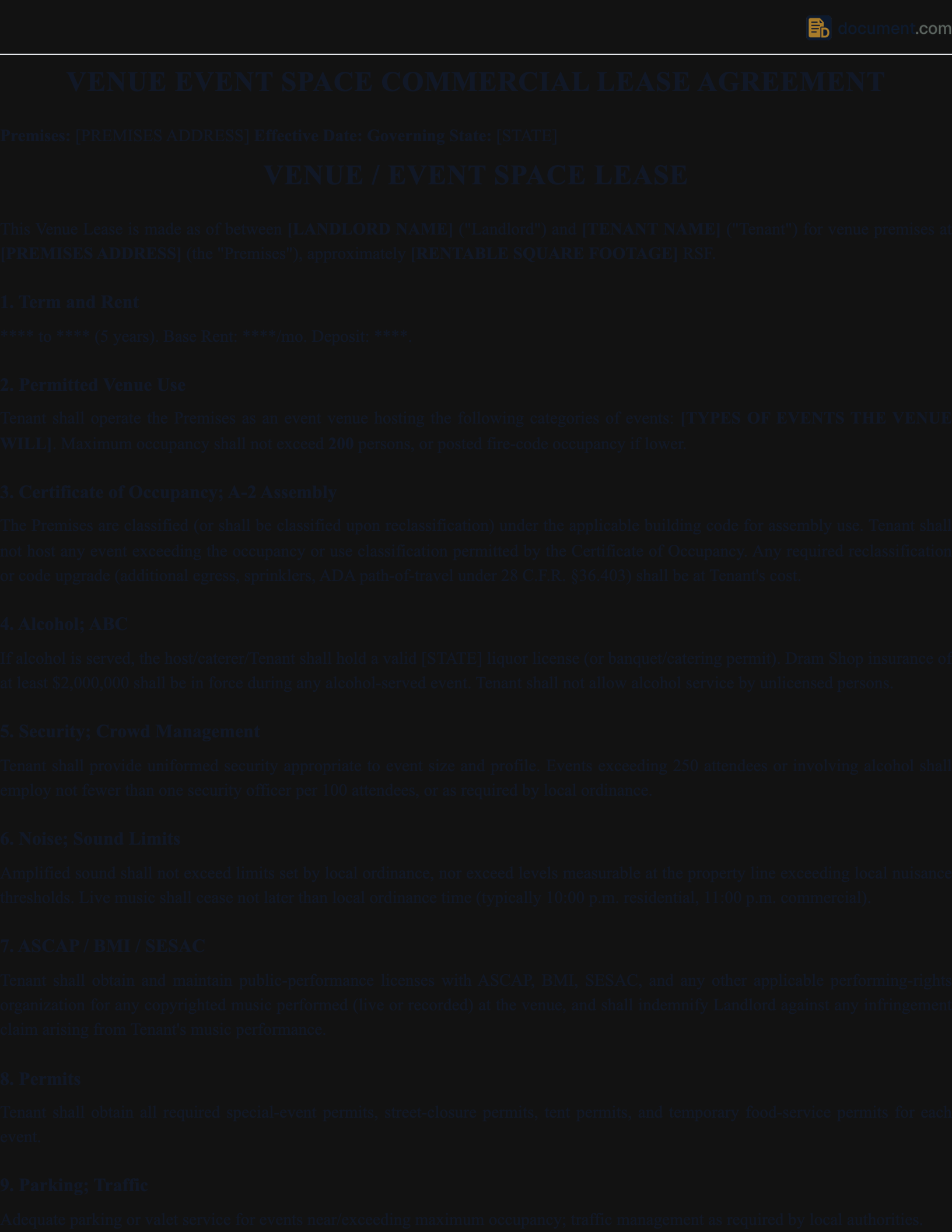



North Carolina Venue/Event Space Lease Agreement Overview
North Carolina's event venue market is shaped by three distinct regional economies. Charlotte hosts a high-volume corporate and social events market driven by the banking and professional services sectors, with significant demand for wedding venues in the surrounding suburbs. Raleigh and the Research Triangle have experienced some of the fastest population and economic growth in the Southeast over the past decade, creating strong demand for tech-sector corporate events, university gatherings, and a growing wedding market. Asheville operates as a destination event market, drawing out-of-state wedding parties and retreat groups who are willing to pay premium rates for memorable mountain settings. Asheville's venue market is more seasonal than the others, with a strong peak from spring through fall and a slower winter period that operators have to account for in their financial planning.
Leasing event space in North Carolina involves regulatory complexity beyond what a standard commercial lease addresses. The NC ABC Commission governs alcohol permits, and the state's patchwork of wet and dry counties and municipalities means that whether a venue can legally serve alcohol at all depends entirely on where the property is located. Local fire marshals establish occupancy limits for assembly spaces, and those limits can sometimes be lower than operators expect based on the physical size of the space. Cities like Asheville have active noise ordinance enforcement, and outdoor event venues can face compliance challenges that affect their operational hours and event programming.
NC ABC
Alcohol permitting
Wet/Dry
County variation
3
Major markets
Local
Fire marshal CO
North Carolina Venue Lease Requirements
Leasing an event venue in North Carolina requires addressing regulatory and operational provisions that go beyond a standard commercial lease. Prospective tenants should conduct due diligence on the space's regulatory approvals before signing, particularly around alcohol service rights, fire occupancy capacity, and noise compliance in their specific municipality.
Wet/Dry Jurisdiction and ABC Permit Verification
Confirm whether the venue property is in a wet or dry jurisdiction before signing. A long-term lease on a venue in a dry municipality where alcohol service is prohibited can fundamentally change the economics of a wedding or corporate event business. Verify jurisdiction status directly with the NC ABC Commission and include an ABC permit contingency clause in any lease where alcohol service is essential to the business model.
Key Lease Requirements
- Certificate of Occupancy: Confirm the space holds a CO for assembly use that covers the maximum event size the tenant plans to host
- Fire Marshal Capacity: Verify the local fire marshal's approved occupancy count for the space and its event configurations, including both seated and standing arrangements
- ABC Commission Permit Contingency: Include a contingency allowing lease termination if the applicable ABC Commission permit cannot be obtained, particularly for venues in questionable wet/dry jurisdictions
- Noise Ordinance Compliance: Review the applicable city or county noise ordinance and confirm the lease defines operating hours for amplified sound and assigns responsibility for noise complaints
- ADA Accessibility: Assess the space for ADA compliance and address in the lease which party is responsible for any required accessibility improvements
- Event Vendor and Client Insurance: Establish in the lease whether tenants must require event clients and vendors to carry their own liability coverage and submit certificates before events
How to Execute a North Carolina Venue Lease
Executing a North Carolina event venue lease successfully requires working through regulatory due diligence in the right order. The alcohol permitting and fire occupancy steps should happen before signing, not after.
Confirm Wet/Dry Status and ABC Permit Eligibility
Before negotiating seriously, verify the venue property's jurisdiction with the NC ABC Commission to confirm whether alcohol service is permitted at all. If alcohol is central to your event business, confirm that the type of ABC permit you need is available for the specific property and use. In some municipalities, proximity to schools or churches affects permit eligibility regardless of wet/dry status.
Verify CO, Fire Marshal Capacity, and Noise Compliance
Request a copy of the Certificate of Occupancy and confirm it covers assembly use. Contact the local fire marshal to verify the approved occupancy count for the event configurations you plan to offer. Review the applicable city or county noise ordinance for outdoor or amplified sound restrictions. Asheville's noise ordinance enforcement is particularly active, and outdoor event venues in the city should get clear answers on decibel limits and enforcement practices before committing to a lease.
Assess Buildout Needs and Negotiate Lease Terms
Walk the space with your event production team before signing. Identify any buildout needed for catering infrastructure, sound systems, lighting, restroom capacity, or ADA accessibility. Negotiate a tenant improvement allowance or rent abatement during buildout if the space needs work. Address use restrictions explicitly in the lease, including whether the landlord can restrict event types or cap occupancy below the fire marshal limit for liability reasons.
Execute the Lease With ABC Contingency
Both parties should sign a comprehensive written lease. Include an ABC permit contingency if alcohol service is essential and the permit has not yet been granted. Retain fully executed copies. Have an attorney review the lease, particularly the use restriction provisions, before signing. Asheville and Charlotte event venue leases often contain landlord-imposed restrictions on event types, noise, and hours that are not obvious from the base rent terms.
Begin Permit Applications and Buildout
After signing, begin the ABC Commission permit application immediately. Processing can take weeks to months. File for any additional business licenses, health permits for catering operations, or sound variance permits required by the local municipality. Begin buildout according to the lease timeline and document all improvements with photographs and contractor invoices, which protects your right to the TI allowance and simplifies the departure process at lease end.
Tax Implications for North Carolina Venue Tenants
North Carolina venue tenants face several tax considerations that vary depending on their business structure and how they generate revenue.
| Tax Issue | North Carolina Treatment |
|---|---|
| NC Sales Tax on Event Venue Rental | North Carolina imposes sales tax on certain rentals of tangible personal property and some service contracts. Event space rental for private events is generally not subject to NC sales tax when it constitutes a real property lease, but ancillary services like equipment rental, catering, and production services may be taxable. Confirm the tax treatment of each revenue stream with the NC Department of Revenue. |
| Prepared Food and Beverage Sales | If the tenant provides catering services or operates a bar at events, those sales are subject to NC sales tax. Prepared food sold for immediate consumption is taxed at 2% state rate plus county tax; malt beverages and wine have separate excise tax treatment under ABC regulations. |
| Lease Rent Deductibility | Venue rent paid by a business entity is deductible as an ordinary business expense for both federal and NC state income tax purposes. Document rent payments consistently and ensure the lease clearly identifies the business as the tenant. |
| Tenant Improvement Depreciation | Leasehold improvements the tenant makes to the venue space may qualify for 15-year depreciation under MACRS or Section 179/bonus depreciation treatment, depending on the nature of the improvement. Equipment installed by the tenant that remains removable at lease end is generally treated as personal property with faster depreciation schedules. |
Sample North Carolina Venue Rental Agreement
Preview of our North Carolina-specific template. Your document will include all fields required for recording in any North Carolina county.
VENUE/EVENT SPACE RENTAL AGREEMENT
STATE OF NORTH CAROLINA
Legal Document
PARTY INFORMATION
Name: [Full Legal Name]
Address: [North Carolina Address]
County: [County]
PROPERTY DESCRIPTION
County: [County] State: North Carolina
Legal Description: [Per Recorded Plat]
Parcel No.: [APN]
North Carolina Venue Rental Agreement FAQ
Common questions about filing in North Carolina, including requirements, fees, and tax implications.
Official North Carolina Resources
Official state resources for verifying permit requirements and regulatory guidance for North Carolina event venue operators.
NC ABC Commission
Alcohol permits, wet/dry jurisdiction lookup, and permit types
NC State Fire Marshal
Fire safety standards for assembly occupancies
NC Department of Revenue
Sales tax rates on food, beverage, and event rental revenue
NC Department of Justice
Consumer protection and commercial lease guidance
Important Considerations for NC Venue Tenants
North Carolina event venue tenants need to think carefully about the ABC permit timeline before signing a lease. An ABC Commission permit for a venue that plans to serve liquor can take several months to process, and opening without the permit in place means either forgoing alcohol service or delaying events. Tenants who need the permit to generate revenue should include an ABC contingency clause in the lease and negotiate for a rent-free period or reduced rent during the permitting window.
Asheville venue operators need to pay particular attention to seasonality. The market sees strong demand from spring through fall, with peak wedding season creating intense competition for popular dates. Winter revenue can be significantly lower, and lease terms should account for this reality. Long-term fixed-rent leases in Asheville can create cash flow problems if the rent level assumes year-round performance. Tenants should negotiate for flexible terms or plan cash reserves that cover the slower winter months.
Charlotte and Raleigh venue tenants face a more consistent year-round demand profile from corporate events, but they compete in larger markets with more established venue options. New venue operators in these markets should assess their differentiation carefully before committing to long-term leases, since startup venues may take 12 to 18 months to build their reputation and booking volume to a sustainable level.
Have an Attorney Review the Use Restrictions
North Carolina event venue leases often contain use restrictions that significantly limit what types of events a tenant can host, what hours they can operate, and what occupancy levels they can reach. An attorney with commercial real estate or hospitality experience can identify these restrictions before you sign and help you negotiate language that protects your ability to run the business you are planning to operate.
Related North Carolina Documents
Depending on your situation, you may need additional documents alongside your North Carolina venue lease agreement.
Create your North Carolina Commercial Venue Event Space Lease Agreement in under 5 minutes.
Answer a few questions and download a North Carolina-compliant document, ready for the state agency.