



Florida Venue Rental Agreement Overview
Florida has one of the most active event venue markets in the country, driven by year-round warm weather, a large tourism economy, and a corporate event sector that concentrates heavily in Miami, Orlando, and Tampa. The absence of a state income tax makes Florida an attractive base for event businesses, but the state imposes a 6 percent sales tax on commercial rents that adds directly to venue operating costs. Operators must factor this recurring tax into lease economics before signing.
Florida's Division of Alcoholic Beverages and Tobacco administers a quota licensing system for on-premise alcohol service that creates scarcity in the highest-demand markets. Miami-Dade County quota licenses regularly trade on the secondary market for $50,000 to $150,000, and securing one before lease signing is critical for venues that depend on bar revenue. Operators who cannot obtain a quota license may rely on ABT's special event permit process, but this limits the business model significantly. Florida's hurricane exposure also requires specific lease provisions: force majeure clauses, storm closure rent abatement, and flood zone disclosure are standard expectations in any well-drafted Florida venue lease.
$10
Recording fee
$0.70 per $100
Transfer tax
Required
Notarization
2
Witnesses required
Florida Requirements
Florida venue leases must account for the ABT quota licensing structure, hurricane and storm provisions, the state's commercial rent sales tax, and county-level fire marshal authority over assembly occupancy. Markets differ significantly: a Miami Beach rooftop venue, an Orlando convention hotel ballroom, and a Tampa waterfront event space each face distinct regulatory requirements from different local authorities.
Quota License Scarcity in South Florida
Florida's ABT quota system caps on-premise licenses by county population. In Miami-Dade, Broward, and Palm Beach counties, quota licenses have traded for $50,000 to $150,000 on the secondary market. No amount of lease negotiation can guarantee license availability. A venue lease that depends on alcohol revenue without a license contingency is a serious financial risk for the tenant.
Key Lease Provisions
- ABT License Contingency: Right to terminate if a quota license cannot be secured within budget and timeline defined in the lease
- Hurricane and Storm Provisions: Rent abatement for government-ordered closures, storm shutter responsibility, and restoration timelines with tenant termination rights
- Outdoor Event Rights: Express grant of outdoor space use with defined hours, noise compliance responsibility, and permit coordination
- CAM Cap and Audit Rights: Limit on annual CAM charge increases and right to audit landlord's CAM expense records
- Fire Marshal Compliance: Confirm permitted occupancy load and allocate responsibility for fire system upgrades required by the county fire marshal
- Flood Zone Disclosure: Document FEMA flood zone designation and address insurance requirements for flood-prone coastal locations
How to Execute a Florida Venue Lease
Executing a Florida venue lease requires coordinating ABT licensing, county fire and building permit review, and storm protection provisions before the venue can open. The steps below reflect the typical sequence for a Florida event space transaction.
Verify Zoning and Assembly Occupancy
Confirm the property's zoning allows event venue use and that the current certificate of occupancy covers assembly occupancy. In Miami-Dade, Broward, and Hillsborough counties, zoning for assembly use can differ significantly from general commercial, and the change-of-use permit process adds time and cost to the buildout.
Assess ABT License Availability and Cost
Before signing, determine whether a quota license is available in the county, what it would cost on the secondary market, and whether a special event permit structure is a viable alternative. Build a license contingency into the lease with a specific budget ceiling and timeline. If the venue operates outside a quota county, the standard on-premise license application can proceed directly through ABT.
Negotiate Storm and CAM Provisions
Florida venue leases should include rent abatement for government-ordered closures caused by tropical storms or hurricanes, a defined timeline for landlord restoration of storm-damaged premises, and tenant termination rights if restoration is not complete within the agreed period. CAM caps and audit rights are equally important, particularly in multi-tenant properties where CAM includes insurance costs that can spike after a major storm season.
Complete Fire Marshal Inspection and TI Permits
Florida's county fire marshals conduct inspections of assembly occupancy venues. Submit permit applications for any TI work, fire system upgrades, or outdoor structure installations before beginning construction. Orange County (Orlando), Miami-Dade, and Hillsborough County each have active fire marshal offices that require plan review for assembly use changes.
Execute the Lease and Obtain Outdoor Event Permits
Execute the lease and immediately pursue any municipal outdoor entertainment permits, noise variance approvals, and parking special use permits needed for your event programming. Miami Beach, Key West, and Tampa's Ybor City entertainment district each have distinct permit requirements for outdoor amplified music and public gatherings that must be resolved before opening.
Florida Fees & Costs
Typical costs for filing in Florida. Actual fees may vary by county.
| Fee / Tax | Amount |
|---|---|
| Recording Fee | $10 |
| Transfer Tax | $0.70 per $100 |
| Notarization | $5 - $25 per signature |
| Certified Copy | $1 - $10 per page |
| Attorney Review (optional) | $150 - $500 |
Florida Tax Implications
Florida is one of the only states in the country that imposes a sales tax on commercial rent. The state rate is 6 percent, and many counties add a discretionary surtax of up to 1 percent. This sales tax applies to the base rent, CAM charges, and any other payments that qualify as consideration for the use of real property. For a venue paying $15,000 per month in base rent plus $3,000 in CAM charges, the monthly Florida sales tax obligation can exceed $1,000. This cost is frequently underestimated during lease negotiations and should be modeled explicitly in the tenant's budget before signing.
Florida also imposes a documentary stamp tax on commercial leases at $0.35 per $100 of total rent over the lease term. A five-year venue lease with $200,000 in total annual rent creates a documentary stamp tax obligation of several thousand dollars due at or shortly after execution. Florida's Division of Revenue can assess penalties and interest for documentary stamp tax noncompliance, and both parties to the lease can be held jointly liable for the unpaid obligation.
For venues that serve alcohol, Florida's ABT collects alcohol excise taxes at the wholesale distribution level. These costs are embedded in wholesale pricing and passed through in the cost of goods for bar operations. Venue operators should also be aware that Florida has no state income tax, which benefits the overall economics of operating a profitable event business. However, the combination of sales tax on rent, documentary stamp tax, and federal self-employment taxes means that Florida venue operators still carry a significant total tax burden that must be planned for.
Sample Florida Venue Rental Agreement
Preview of our Florida-specific template. Your document will include all fields required for recording in any Florida county.
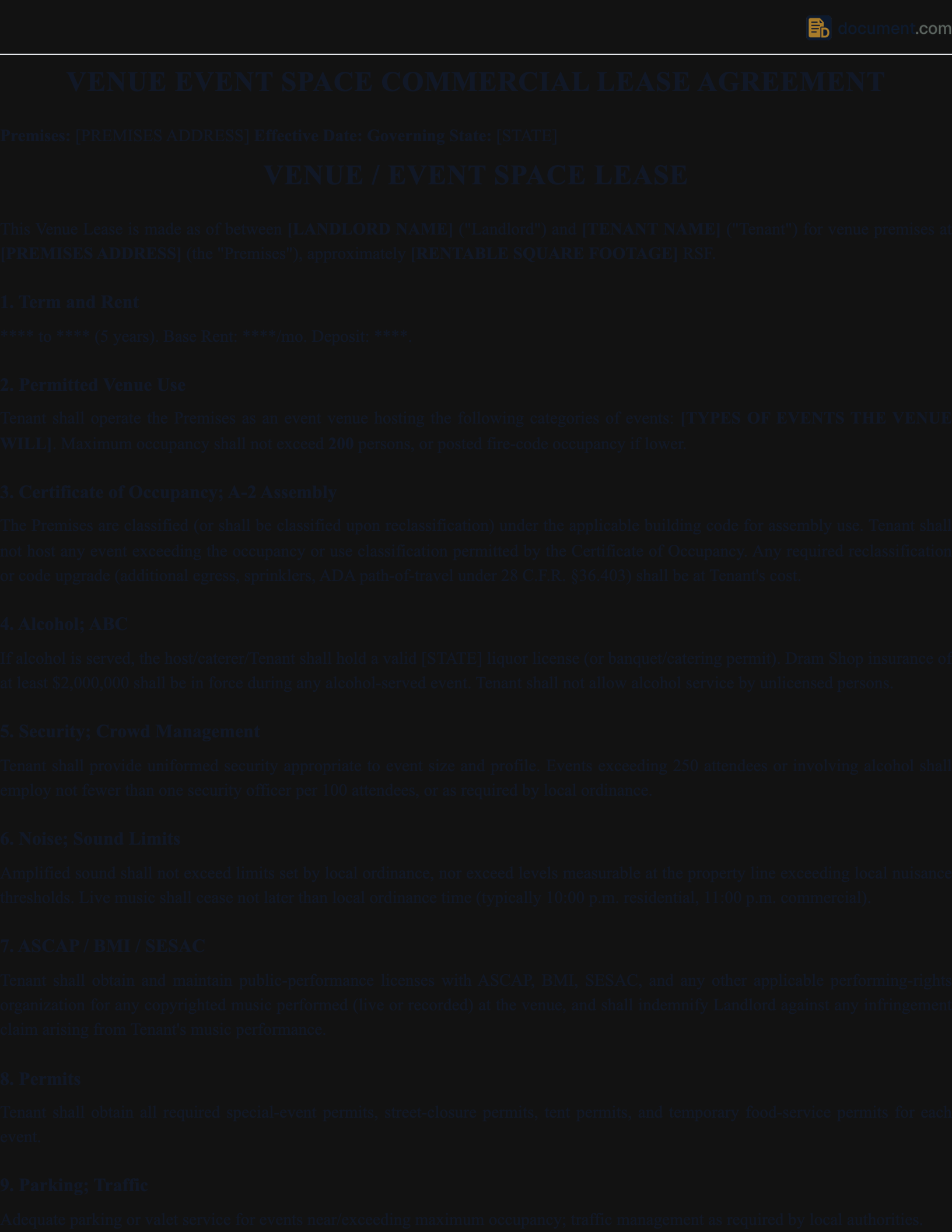
VENUE/EVENT SPACE RENTAL AGREEMENT
STATE OF FLORIDA
Legal Document
PARTY INFORMATION
Name: [Full Legal Name]
Address: [Florida Address]
County: [County]
PROPERTY DESCRIPTION
County: [County] State: Florida
Legal Description: [Per Recorded Plat]
Parcel No.: [APN]
Florida Venue Rental Agreement FAQ
Common questions about filing in Florida, including requirements, fees, and tax implications.
Official Florida Resources
Official state resources for verifying requirements and finding your local recording office.
Important Considerations
The ABT quota license system is the most common reason Florida venue deals collapse after signing. Tenants who agree to lease terms before confirming license availability in a quota county can find themselves locked into rent obligations for a space they cannot legally operate as a bar or full-service event venue. The contingency must address both denial and delay: if ABT approval takes six months instead of the expected ninety days, a tenant without adequate rent abatement language will pay full rent during an operational blackout that was not their fault.
Florida's hurricane risk requires lease provisions that most other states do not need. A well-drafted force majeure clause for a Florida venue should distinguish between voluntary closures and government-ordered evacuations or closures. Rent abatement should begin automatically when a mandatory evacuation order covers the venue's address, not just when the landlord chooses to close. The restoration timeline should be no longer than 180 days for major structural damage, with tenant termination rights if the landlord cannot restore the premises within that window.
Florida's sales tax on commercial rents is frequently overlooked during lease negotiations because it is not part of the quoted rental rate. A venue operator who signs a lease without modeling the sales tax cost may discover a 6 to 7 percent gap between their budget and their actual monthly payment. This tax applies to base rent and CAM charges and is the tenant's obligation to remit to the Florida Department of Revenue, regardless of whether the landlord reminds them of it.
Attorney Review Recommended
Florida venue leases should be reviewed by a Florida commercial real estate attorney who understands ABT licensing, hurricane force majeure provisions, commercial rent sales tax, and county-specific fire and building code requirements. Markets differ significantly enough that Miami, Orlando, and Tampa each benefit from counsel with local market experience.
Related Documents
Florida venue operators commonly need companion agreements alongside the core venue lease. The documents below address the most frequently needed instruments for Florida event space operations.
Create your Florida Commercial Venue Event Space Lease Agreement in under 5 minutes.
Answer a few questions and download a Florida-compliant document, ready for the state agency.