
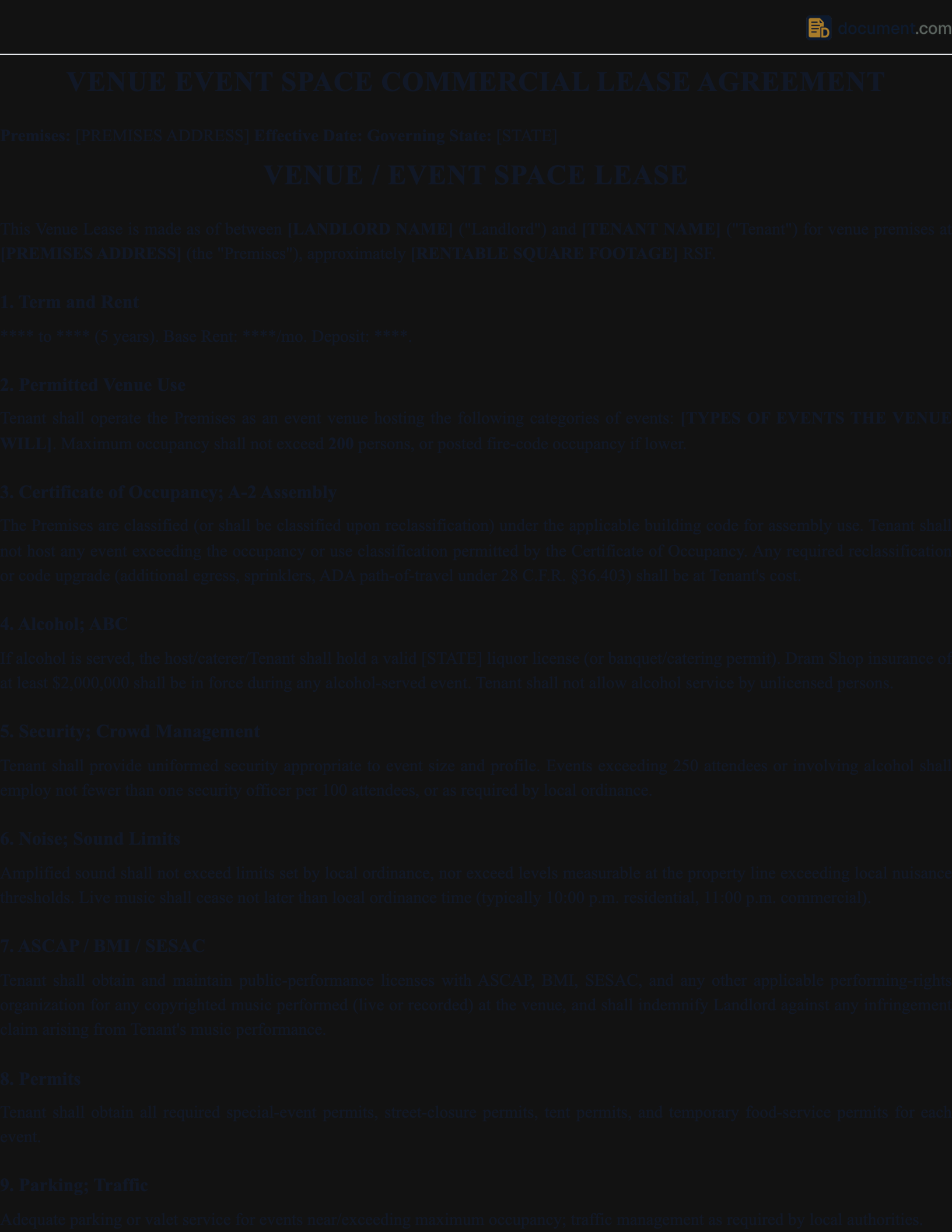



Connecticut Venue Rental Agreement Overview
Connecticut's event venue market is concentrated in its urban centers and coastal communities. Hartford hosts a strong corporate event and conference market. New Haven benefits from Yale University and a growing arts and culture venue scene. Stamford, close to New York City, draws destination corporate events and weddings. Connecticut's regulatory environment is demanding, with DESPP handling liquor licensing at the state level and strict local fire marshal oversight of occupancy capacity.
A Connecticut venue lease must address DESPP liquor license contingencies and timelines, local fire marshal occupancy capacity documentation, noise ordinance compliance for events with amplified music, ADA responsibilities in older Connecticut buildings, liquor liability insurance requirements, parking adequacy for the planned event types, and event-specific permit rights. Connecticut's regulatory complexity makes pre-lease due diligence on each of these points important before you commit to rent obligations.
$60
Recording fee
0.75% - 2.25%
Transfer tax
Required
Notarization
2
Witnesses required
Connecticut Requirements
Connecticut venue leases must address DESPP liquor licensing timelines, fire marshal occupancy documentation, noise ordinance compliance, ADA responsibilities, and liquor liability insurance requirements. Connecticut's high regulatory burden means that pre-signing due diligence on each of these points is more important than in many other states.
Connecticut Specific Note
Connecticut DESPP liquor licensing can take 60 to 120 days from a complete application. Venue leases that include alcohol service rights should address DESPP approval as a condition of the lease, including a contingency period or rent abatement if DESPP processing delays the venue's ability to serve alcohol at events. Connecticut dram shop liability exposure is also significant, making liquor liability insurance a non-negotiable lease requirement for most landlords.
Document Requirements
- Occupancy and Fire Capacity: Document the fire marshal-approved occupancy load and specify who maintains the certificate of occupancy and handles fire marshal inspection responses
- DESPP Liquor License: Address DESPP licensing rights, which party holds the license, application and renewal costs, and what happens if DESPP denies or revokes the license
- Noise Ordinance Compliance: Confirm the right to host amplified events and specify who is responsible for soundproofing or mitigation costs if local noise enforcement actions are issued
- ADA Compliance: Allocate responsibility for accessible seating, restrooms, stages, and path-of-travel improvements in older Connecticut buildings
- Liquor Liability Insurance: Require dram shop or host liquor liability coverage at defined minimum limits, with the landlord named as additional insured
How to Execute a Connecticut Venue Lease
Connecticut's regulatory demands mean that confirming occupancy status, DESPP licensing feasibility, and noise ordinance compliance before signing is essential. Work through these steps to protect your event business from the start.
Verify Occupancy, Zoning, and DESPP License Eligibility
Confirm the venue has a current certificate of occupancy for assembly use and that the fire-approved capacity supports your planned event sizes. Contact DESPP to confirm the address qualifies for the liquor license type you need and check for any disqualifying history.
Negotiate Connecticut-Specific Provisions
Address DESPP license rights and contingencies, fire marshal occupancy documentation, noise ordinance compliance responsibility, ADA improvements allocation, liquor liability insurance requirements with minimum coverage limits, parking adequacy, and event permit rights.
Execute the Lease with Connecticut Formalities
Both parties sign with 2 witnesses and notarization as required in Connecticut. Confirm that all exhibits and schedules are attached to the executed agreement.
Apply for DESPP License Promptly
Begin the DESPP liquor license application immediately after signing. At 60 to 120 days of processing time, early filing is essential to minimize the pre-opening rent exposure period. Include a rent abatement or contingency period in the lease that accounts for DESPP's timeline.
Confirm Insurance and Event Permit Procedures
Verify that required liquor liability and general liability insurance policies are in place before the first event. Confirm what event-specific permits your municipality requires and ensure the lease grants you the right to apply for these permits using the property address.
Connecticut Fees & Costs
Typical costs for filing in Connecticut. Actual fees may vary by county.
| Fee / Tax | Amount |
|---|---|
| Recording Fee | $60 |
| Transfer Tax | 0.75% - 2.25% |
| Notarization | $5 - $25 per signature |
| Certified Copy | $1 - $10 per page |
| Attorney Review (optional) | $150 - $500 |
Connecticut Tax Implications
Connecticut imposes sales tax on admissions to certain events and on some room and event space rentals. The Connecticut Department of Revenue Services administers these obligations, and whether a specific venue rental is taxable depends on the structure of the arrangement and what services are bundled with the space rental. Venue operators should consult a Connecticut tax professional to confirm their sales tax obligations before beginning operations.
Alcohol sales at Connecticut venues are subject to state excise taxes on beer, wine, and spirits. DESPP licensees are responsible for accurate reporting of alcohol sales to the state. Venues that bundle alcohol service into event packages should be particularly careful about how they characterize revenue for tax purposes.
Connecticut's real property conveyance tax applies to transfers of property interests and can affect lease restructurings or long-term lease agreements that are treated as property transfers under state tax rules. Consult a Connecticut attorney before entering a ground lease or other arrangement that could be characterized as a property transfer for tax purposes.
Sample Connecticut Venue Rental Agreement
Preview of our Connecticut-specific template. Your document will include all fields required for recording in any Connecticut county.
VENUE/EVENT SPACE RENTAL AGREEMENT
STATE OF CONNECTICUT
Legal Document
PARTY INFORMATION
Name: [Full Legal Name]
Address: [Connecticut Address]
County: [County]
PROPERTY DESCRIPTION
County: [County] State: Connecticut
Legal Description: [Per Recorded Plat]
Parcel No.: [APN]
Connecticut Venue Rental Agreement FAQ
Common questions about filing in Connecticut, including requirements, fees, and tax implications.
Official Connecticut Resources
Official state resources for verifying requirements and finding your local recording office.
Important Considerations
Connecticut venue leases carry regulatory exposure that generic commercial lease templates rarely anticipate. The DESPP Liquor Control Division licensing process can take 60 to 120 days, and approval is not guaranteed if the premises have a prior license suspension or if zoning does not explicitly permit on-premise consumption. Tenants who begin operating before receiving final licensure risk enforcement action that can close the venue before a single ticketed event.
Connecticut's dram shop statute, C.G.S. Section 30-102, creates direct liability for venues and their landlords when alcohol-related incidents involve guests who were served on the premises. Your lease should clearly allocate responsibility for liquor liability insurance and specify minimum coverage levels. A requirement of at least $2 million per occurrence is standard in the Hartford and Stamford markets. Failure to carry adequate coverage exposes both parties to personal injury claims that exceed typical commercial general liability limits.
Many attractive Connecticut venue spaces occupy pre-1990 historic buildings, particularly in Hartford's Colt Gateway district and New Haven's industrial corridors. These structures frequently require ADA path-of-travel upgrades when occupancy changes, and the cost of accessible restrooms, elevators, or ramp installations can run well into six figures. Negotiate clearly which party funds ADA compliance upgrades and whether tenant improvement allowances cover accessibility work before signing.
Attorney Review Recommended
Connecticut venue leases intersect with dram shop liability, municipal noise ordinances, DESPP licensing conditions, and local fire marshal authority. A Connecticut commercial real estate attorney familiar with hospitality and event space regulations can identify lease terms that expose you to liability and negotiate protections specific to your municipality and intended event programming.
Related Documents
Connecticut venue operators frequently need supporting agreements and permits alongside the core lease. The documents below address the most common companion needs for event space operations in this state.
Create your Connecticut Commercial Venue Event Space Lease Agreement in under 5 minutes.
Answer a few questions and download a Connecticut-compliant document, ready for the state agency.