



Wisconsin Commercial Modified Gross Lease Overview
A modified gross lease occupies the middle ground between a full gross lease and a NNN structure. The landlord and tenant negotiate which expenses each side will carry, then document that allocation in an expense schedule attached to the lease. In Wisconsin commercial markets, modified gross leases are especially common in multi-tenant office buildings and suburban flex space where landlords want to retain building management control but are willing to pass certain tenant-controlled costs back to the occupant.
Wisconsin has no commercial rent tax, so modified gross tenants pay base rent plus their agreed share of operating costs without a statewide lease excise tax on top. The split is purely a matter of contract, and there are no statutory defaults that fill in the gaps if the lease is silent on a particular expense. Getting the expense schedule right before signing is essential because disputes about cost responsibility tend to compound over multi-year lease terms.
Hybrid
Expense structure
Negotiated
Expense allocation
Written
Expense schedule required
Contract
Governs all terms
Wisconsin Modified Gross Lease Requirements
Because Wisconsin modified gross leases are entirely contract-driven, the tenant's cost exposure over the full lease term is determined by the language in the expense schedule and escalation provisions. Taking time to negotiate these details before signing prevents disputes later.
Wisconsin Expense Schedule Note
Wisconsin has no statutory default that determines how operating costs are allocated in a modified gross lease. If the lease does not clearly specify which expenses are the tenant's responsibility, the ambiguity will be resolved by contract interpretation, often in the landlord's favor. A detailed expense schedule identifying each cost category and its treatment is the most important document protection a tenant can negotiate.
Key Modified Gross Lease Provisions
- Expense Schedule: The lease should include a written schedule listing every operating cost category and clearly indicating whether each falls on the landlord, the tenant, or is shared on a prorated basis
- Utility Metering: Confirm whether in-suite utilities are separately metered or allocated by square footage, and specify which party is responsible for establishing utility service accounts
- HVAC Responsibility: Define who handles routine HVAC maintenance, filter replacements, and major system repairs or replacements, particularly important in older Wisconsin office and flex buildings
- Base Rent Escalation: State the annual escalation rate for base rent, whether fixed percentage or CPI-linked, and confirm that escalation applies only to base rent and not to tenant-side expense obligations
- Maintenance Obligations: Specify the standard to which the tenant must maintain the premises and any restrictions on alterations or improvements
- Permitted Use: Define the tenant's permitted use narrowly enough to protect the landlord's other tenants but broadly enough not to restrict the tenant's legitimate business operations
How to Draft a Wisconsin Modified Gross Lease
Drafting a Wisconsin modified gross lease involves negotiating the expense split during the letter of intent stage and then documenting it clearly in the executed lease. The steps below walk through the process.
Agree on the Expense Split in the Letter of Intent
Before drafting the lease, both parties should agree in writing on which expenses are landlord-side and which are tenant-side. Documenting this in the LOI prevents the expense allocation from being relitigated during lease drafting.
Build a Detailed Expense Schedule
Draft an expense schedule that lists every operating cost category for the property and marks each as landlord, tenant, or shared. For shared costs, define the allocation methodology. Attach this schedule as an exhibit to the lease so it is unambiguous.
Confirm Utility Metering and HVAC Setup
Walk the space before execution and confirm how utilities are metered and who the HVAC service contracts are with. In Wisconsin older office and industrial stock, HVAC systems sometimes serve multiple suites, which complicates cost allocation if it is not addressed in the lease.
Wisconsin Attorney Review
Have a Wisconsin commercial real estate attorney review the expense schedule and escalation provisions before execution. Multi-year leases in Milwaukee, Madison, or Appleton are significant financial commitments where legal review costs are well justified by the exposure they help avoid.
Execute and Set Up Expense Tracking
Once the lease is executed, set up a budget that tracks base rent and each tenant-side expense separately. Review all landlord billings against the lease schedule. Address any discrepancies promptly in writing to create a record if a dispute arises later.
Wisconsin Market Considerations
Wisconsin commercial real estate markets are diverse in structure and pricing. Milwaukee's downtown office market is dominated by multi-tenant buildings where modified gross structures are the norm, with base rents ranging from $16 to $28 per square foot in Class A properties and lower in Class B suburban corridors like Brookfield and Wauwatosa. Madison's market is heavily influenced by the UW-Madison campus and state government employment base, with consistent demand near the Capitol and along the University Avenue corridor.
Wisconsin does not impose a commercial rent tax, which keeps modified gross lease total occupancy cost calculations straightforward. The tenant's effective cost is base rent plus the expenses defined in the lease, without a state-level excise layer on top. This is a meaningful difference from states like Florida or Arizona that impose additional taxes on commercial rent.
Older Wisconsin office and industrial buildings, particularly in Milwaukee and Green Bay, sometimes have shared mechanical systems and limited utility metering. Tenants leasing space in these properties should carefully confirm how HVAC, electrical, and water costs will be allocated before agreeing to tenant-side expense obligations. A modified gross lease that assigns utilities to the tenant without accounting for shared metering creates billing disputes that are common in converted or older commercial stock.
Wisconsin Modified Gross Lease Fees & Costs
Total occupancy cost under a Wisconsin modified gross lease includes base rent plus each tenant-side expense as defined in the lease. The ranges below reflect typical Wisconsin commercial markets.
| Cost Item | Typical Range |
|---|---|
| Base Rent | $10 to $22 per sq ft annually (office and flex; Milwaukee and Madison range) |
| In-Suite Utilities (if tenant-side) | $1 to $3 per sq ft annually depending on usage and metering |
| Janitorial Service (if tenant-side) | $0.75 to $1.50 per sq ft annually |
| HVAC Maintenance (if tenant-side) | $0.25 to $0.75 per sq ft annually for routine service |
| Attorney Review | $1,500 to $4,000 depending on lease complexity |
Sample Wisconsin Commercial Modified Gross Lease
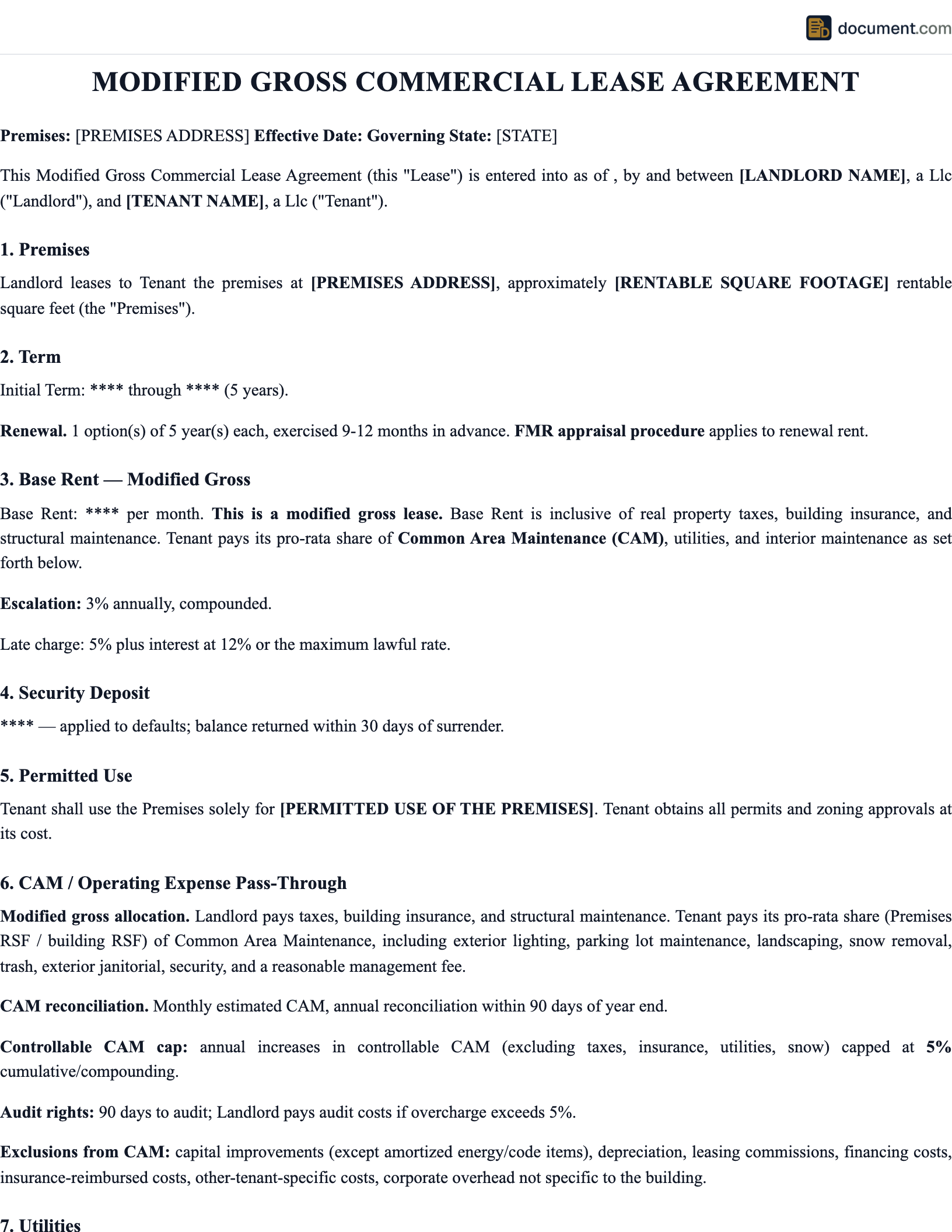
Below is a preview of our Wisconsin-specific commercial modified gross lease. Your customized document will include all fields and provisions required under WI law.
COMMERCIAL MODIFIED GROSS LEASE
STATE OF WISCONSIN
WI-Compliant Template
PARTY A:
Name: [Full Legal Name]
Address: [Wisconsin Address]
PARTY B:
Name: [Full Legal Name]
Address: [Wisconsin Address]
PROPERTY / PREMISES:
Address: [Property Address]
County: [Wisconsin County]
WISCONSIN COMPLIANCE
This document complies with Wisconsin (WI) state law requirements and includes all provisions mandated for this type of document in Wisconsin.