



West Virginia Commercial Modified Gross Lease Overview
A modified gross lease in West Virginia divides operating expenses between landlord and tenant, with the landlord covering certain costs in the base rent and the tenant paying others directly. This hybrid structure is common in West Virginia's mid-tier commercial office market, flex space, and suburban business parks in Charleston, Huntington, Morgantown, Parkersburg, and Beckley. It suits landlords who want some cost pass-through without a full NNN structure, and tenants who want to control certain expenses directly.
West Virginia commercial leases are governed by contract law, with minimal statutory framework specific to commercial tenants. The expense allocation in a modified gross lease is whatever the parties agree to and document in the lease. That flexibility makes West Virginia modified gross leases relatively easy to negotiate but also means that the quality of the expense schedule in the lease document has a direct impact on how disputes are resolved. A well-drafted schedule prevents arguments; a vague one invites them.
Hybrid
Expense structure
Negotiated
Expense split
Written
Required form
Contract
Law governs
West Virginia Modified Gross Lease Requirements
A West Virginia modified gross lease must be in writing for any term exceeding one year under the state's statute of frauds. Beyond that requirement, the law imposes few mandatory provisions on commercial lease parties, making the quality and completeness of the negotiated document the primary protection for both sides.
West Virginia Expense Schedule Note
In West Virginia, modified gross lease expense disputes are resolved by reading the lease language as written. A poorly drafted expense schedule that uses vague terms will be interpreted by the court based on the plain meaning of those terms, which may not reflect what either party intended. Always document the expense split with item-level specificity, not general category descriptions.
Key West Virginia Modified Gross Lease Provisions
- Expense Schedule: The lease must include a written schedule identifying exactly which costs are covered in the base rent and which are tenant-paid, by category and item
- Utility Metering: Confirm whether utilities serving the space are separately metered; if shared metering exists, the lease must define how costs are allocated between tenants
- HVAC Responsibility: Define whether routine HVAC maintenance is a tenant obligation, and where the line falls between maintenance (tenant) and replacement (landlord); many West Virginia buildings have older HVAC systems where this distinction matters
- Base Rent Escalation: Annual increases should specify whether they apply to the full base rent or only to certain components, and whether they are fixed percentage or CPI-based
- Maintenance Boundaries: Define interior, exterior, structural, and common area maintenance responsibilities with clear boundaries to prevent overlapping or conflicting claims
- Permitted Use and Zoning: West Virginia requires the permitted use to comply with applicable local zoning; confirm the space is zoned for the intended business before executing
How to Draft a West Virginia Modified Gross Lease
Drafting a West Virginia modified gross lease requires agreeing on the expense split before drafting begins and documenting it precisely in the lease. These five steps guide the process from initial negotiation through execution.
Agree on the Expense Split in the Letter of Intent
Negotiate the full expense allocation before involving attorneys. Document which costs are landlord-borne and which are tenant-paid, item by item, in the letter of intent. In West Virginia's smaller commercial markets, this negotiation is often done informally, but getting it in writing before the lease is drafted prevents subsequent misunderstandings
Build a Detailed Expense Schedule
Translate the agreed split into a written schedule exhibit attached to the lease. Specify each cost category, who pays it, and how disputes about that category are resolved. Avoid general phrases; use specific item names so both parties understand exactly what is covered
Verify Utility Metering and HVAC Setup
Before finalizing the lease, physically confirm whether utilities are separately metered to the tenant's space and whether the HVAC system is dedicated or shared. Many West Virginia commercial buildings are older and may not have separate metering, which affects both the lease structure and cost allocation
Have a West Virginia Attorney Review
A West Virginia commercial real estate attorney should confirm that the expense schedule matches the negotiated intent, that escalation provisions are correctly structured, and that the lease complies with any applicable local zoning or permitting requirements for the intended business use
Execute and Track Expenses
Both parties sign the lease. Tenants should set up a simple tracking system from day one, recording base rent payments and all direct expense invoices monthly so total occupancy cost can be monitored against lease terms throughout the lease period
West Virginia Market Considerations
West Virginia commercial rents are generally lower than surrounding states, which makes modified gross leases in the state relatively affordable even with some landlord-borne expenses embedded in the base rent. Charleston, as the state capital and primary commercial center, has the most active office and retail leasing market in the state. Morgantown benefits from West Virginia University's economic presence. Secondary markets like Huntington, Parkersburg, and Clarksburg offer even lower rents with fewer tenants competing for space.
West Virginia does not impose a commercial rent tax at the state level. The state's Business and Occupation tax applies to business revenues and is the tenant's own tax obligation, separate from any modified gross lease expense structure. Property taxes are assessed at the county level and, if included in the landlord's base rent, represent the primary pass-through cost in a modified gross structure.
Many West Virginia commercial buildings are older stock that may have deferred maintenance, aging mechanical systems, or infrastructure issues. Tenants entering into modified gross leases in older West Virginia buildings should conduct a thorough building inspection and understand the condition of the HVAC, plumbing, and electrical systems before signing, particularly since the lease may assign some maintenance obligations to the tenant.
West Virginia Modified Gross Lease Costs
Total occupancy cost under a West Virginia modified gross lease includes the base rent plus whatever expenses the tenant pays directly. The table below covers the main cost categories.
| Cost Item | Typical Range |
|---|---|
| Base Rent (modified gross, WV office/flex) | $10 - $22 per sq ft per year |
| Utilities (tenant-paid, separately metered) | $1.50 - $4 per sq ft per year |
| Janitorial Service (tenant-paid) | $1 - $2.50 per sq ft per year |
| HVAC Maintenance (tenant-paid, routine) | $300 - $1,500 per year |
| Attorney Review (West Virginia) | $750 - $2,000 |
Sample West Virginia Commercial Modified Gross Lease
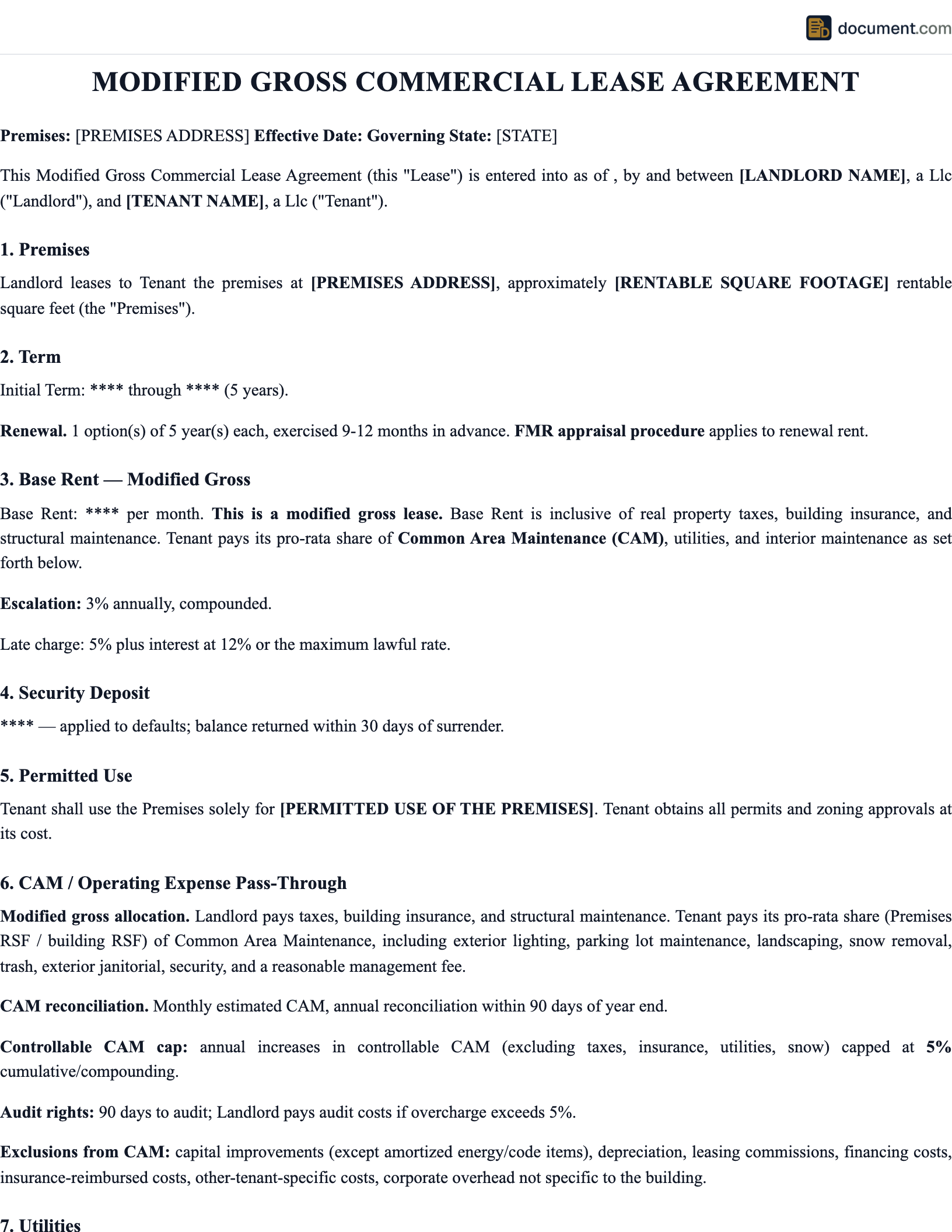
Below is a preview of our West Virginia-specific commercial modified gross lease. Your customized document will include all fields and provisions required under WV law.
COMMERCIAL MODIFIED GROSS LEASE
STATE OF WEST VIRGINIA
WV-Compliant Template
PARTY A:
Name: [Full Legal Name]
Address: [West Virginia Address]
PARTY B:
Name: [Full Legal Name]
Address: [West Virginia Address]
PROPERTY / PREMISES:
Address: [Property Address]
County: [West Virginia County]
WEST VIRGINIA COMPLIANCE
This document complies with West Virginia (WV) state law requirements and includes all provisions mandated for this type of document in West Virginia.