



Washington Commercial Modified Gross Lease Overview
A commercial modified gross lease is a hybrid structure that sits between a full gross lease and a triple-net lease. The landlord absorbs some operating costs in the base rent while the tenant pays certain defined expenses directly. In Washington, this structure is particularly common in suburban office parks, mid-tier multi-tenant buildings, and flex space throughout King, Pierce, and Snohomish counties. It gives tenants a degree of cost predictability while allowing landlords to pass through the most variable expenses.
Washington commercial leases are governed almost entirely by contract law. The state provides minimal statutory protection for commercial tenants, which means the precise language in the lease document controls everything. In the Seattle metropolitan market, where commercial rents and operating costs are among the highest in the country, the expense allocation in a modified gross lease can represent a significant dollar difference over a multi-year term. Tenants should treat the expense schedule as carefully as the base rent itself.
Hybrid
Expense structure
Negotiated
Expense split
Written
Required form
B&O Tax
Tenant obligation
Washington Modified Gross Lease Requirements
Washington commercial leases are contract-governed documents with minimal state statutory intervention. That flexibility is a double-edged situation: parties can structure the expense allocation however they choose, but a poorly drafted expense schedule creates disputes that courts resolve by reading the written language literally. Getting the split exactly right in the lease document matters more in Washington than it might in states with tenant-protective commercial lease statutes.
Washington B&O Tax Note
Washington's Business and Occupation tax is a gross receipts tax on the tenant's business revenue and is entirely separate from any operating expense component in the lease. Landlords should not include their own B&O tax on rental income in any expense pass-through to the tenant. The tenant's B&O obligation is paid directly to the Washington Department of Revenue and should not appear in the modified gross lease expense schedule at all.
Key Modified Gross Lease Provisions
- Expense Schedule: The lease must include a written schedule identifying exactly which costs are in the base rent and which are tenant-paid, rather than relying on vague descriptions
- Utility Metering: Confirm whether each utility is separately metered to the tenant's space or allocated from a master meter, as this affects who bills and how disputes are handled
- HVAC Responsibility: Many Washington modified gross leases assign routine HVAC maintenance to the tenant while keeping major mechanical system replacement with the landlord; the line between the two must be defined
- Base Rent Escalation: Annual increases are common; specify whether the escalation is a fixed percentage, CPI-tied, or market-based, and whether it applies equally to both landlord-borne and tenant-paid expense components
- Maintenance Obligations: Define interior, exterior, structural, and common area maintenance responsibilities with clear boundaries, particularly for multi-tenant buildings in suburban King and Pierce county parks
- Permitted Use and Zoning: Washington requires the permitted use clause to align with local land use regulations; the tenant should verify the space is properly zoned for the intended business prior to signing
How to Draft a Washington Modified Gross Lease
Getting the expense allocation right from the start is the most important step in drafting a Washington modified gross lease. These five steps walk through the process from initial term negotiation to execution.
Agree on the Expense Split Before Drafting
Negotiate the full expense allocation in the letter of intent before involving attorneys. Specify whether taxes, insurance, common area maintenance, utilities, janitorial, and HVAC maintenance are landlord-borne or tenant-paid, and document the result in writing before the lease is drafted
Build a Complete Expense Schedule
Translate the negotiated split into a detailed exhibit or schedule within the lease. Avoid category descriptions that could be read differently by each party; use item-level lists. In Washington flex and suburban office buildings, this schedule is often an exhibit to the base lease form
Verify Utility and HVAC Setup On-Site
Before finalizing the lease, physically confirm whether utilities serving the space are separately metered and whether the HVAC system is dedicated to the tenant or shared. These physical facts affect lease terms and cannot be assumed from the floor plan alone, particularly in older suburban Washington buildings
Have a Washington Attorney Review the Expense Language
Washington courts interpret commercial lease expense language literally. A Washington commercial real estate attorney should confirm that the expense schedule matches the negotiated intent, that landlord B&O tax obligations are excluded from any pass-through, and that escalation provisions apply only to the appropriate cost components
Execute and Set Up Cost Tracking
Both parties sign the lease. Tenants should set up a simple monthly cost tracker from day one, logging base rent, utility bills, janitorial invoices, and any other tenant-paid items so they can verify total occupancy cost against the lease terms throughout the lease term
Washington Market Considerations
Washington has no state income tax, which is a selling point for businesses locating in the state. But the B&O gross receipts tax applies to most business activity, and tenants should factor their B&O liability into total occupancy cost modeling alongside any modified gross lease obligations. Seattle's commercial market also features some of the highest common area maintenance costs in the western United States, driven by Seattle's labor costs and building density, so even a modified gross lease where the landlord covers CAM can represent a significant embedded cost in the base rent.
In the suburban markets of Bellevue, Redmond, Kirkland, and Renton, modified gross leases frequently appear in tech-adjacent office buildings and life sciences flex space. These leases tend to have more negotiable expense splits because suburban landlords compete for tenants more actively than core Seattle landlords. Tenants with strong credit or desirable business profiles can often negotiate to keep more expenses in the base rent rather than bearing them directly.
Washington has no commercial rent tax at the state level. Seattle previously enacted a business head tax, which was repealed, but the regulatory environment for businesses in Seattle continues to evolve. Tenants signing multi-year modified gross leases in Seattle should include provisions that address extraordinary changes in local business taxes or assessments that could materially affect total occupancy costs during the lease term.
Washington Modified Gross Lease Costs
Total occupancy cost under a modified gross lease in Washington includes the base rent plus whatever expenses the tenant pays directly. The table below covers the main cost categories tenants should budget for.
| Cost Item | Typical Range |
|---|---|
| Base Rent (modified gross, Seattle area office) | $30 - $65+ per sq ft per year |
| Utilities (tenant-paid, typical suburban WA flex space) | $2 - $5 per sq ft per year |
| Janitorial Service (tenant-paid) | $1 - $3 per sq ft per year |
| HVAC Maintenance (tenant-paid, routine service) | $500 - $2,500 per year |
| Attorney Review (Washington commercial lease) | $1,500 - $4,000 |
Sample Washington Commercial Modified Gross Lease
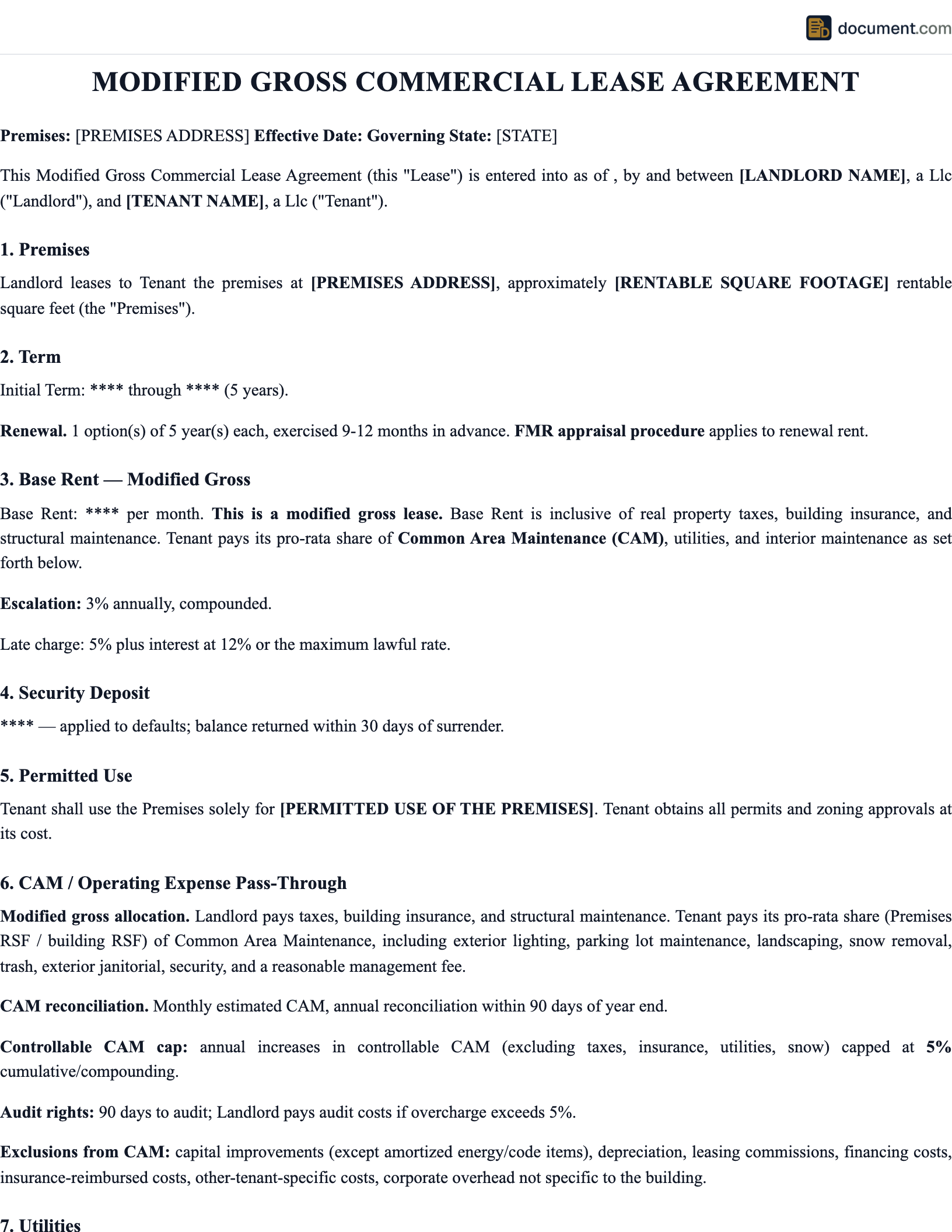
Below is a preview of our Washington-specific commercial modified gross lease. Your customized document will include all fields and provisions required under WA law.
COMMERCIAL MODIFIED GROSS LEASE
STATE OF WASHINGTON
WA-Compliant Template
PARTY A:
Name: [Full Legal Name]
Address: [Washington Address]
PARTY B:
Name: [Full Legal Name]
Address: [Washington Address]
PROPERTY / PREMISES:
Address: [Property Address]
County: [Washington County]
WASHINGTON COMPLIANCE
This document complies with Washington (WA) state law requirements and includes all provisions mandated for this type of document in Washington.