



Virginia Commercial Modified Gross Lease Overview
A modified gross lease sits between a full gross lease and a triple-net lease in terms of how operating costs are allocated. In Virginia, these leases are common in suburban office parks, flex buildings, and mid-tier commercial space where landlords want some predictability in their operating costs and tenants want to directly control at least some expense categories. Virginia contract law governs, so the expense split is whatever the parties agree to in writing.
Virginia's modified gross lease market reflects the diversity of the state's commercial submarkets. In Northern Virginia, modified gross leases often appear in flex and mid-tier office properties where institutional landlords use them as an intermediate option between NNN and full gross structures. In Richmond and Hampton Roads, modified gross leases are negotiated with more landlord flexibility, and tenants often have more room to shape the expense split. The common thread across all Virginia markets is that the lease language, not the label, determines what you actually pay.
Hybrid
Expense structure
Negotiated
Expense split
Written
Required form
Contract
Law governs
Virginia Modified Gross Lease Requirements
Because Virginia commercial leases are governed entirely by contract, a modified gross lease in Virginia needs to be drafted with enough detail that both parties know exactly what the expense split looks like from day one. The lease should explicitly list each operating cost category and assign it to either the landlord or tenant. Vague references to a "modified gross" structure without defining the terms create ambiguity that Virginia courts will resolve based on the actual contract language.
Virginia Specific Note
Virginia's city and county separation affects how property taxes and local permits are handled in commercial leases. Confirm whether the property is in an independent city or a county before drafting the lease, because zoning, business license requirements, and tax rates differ between jurisdictions even within the same metro area. This is particularly relevant in the Northern Virginia market where properties in Fairfax County, the City of Fairfax, and the City of Falls Church are physically adjacent but legally distinct.
Key Modified Gross Lease Provisions for Virginia
- Expense Schedule: A clear schedule identifying each operating cost category and the party responsible for it, rather than relying on the modified gross label alone
- Utility Metering: Confirm whether utilities are separately metered for the tenant's space; in some Virginia commercial buildings, utility costs are sub-metered and billed back through a landlord reconciliation process
- HVAC Responsibility: Specify whether the landlord or tenant handles HVAC maintenance contracts and replacement; this is a frequently disputed item in Virginia flex and office modified gross leases
- Base Rent Escalation: Define how annual base rent increases are calculated, whether as a fixed percentage or tied to CPI, and confirm the measurement period
- Maintenance Obligations: Define the boundary between tenant maintenance obligations for interior systems and landlord obligations for building envelope, roof, and structural components
- Permitted Use and Zoning: Confirm the intended use is permitted under Virginia local zoning and that the lease's permitted use clause matches the actual business activity
How to Draft a Virginia Modified Gross Lease
Drafting a Virginia modified gross lease correctly starts with agreeing on the expense split before putting anything in writing. Once both parties know which costs stay with the landlord and which are the tenant's responsibility, the lease document can be built around that framework clearly and without ambiguity.
Agree on the Expense Split Before Drafting
Reach a clear understanding with the other party on which specific costs each side will bear. Common Virginia structures include landlord covering taxes, insurance, and roof while the tenant pays utilities and janitorial, but the exact split is always negotiated.
Build an Expense Schedule Into the Lease
Document every operating cost category in an explicit expense schedule or exhibit. This prevents disputes over ambiguous categories like HVAC maintenance, parking lot repairs, or signage costs that often arise mid-lease when the building requires attention.
Verify Utility Metering and HVAC Setup
Before finalizing the lease, confirm how utilities are metered for the space and whether the HVAC system serves only the tenant's premises or is a shared building system. This affects how utility and HVAC responsibilities should be written.
Have Virginia Counsel Review the Document
A Virginia commercial real estate attorney can review the expense split language, escalation provisions, and maintenance obligations to ensure they reflect what the parties agreed to and that no gaps exist that could create disputes later.
Execute the Lease and Retain Fully Executed Copies
Both parties sign the final lease, each keeping a fully executed original. Virginia does not require notarization for the lease to be enforceable between parties, but some lenders and institutional landlords require it for their internal processes.
Virginia-Specific Considerations
Virginia commercial modified gross leases need to account for the state's unique city-county tax structure. A property in an independent city like Alexandria or Roanoke is taxed at city rates, while a property in a county like Fairfax or Loudoun is taxed at county rates. If the landlord is covering property taxes in the modified gross base rent, both parties should understand which jurisdiction's rates apply and how reassessments could affect that cost over the lease term.
Virginia does not impose a statewide commercial rent tax, which simplifies the expense picture compared to some other states. Business license taxes, however, are imposed by Virginia localities and apply to tenants based on their gross receipts, not on the rent itself. Tenants in Virginia commercial modified gross leases should budget for local business license taxes separately from their lease obligations.
In Northern Virginia markets where federal government and contractor tenants are common, assignment and subletting provisions in modified gross leases deserve extra attention. Landlords in that market often restrict assignment without consent, but contractor tenants may need flexibility to accommodate changes in their government contract relationships. Negotiating clear assignment rights at the outset is worthwhile if the tenant's business depends on government contracting activity.
Virginia Modified Gross Lease Fees & Costs
Below are the typical costs involved in entering into a Virginia commercial modified gross lease, including both upfront transaction costs and the ongoing expense categories tenants pay directly.
| Fee / Cost | Typical Amount |
|---|---|
| Base Rent (Modified Gross) | Negotiated per sq ft annually; reflects landlord cost absorption plus margin; typically lower than full gross for equivalent space |
| Utilities (Tenant-Paid) | Variable by usage; electric, gas, and water are commonly the tenant's direct responsibility in Virginia modified gross leases |
| Janitorial Service (Tenant-Paid) | $1.00 to $2.50 per sq ft annually depending on service frequency and building location |
| HVAC Maintenance (if tenant's responsibility) | $0.50 to $1.50 per sq ft annually for service contracts; varies by system age and building type |
| Attorney Review (recommended) | $750 to $3,500 for Virginia modified gross lease review; worth the cost to confirm expense split language is accurate |
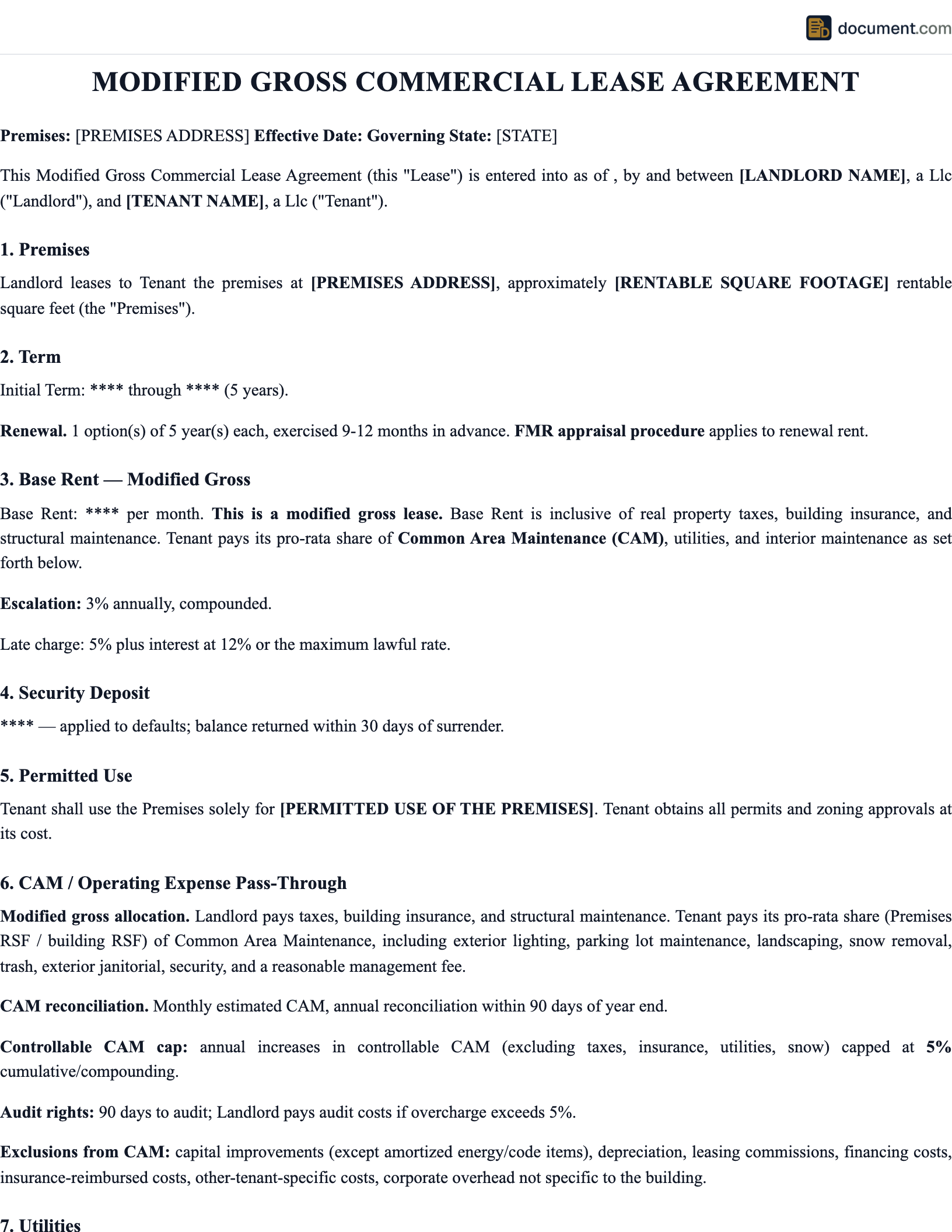
Sample Virginia Commercial Modified Gross Lease
Below is a preview of our Virginia-specific commercial modified gross lease. Your customized document will include all fields and provisions required under VA law.
COMMERCIAL MODIFIED GROSS LEASE
STATE OF VIRGINIA
VA-Compliant Template
PARTY A:
Name: [Full Legal Name]
Address: [Virginia Address]
PARTY B:
Name: [Full Legal Name]
Address: [Virginia Address]
PROPERTY / PREMISES:
Address: [Property Address]
County: [Virginia County]
VIRGINIA COMPLIANCE
This document complies with Virginia (VA) state law requirements and includes all provisions mandated for this type of document in Virginia.