



Vermont Commercial Modified Gross Lease Overview
A modified gross lease is the most common structure for office and flex-space tenants in Burlington, South Burlington, and the wider Chittenden County market. Unlike a triple-net lease, where tenants take on property taxes, building insurance, and full CAM charges, or a full gross lease, where the landlord absorbs nearly all operating costs, the modified gross structure divides expenses along a negotiated boundary. In Vermont, that boundary typically places building-level costs such as real property taxes and building insurance on the landlord, while tenants pay utilities, janitorial services, and interior maintenance costs.
Vermont commercial leases are governed by contract law. No statewide statute imposes specific terms on commercial landlords or tenants beyond the statute of frauds requirement that leases exceeding one year be in writing. Vermont does not impose a commercial rent tax, which simplifies cost modeling for tenants. However, the state's dual property tax structure, combining municipal and statewide education property taxes, means landlords bear a tax burden that can shift within a lease term. Tenants negotiating a modified gross structure should understand which expenses the landlord retains and how Vermont's property tax variability might affect the landlord's operating costs over time.
None
State rent tax
High
Property tax burden
Contract
Governing law
Burlington
Primary office market
Vermont Legal Requirements
Vermont imposes no special statutory structure on commercial modified gross leases. The agreement is enforceable based on contract principles, and the expense allocation framework you negotiate governs the relationship. That said, certain provisions are essential to a well-functioning modified gross lease in Vermont's market.
Vermont HVAC and Heating Cost Risk
Vermont winters are long and demanding. If the tenant is responsible for HVAC maintenance or utility costs, the lease must clearly define which systems fall under tenant responsibility and where landlord obligations begin. Burlington and Montpelier's older commercial building stock often has shared or centralized systems that complicate individual suite allocations. Confirm metering and system ownership before signing.
Key Provisions for Vermont Modified Gross Leases
- Expense Schedule: List every operating cost category and designate it clearly as landlord-paid or tenant-paid, with no ambiguous middle ground
- Utility Metering: Confirm whether the suite has a dedicated electric and gas meter; if not, specify an allocation method acceptable to both parties and in line with Burlington utility rates
- HVAC Responsibility Boundary: Define routine maintenance versus capital replacement obligations, with a dollar threshold above which costs shift to the landlord; Vermont winters make this provision material
- Expense Escalation: Include an annual cap on increases in tenant-paid operating costs, tied to a recognized index or a fixed percentage, to protect against utility or service cost spikes
- Capital vs. Operating Distinction: Separate capital expenditures, such as roof replacement or major system overhauls, from operating expenses that may appear in any year-end reconciliation; Vermont's older building inventory makes this distinction more likely to arise
How to Draft a Commercial Modified Gross Lease in Vermont
Drafting a Vermont modified gross lease requires careful attention to the expense allocation boundary, utility metering conditions, and the HVAC provisions that matter most in Vermont's climate. These steps reflect the key decision points for Burlington and Chittenden County office transactions.
Map Expenses and Confirm Utility Metering
Request a full list of building operating expenses from the landlord and confirm whether the suite has a dedicated electric and gas meter. Burlington's older downtown buildings frequently share utility systems, making allocation methodology a threshold issue before lease terms are set.
Negotiate the HVAC Boundary and Escalation Caps
Define which HVAC components the tenant maintains versus which the landlord owns. Set a dollar threshold above which HVAC costs become landlord obligations. Negotiate an annual escalation cap on tenant-paid operating expenses, referencing the Boston-Cambridge CPI index or a fixed percentage, to limit exposure over the lease term.
Define Capital Expenses and Secure Audit Rights
Include a clear definition of capital expenditures that distinguishes them from routine operating costs. Negotiate audit rights that allow the tenant to inspect landlord records for any year-end reconciliation of shared or building-wide expenses, with a reimbursement provision if the audit reveals material overcharges.
Execute the Lease
Vermont does not require notarization between the parties for a commercial lease to be enforceable, but notarization is necessary if the lease will be recorded at the town land records office. Have authorized representatives of both parties sign. Distribute fully executed copies to all parties and any lenders who require a copy.
Set Up Expense Tracking and Payment Systems
Establish separate accounts or ledger categories for tenant-paid operating costs versus base rent. Vermont utility bills can spike sharply in winter, so tracking monthly costs against the budgeted escalation cap gives early warning of disputes before year-end reconciliation. Maintain records of all invoices for any audit proceeding.
Vermont Fees and Costs
Modified gross lease costs in Vermont reflect the split-expense structure. Base rent is fixed, while tenant-paid operating costs vary by season and building efficiency. Vermont does not impose a commercial rent tax, which keeps ongoing costs simpler than in some other states.
| Cost Item | Typical Amount or Note |
|---|---|
| Base Rent (Modified Gross) | Fixed monthly payment covering landlord-retained expenses; Burlington Class B office space typically ranges from $18 to $28 per square foot annually |
| Tenant-Paid Utilities | Electricity and heating costs paid directly to Green Mountain Power or Vermont Gas; Vermont winters can push heating costs significantly higher than in warmer states |
| State Commercial Rent Tax | None; Vermont does not impose a tax on commercial rent payments |
| Vermont Income Tax on Rent | Landlords pay Vermont income tax on net rental income; tenants may deduct rent as a business expense; no separate rental levy |
| Notarization (if recording) | $5 to $25 per signature; required only if recording at Vermont town land records office |
| Attorney Review | $500 to $1,500 typical for Vermont commercial lease review; recommended given the negotiated nature of modified gross expense allocations |
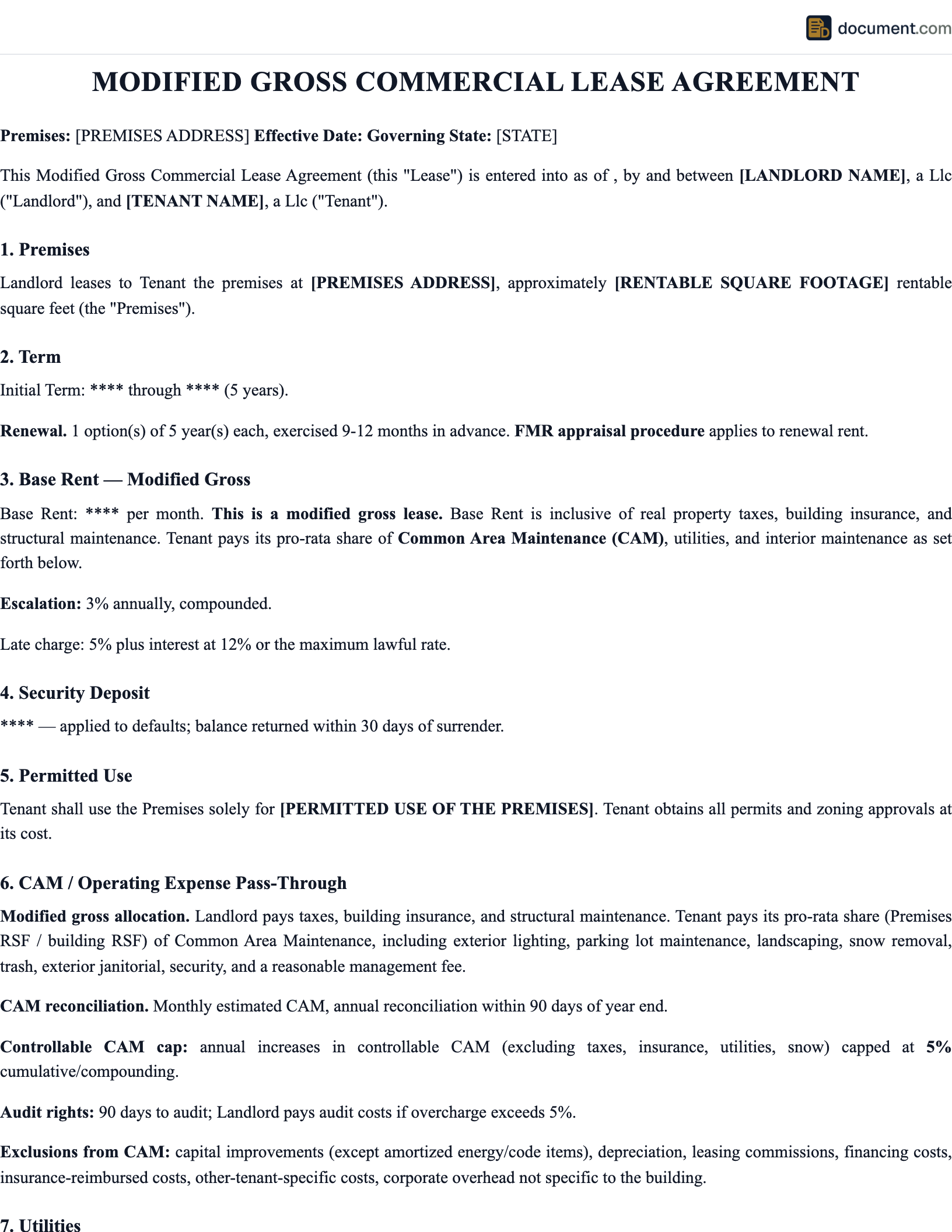
Sample Vermont Commercial Modified Gross Lease
Below is a preview of our Vermont-specific commercial modified gross lease. Your customized document will include all fields and provisions required under VT law.
COMMERCIAL MODIFIED GROSS LEASE
STATE OF VERMONT
VT-Compliant Template
PARTY A:
Name: [Full Legal Name]
Address: [Vermont Address]
PARTY B:
Name: [Full Legal Name]
Address: [Vermont Address]
PROPERTY / PREMISES:
Address: [Property Address]
County: [Vermont County]
VERMONT COMPLIANCE
This document complies with Vermont (VT) state law requirements and includes all provisions mandated for this type of document in Vermont.