
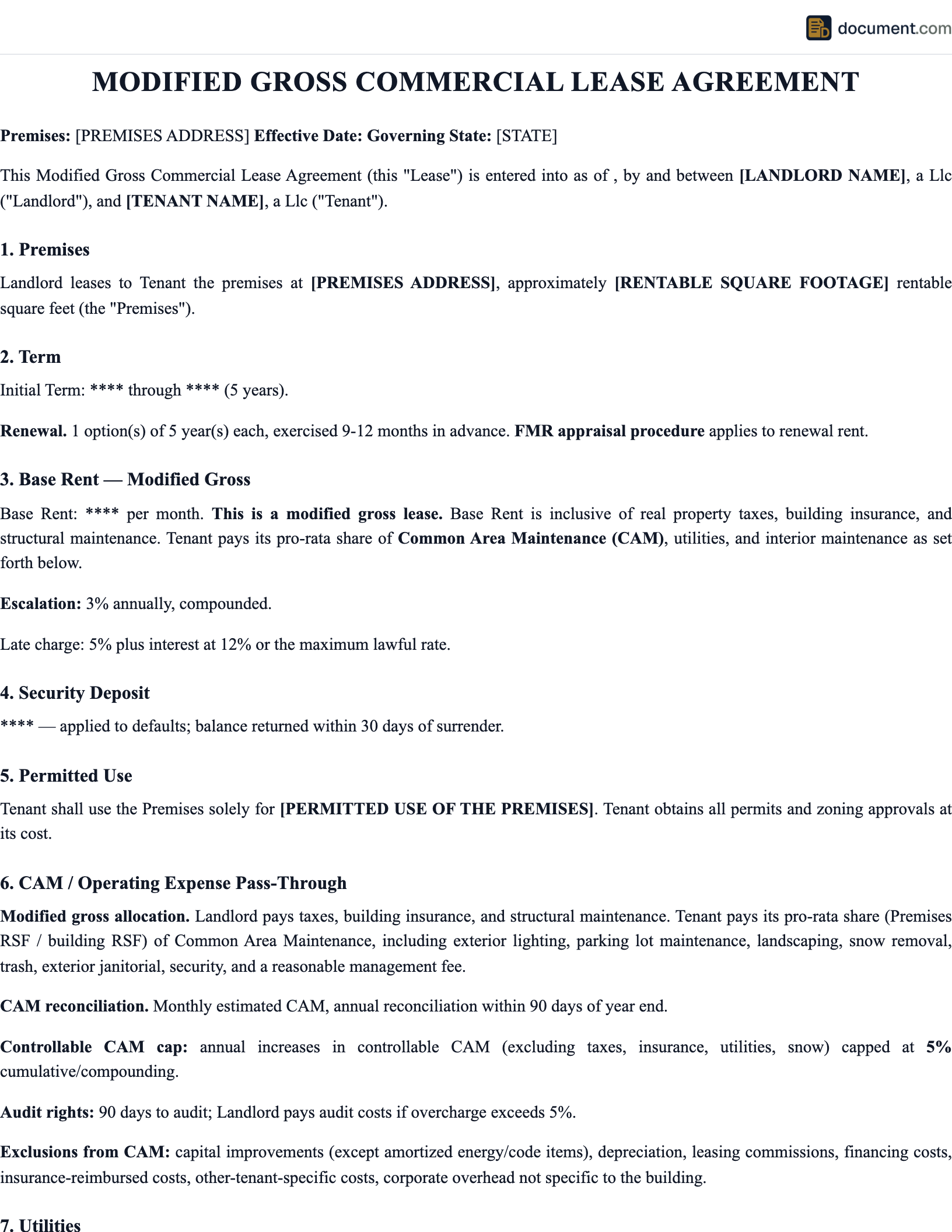



Utah Commercial Modified Gross Lease Overview
The modified gross lease has become a practical middle-ground option in Utah's office and mixed-use commercial markets, particularly in Salt Lake City, Provo, and the Ogden corridor. Under this structure, the landlord covers a defined set of building operating expenses while the tenant takes responsibility for a negotiated subset, most often utilities, janitorial service, and sometimes HVAC maintenance. The split gives tenants more cost visibility than a triple-net lease without the full expense absorption of a pure gross arrangement.
Utah does not impose a commercial rent tax or state income tax surcharge on lease payments. Both parties pay Utah's flat income tax rate on their business profits, and the lease structure itself does not trigger any separate Utah tax at the transaction level. Because Utah governs commercial leases through general contract law rather than a dedicated landlord-tenant statute, every expense allocation must be spelled out clearly. Ambiguities about who pays for HVAC repairs or building security are resolved by Utah courts using general contract interpretation principles, which rarely produce the result either side intended.
None
State income tax
None
State rent tax
Contract
Governing law
High
Property tax state
Utah Legal Requirements
A Utah modified gross lease must clearly define which party bears each operating expense category. Because Utah contract law governs commercial leases without a separate landlord-tenant statute offering default rules, any expense not explicitly assigned in the lease will be interpreted by a Utah court using general contract principles, which often leads to results neither party intended. The following provisions are essential for a well-drafted Utah modified gross lease.
Utah HVAC and Utility Allocation Risk
HVAC costs in Utah office buildings can be a significant expense during summer months when temperatures in the Salt Lake Valley and Provo metro regularly exceed 95 degrees Fahrenheit. In buildings without individual utility submeters, electric and cooling costs are often allocated by square footage rather than actual consumption. Tenants should confirm the allocation method in writing and, where possible, negotiate for a cap on utility escalations to avoid unexpected mid-year charges.
Key Expense Provisions
- Expense Schedule: Include a detailed written schedule identifying every operating expense category and whether the landlord or tenant is responsible; generic language about "typical modified gross" is not sufficient in Utah
- Utility Metering: Confirm whether individual utility submeters exist or whether tenant charges will be based on a pro-rata allocation; specify the allocation formula if submeters are not present
- HVAC Responsibility Boundary: Specify whether the tenant maintains and replaces HVAC filters only, or whether tenant responsibility extends to unit repairs or full HVAC system replacement costs
- Expense Escalation: Include a cap or formula for annual increases in tenant-paid operating expense allocations so tenants have budget certainty for multi-year lease terms
- Capital vs. Operating Expense Distinction: Define whether capital items such as roof repairs or parking lot resurfacing can be amortized over time and billed to tenants or whether they are fully the landlord's responsibility
How to Draft a Utah Modified Gross Lease
Drafting a modified gross lease in Utah starts with mapping every expense category and assigning it clearly. The structure rewards upfront negotiation and punishes vague language.
Map All Expenses and Confirm Utility Metering
Before drafting, walk through the building with the landlord and identify every operating expense category. Confirm whether the building has individual utility submeters for each tenant space. Salt Lake City and Provo office buildings vary widely in how utilities are measured, and the allocation method must be stated in the lease.
Negotiate HVAC Responsibility and Escalation Caps
HVAC is the most commonly disputed expense in Utah modified gross leases because of summer cooling demands in the Salt Lake Valley. Establish clearly whether the tenant pays for routine maintenance only or whether it bears repair and replacement costs. Negotiate a cap on annual escalations for tenant-paid operating expenses to limit budget uncertainty over a multi-year lease term.
Define Capital Expense Treatment and Audit Rights
Specify whether the landlord can amortize capital expenditures and bill the tenant for a pro-rata share. Add an explicit audit right with a 60-day window after receiving any annual expense reconciliation, and confirm that landlord-estimated monthly charges will be reconciled against actual costs each year.
Execute with Authorized Signatories
Both parties must sign through authorized representatives. Utah commercial leases do not require notarization between the parties unless the lease will be recorded with the county recorder. Distribute fully executed copies to all parties and retain in accessible storage for the full lease term plus any applicable statute of limitations period.
Set Up Expense Payment Tracking
Create a payment schedule for all tenant-paid operating expenses and confirm which are paid directly to service providers versus reimbursed to the landlord. Track escalation dates and any annual reconciliation deadlines to avoid inadvertently waiving dispute rights under the lease's notice provisions.
Utah Modified Gross Lease Costs
The cost profile of a Utah modified gross lease combines a fixed monthly base rent with tenant-paid operating expenses. Understanding what each side typically pays helps both parties build accurate budgets before executing the lease.
| Fee / Cost | Typical Amount |
|---|---|
| Base Rent (modified gross) | Covers landlord-side expenses; varies by Wasatch Front submarket and building class |
| Tenant-Paid Utilities | Variable; Utah summer electricity costs can be significant due to air conditioning demand in the Salt Lake Valley |
| Utah State Income Tax on Business Income | Flat rate applies to business profits; no separate state tax on rent payments or lease structures |
| Notarization (if lease recorded) | $5 - $25 per signature; required only if parties elect to record the lease with the Utah county recorder |
| Attorney Review (recommended) | $400 - $1,000; Salt Lake City commercial attorneys frequently offer flat-fee review for standard office modified gross leases |
Sample Utah Commercial Modified Gross Lease
Below is a preview of our Utah-specific commercial modified gross lease. Your customized document will include all fields and provisions required under UT law.
COMMERCIAL MODIFIED GROSS LEASE
STATE OF UTAH
UT-Compliant Template
PARTY A:
Name: [Full Legal Name]
Address: [Utah Address]
PARTY B:
Name: [Full Legal Name]
Address: [Utah Address]
PROPERTY / PREMISES:
Address: [Property Address]
County: [Utah County]
UTAH COMPLIANCE
This document complies with Utah (UT) state law requirements and includes all provisions mandated for this type of document in Utah.
Official Utah Resources
These Utah government resources cover property tax information, business registration, and commercial building code requirements relevant to modified gross lease parties.
Utah State Tax Commission - Property Tax
Commercial property assessment and tax rates by county
Utah Property Rights Ombudsman
Dispute resolution assistance for Utah property matters
Utah Division of Corporations
Entity registration and good standing verification for lease parties
Utah Building Energy Codes
State energy and building code standards affecting commercial spaces