



Texas Commercial Modified Gross Lease Overview
A modified gross lease is a hybrid commercial lease structure where the landlord and tenant each take responsibility for specific expense categories rather than one side absorbing everything. Texas has no statutory definition of modified gross lease, so the exact allocation of costs must be spelled out in the agreement. In Dallas, Houston, Austin, and San Antonio, modified gross structures are common for mid-sized professional office tenants who want a predictable base rent but are willing to take on some operating costs, typically utilities and janitorial services, in exchange for a lower all-in rate.
Texas's commercial real estate market is driven by strong corporate migration patterns and a no-income-tax environment that attracts businesses from higher-tax states. The Dallas-Fort Worth office corridor and Houston's energy sector have historically set the tone for Texas commercial lease structures, with modified gross becoming more common as tenants demand expense transparency after experiencing sharp property tax increases through NNN pass-throughs. Austin's technology-driven office market has seen particularly rapid rent and expense escalation, making the allocation of costs in modified gross leases a financially significant negotiation.
None
State income tax
None
State rent tax
Contract
Law governs
High
Property tax state
Texas Legal Requirements
Texas modified gross leases are governed entirely by contract. There is no Texas statute defining the structure or required provisions. The expense schedule must be spelled out explicitly in the lease, because the term "modified gross" means different things to different landlords in Texas.
Get the Expense Schedule in Writing
Never rely on the label "modified gross" to define what costs the tenant is taking on. In Texas, the specific expense allocation differs from building to building and market to market. Confirm in the written lease which expenses the tenant pays directly, which the landlord pays and absorbs in the base rent, and whether any landlord-paid expenses can be passed through as escalations. This is especially important for HVAC maintenance in Texas given the state's extreme summer heat and the cost of commercial HVAC replacement.
Key Expense Allocation Provisions
- Expense Schedule: Create a clear written schedule listing each expense category, whether it is tenant-paid directly or landlord-paid and absorbed in base rent, and how shared costs are allocated among multiple tenants
- Utility Metering: Confirm whether utilities are directly metered to the tenant from the Texas utility provider or submetered through the landlord; confirm the metering methodology and reconciliation process for older Dallas or Houston buildings without individual meters
- HVAC Responsibility: State clearly whether the tenant or landlord handles HVAC maintenance and replacement; for Texas buildings with dedicated rooftop units serving individual suites, replacement costs can reach tens of thousands of dollars per unit
- Expense Escalation: If the landlord retains property taxes, insurance, or CAM but can pass through increases above a base year, define the base year, what is included in the calculation, and whether the tenant can audit the landlord's figures
- Capital vs Operating: Exclude capital improvements from any expense escalation provision or require amortization over the useful life; given Texas property tax-driven asset improvements, this distinction is financially significant
How to Draft a Commercial Modified Gross Lease in Texas
Drafting a Texas modified gross lease requires working through the expense schedule with specificity. The steps below reflect the process from initial review through execution.
Map Expenses and Confirm Utility Metering
Before drafting, build a complete list of all building operating expenses and determine how each is allocated. Confirm whether the Texas property has individual utility meters or submeters for each tenant. In older Dallas or Houston office buildings, utility allocation can be based on square footage rather than actual consumption. Understand the metering setup before agreeing to any utility payment obligation.
Negotiate HVAC and Maintenance Boundaries
Confirm HVAC responsibility in writing. For Texas buildings with rooftop units, define which party handles preventive maintenance, repair, and replacement. If the tenant is responsible, negotiate a maintenance contract and a landlord contribution or replacement reserve for systems over a certain age. Texas's extreme summer heat places more demand on commercial HVAC than in most other states, making this provision more financially significant than tenants typically expect.
Set Escalation Provisions and Audit Rights
If the landlord retains property taxes, insurance, or CAM but can escalate those costs to the tenant in future years, define the base year, the escalation mechanism, and the tenant's audit rights. For Austin or San Antonio office leases where property tax increases have been substantial, negotiate a cap on year-over-year escalation of controllable costs. Confirm that capital expenditures are excluded or amortized rather than included as operating expenses in the escalation calculation.
Execute the Lease
Both parties sign the finalized lease. Texas commercial leases do not require notarization to be enforceable between the parties, but notarization is needed if the lease is recorded. If the lease is based on a Texas Association of Realtors form, have a Texas attorney confirm the expense schedule additions are properly integrated into the TAR form before signing. Distribute executed originals to all parties.
Set Up Payment and Escalation Tracking
Establish separate tracking for each expense category the tenant pays directly. In Texas, electricity and gas costs can vary significantly by season, with summer electricity costs running substantially higher than other months. If the lease includes a landlord-administered expense escalation, track the annual reconciliation dates and exercise audit rights within the contractual window if the landlord's calculations do not match available records.
Texas Modified Gross Lease Fees & Costs
A Texas modified gross lease has two cost streams: the base rent and the tenant-paid expenses defined in the lease. The table below covers both ongoing costs and transaction costs at signing.
| Fee / Cost | Amount |
|---|---|
| Base Rent (Modified Gross) | Fixed monthly rate covering the landlord-retained expenses; typically lower than a full gross lease for the same space |
| Tenant-Paid Utilities | Electricity and gas paid directly by tenant; Texas summer electricity costs for commercial spaces can be significant given the state's extreme heat and high commercial power rates |
| State Income or Rent Tax | None; Texas has no state income tax and no commercial rent tax |
| Notarization (if recorded) | $5 to $25 per signature; required if the lease or memorandum of lease is recorded with the Texas county clerk |
| Attorney Review | $500 to $1,500; recommended for Texas modified gross leases exceeding 3 years to ensure the expense schedule is clearly defined and the TAR form's landlord-favorable defaults are addressed |
Sample Texas Commercial Modified Gross Lease
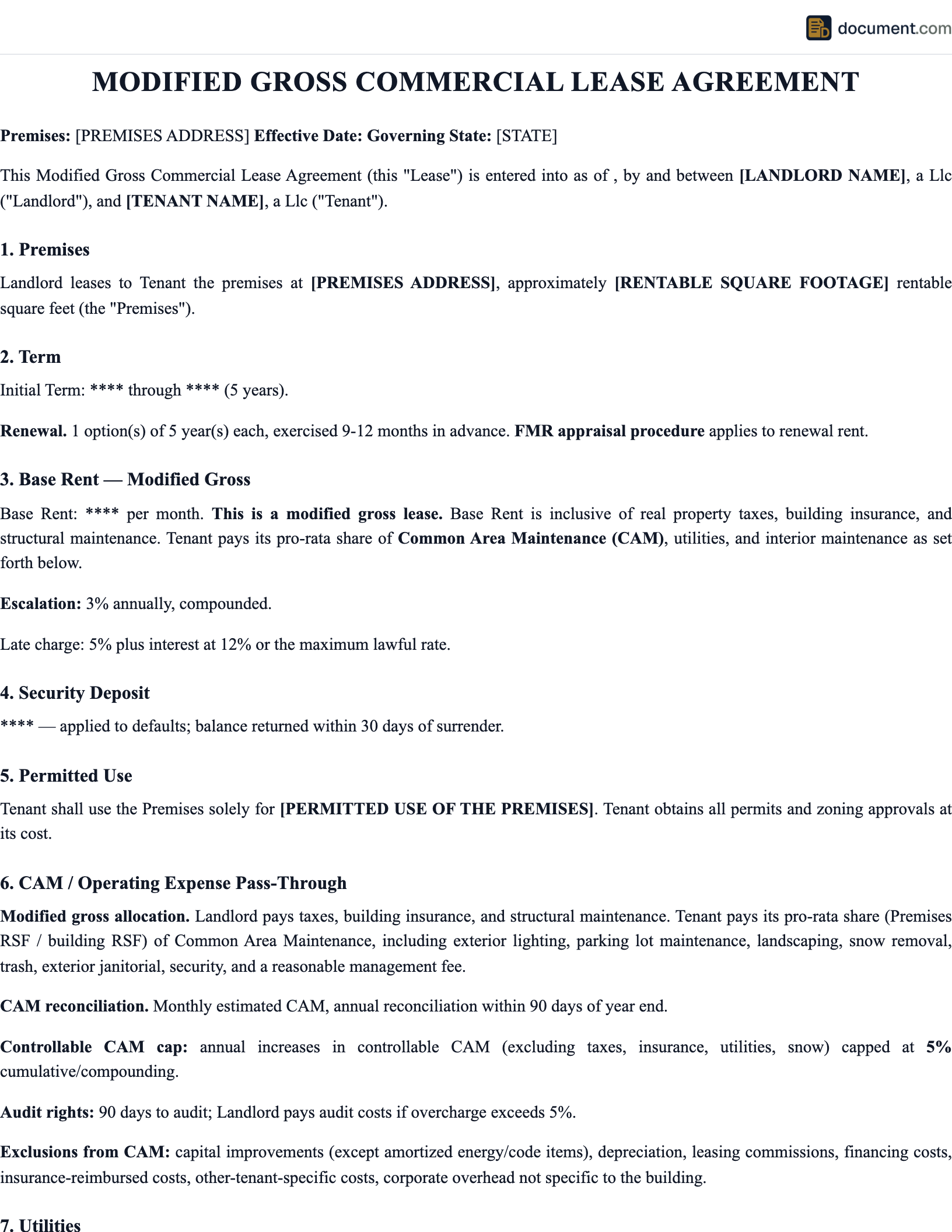
Below is a preview of our Texas-specific commercial modified gross lease. Your customized document will include all fields and provisions required under TX law.
COMMERCIAL MODIFIED GROSS LEASE
STATE OF TEXAS
TX-Compliant Template
PARTY A:
Name: [Full Legal Name]
Address: [Texas Address]
PARTY B:
Name: [Full Legal Name]
Address: [Texas Address]
PROPERTY / PREMISES:
Address: [Property Address]
County: [Texas County]
TEXAS COMPLIANCE
This document complies with Texas (TX) state law requirements and includes all provisions mandated for this type of document in Texas.