



South Carolina Commercial Modified Gross Lease Overview
A modified gross lease in South Carolina divides operating expense responsibility between the landlord and tenant according to a negotiated schedule, splitting the difference between the fixed simplicity of a full gross lease and the full expense exposure of a triple net arrangement. The landlord covers a defined set of operating costs while the tenant pays base rent plus a specified list of expenses. This structure gives tenants some cost predictability while giving landlords protection against expense categories that are genuinely tenant-driven.
Modified gross leases are common across South Carolina's suburban office markets, including the Irmo and Northeast Columbia corridors near Fort Jackson, the Mount Pleasant professional center north of Charleston, and the Woodruff Road and Verdae Boulevard corridors in Greenville. These markets attract regional businesses, healthcare-adjacent tenants, and professional service firms that find modified gross structures more manageable than full NNN leases. South Carolina imposes no commercial rent tax, so the cost components under a modified gross lease are limited to base rent, identified pass-through expenses, and tenant-paid utilities without a rental tax overlay.
SC
State-specific
Varies
Filing fees
Written
Required format
Contract
Law governs
South Carolina Modified Gross Lease Requirements
A South Carolina modified gross lease derives its value from the precision of the expense-sharing framework. Vague allocations produce the same confusion they were designed to prevent. The following requirements address the key structural elements that should be addressed before the lease is finalized.
South Carolina Expense Schedule Requirement
The expense-sharing schedule is the most important document in any South Carolina modified gross lease. It should list every operating expense by category, identify whether it is landlord-paid or tenant-paid, set the base year amount or stop threshold for any expense subject to pass-through of increases, and define the reconciliation process. Request 3 to 5 years of actual expense statements for the property before agreeing to the schedule so you can evaluate whether the base year figures are representative.
Key Provisions to Address
- Written Expense Schedule: Attach a schedule that identifies every expense category, responsible party, and cost-sharing formula. Under S.C. Code Ann. § 27-5-10, commercial leases exceeding one year must be in writing, and the expense schedule must be part of that written agreement.
- Base Year or Expense Stop: If the tenant pays increases above a base year amount, set the base year explicitly and confirm whether a gross-up applies for periods when the building was less than fully occupied. South Carolina county property tax reassessment cycles can produce significant step-ups in the tax line that tenant pass-through provisions should address.
- Base Rent Escalation: Define the base rent escalation rate for each year of the lease. Fixed-percentage annual bumps of 2% to 3% are standard in South Carolina office markets. If CPI is used, agree on the specific index, measurement dates, and any cap on annual escalation.
- Utility Responsibility: Confirm whether the tenant pays suite electricity directly to the utility or reimburses the landlord. South Carolina summers put substantial load on HVAC systems, and electricity cost exposure during summer months can be significant for tenants in spaces with high cooling demands.
- SNDA Protections: For modified gross leases of three or more years, tenants should request a subordination, non-disturbance, and attornment agreement from the landlord's lender. An SNDA protects the tenant's right to remain in occupancy if the landlord defaults on its financing.
How to Draft a South Carolina Modified Gross Lease
Drafting a South Carolina modified gross lease requires careful work on the expense-sharing framework before the parties finalize any other terms. The following steps walk through the process from initial due diligence to execution and recording.
Agree on the Expense Framework
Before drafting anything, the landlord and tenant should agree on the high-level division of expenses. Which costs will be landlord-paid from the base rent? Which will the tenant pay directly or reimburse? Which will be subject to a base year pass-through? Agreeing on these categories first prevents misunderstandings during formal drafting.
Draft the Detailed Expense Schedule
Request 3 to 5 years of actual operating expense statements for the property including property tax bills, insurance invoices, and CAM reconciliation records. Use these to draft a specific expense schedule. For South Carolina properties, confirm whether the county has recently reassessed the parcel or is approaching a scheduled reassessment that could push the property tax line higher. Greenville County and Charleston County are among the most active markets for reassessment activity.
Set Escalation Terms and Expense Caps
Agree on the base rent escalation structure and, for each pass-through expense, set a cap or notification requirement that limits exposure to unpredictable increases. For coastal South Carolina properties in Charleston or Hilton Head where insurance premiums can spike after storm seasons, negotiating an annual cap on insurance cost increases is a common and reasonable tenant ask. South Carolina imposes no commercial rent tax so the escalation analysis can focus purely on base rent and pass-through amounts.
Execute the Lease Agreement
Both parties execute the modified gross lease with the expense schedule attached. South Carolina commercial leases exceeding one year must be in writing under S.C. Code Ann. § 27-5-10. Confirm that authorized signatories are identified with proper entity authority documentation, particularly when either party is an LLC, corporation, or partnership. Retain executed originals for each party.
Record a Memorandum of Lease (Optional)
For leases of three or more years, recording a memorandum of lease at the Register of Deeds office in the applicable South Carolina county provides constructive notice and protects the tenant's leasehold interest against future purchasers and lenders. South Carolina has 46 counties with separate recording offices. The memorandum should identify the parties, property, and lease term without disclosing confidential financial terms.
South Carolina Modified Gross Lease Key Provisions
South Carolina's commercial lease market is governed by contract law rather than a detailed statutory framework. The provisions the parties negotiate and put in writing are the rules that govern their relationship for the entire lease term. Several provisions deserve particular attention in any South Carolina modified gross lease.
South Carolina does not impose a commercial rent tax. This simplifies cost projections because base rent increases and pass-through escalations are not subject to a tax layer that compounds cost growth. Tenants budgeting for a multi-year modified gross lease in Columbia, Charleston, or Greenville can focus on the base rent schedule and negotiated expense pass-throughs without modeling a rent tax component.
For modified gross leases of five or more years, both parties should address subordination and non-disturbance protections. An SNDA agreement with the landlord's lender ensures that if the landlord defaults on its mortgage, the lender steps into the landlord's position rather than terminating the lease. Tenants investing in tenant improvements under a South Carolina modified gross lease should make SNDA protection a condition of finalizing the lease. This protection is standard practice in Charleston and Columbia commercial transactions involving institutional landlords.
South Carolina Modified Gross Lease Costs
Typical costs for a South Carolina commercial modified gross lease. Actual pass-through exposure depends on the negotiated expense schedule and the specific market where the property is located.
| Cost Item | Typical Amount |
|---|---|
| Base Modified Gross Rent | Fixed monthly rent covering landlord-paid operating expenses; varies by market, location, and lease term |
| Tenant Utilities | Suite electricity and data paid directly by tenant; electricity costs in South Carolina summers are meaningful for tenants with high cooling loads |
| Expense Stop Pass-Through | If applicable, tenant pays increases above the base year or stop amount; sensitive to property tax reassessment in active South Carolina counties |
| County Register of Deeds Recording Fee | Varies by county; typically $10 to $25 for a memorandum of lease; optional but protective for leases of 3 or more years |
| Attorney Review | $400 to $900 for a South Carolina commercial modified gross lease review including expense schedule analysis |
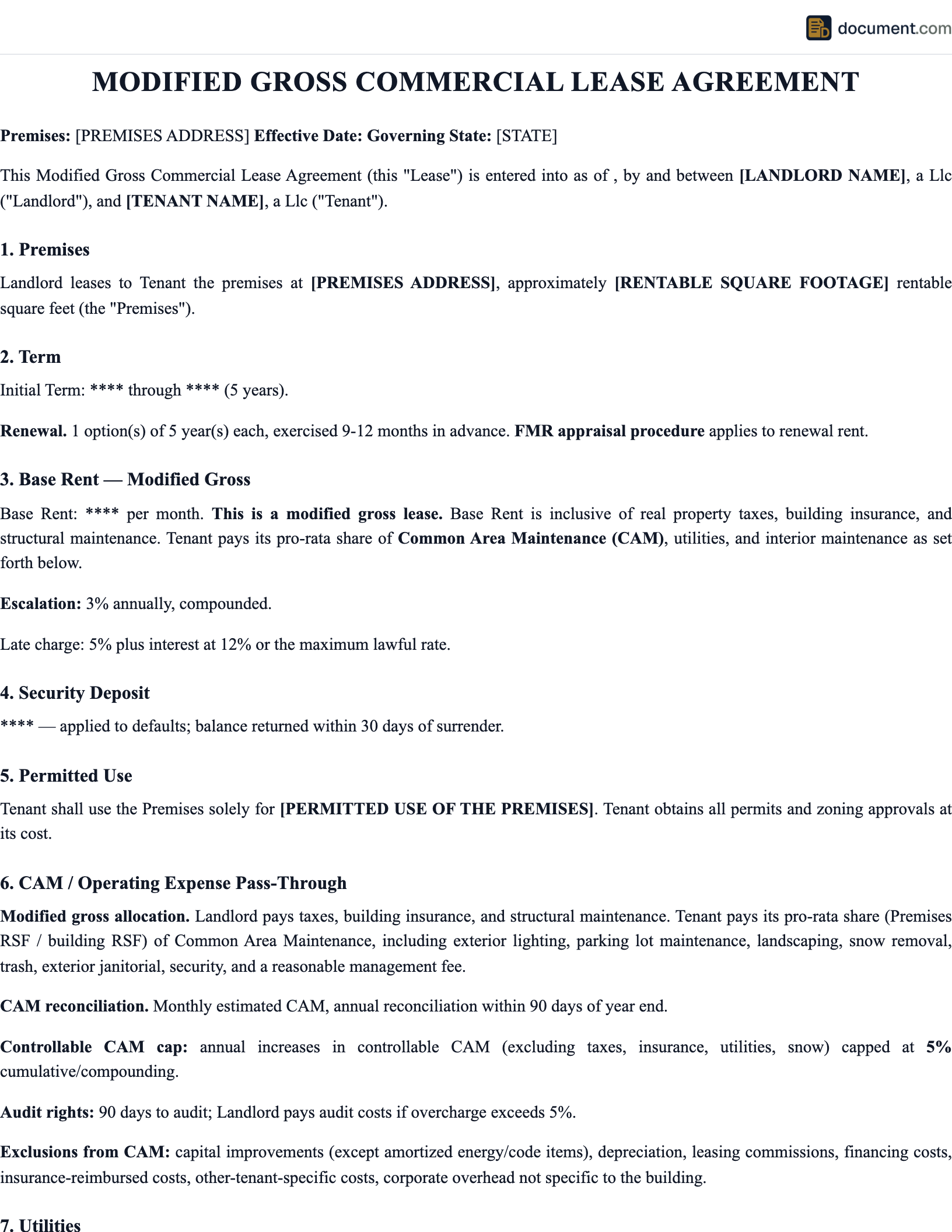
Sample South Carolina Commercial Modified Gross Lease
Below is a preview of our South Carolina-specific commercial modified gross lease. Your customized document will include all fields and provisions required under SC law.
COMMERCIAL MODIFIED GROSS LEASE
STATE OF SOUTH CAROLINA
SC-Compliant Template
PARTY A:
Name: [Full Legal Name]
Address: [South Carolina Address]
PARTY B:
Name: [Full Legal Name]
Address: [South Carolina Address]
PROPERTY / PREMISES:
Address: [Property Address]
County: [South Carolina County]
SOUTH CAROLINA COMPLIANCE
This document complies with South Carolina (SC) state law requirements and includes all provisions mandated for this type of document in South Carolina.