



Oregon Commercial Modified Gross Lease Overview
Modified gross leases are common in Portland-area office and mixed-use commercial buildings, where landlords and tenants negotiate a customized expense split rather than adopting a full gross or full NNN structure. Oregon commercial leases are governed entirely by contract law, meaning the modified gross label is only meaningful if the lease clearly defines which costs each party handles.
Oregon's commercial real estate environment has several distinctive features relevant to modified gross leases: the Measure 50 property tax assessment cap, the absence of a statewide sales tax, the Corporate Activity Tax on business revenues, and Portland's ongoing commercial rent regulation discussions. These factors affect how landlords and tenants approach expense allocation negotiations in Oregon modified gross leases.
OR
State-specific
Varies
Filing fees
Written
Required format
Contract
Law governs
Oregon Legal Requirements
Oregon modified gross leases have no mandatory expense allocation rules for commercial tenants. The parties define the split entirely through negotiation. The key requirement is precision in the lease document: a well-drafted expense schedule attached to the lease prevents the disputes that arise when the parties have different interpretations of what modified gross actually includes.
Oregon Specific Note
Oregon has no statewide sales tax and no commercial rent tax. Oregon property taxes benefit from Measure 50's 3% annual assessment growth cap. Portland office modified gross leases often pass property tax and insurance increases above a base year threshold to tenants through expense stop provisions. Oregon's CAT affects business tenant operating costs, not the lease structure itself. Portland's commercial rent control discussions may affect long-term escalation provisions.
Key Modified Gross Lease Provisions for Oregon
- Expense Split Schedule: A written schedule assigning each operating expense category to landlord or tenant; no abbreviations or general labels
- Base Rent Escalation: Annual escalation mechanism, including any provisions that might be affected if Portland commercial rent regulation takes effect
- Expense Stop or Base Year (if applicable): Define the threshold, calculation basis, and gross-up methodology with reference to Oregon's Measure 50 assessment cap
- Utility Responsibility: Specify which utilities the tenant pays and whether any building-standard usage allowance applies before overage billing
- Statute of Frauds Compliance: Leases over one year must be in writing and signed by the party to be charged under Oregon law
How to Draft a Commercial Modified Gross Lease in Oregon
Drafting an Oregon modified gross lease requires deliberate attention to the expense split from the first negotiation session. The steps below describe how to structure the lease effectively.
Agree on the Expense Split Framework
Decide which expenses the landlord retains (typically taxes, insurance, and structure) and which the tenant assumes (typically utilities and janitorial); this framework sets the economic structure of the lease
Draft a Detailed Expense Schedule
Create an exhibit or schedule listing every relevant cost category with a clear landlord or tenant assignment; include Oregon property tax history and Measure 50 context for the tax line
Set Escalation and Cap Provisions
Agree on annual base rent increases and any expense escalation provisions; consider Portland's commercial rent regulation discussions when structuring long-term escalation clauses
Execute the Lease
Both parties sign; Oregon's statute of frauds requires leases over one year to be in writing; confirm authorized representatives sign for any entity parties
Record if Long-Term or Required by Lender
Record with the county clerk for constructive notice if appropriate; notarize before recording; Oregon's recording fee is approximately $56 for the first page
Oregon-Specific Key Provisions
Oregon modified gross leases should include a clear governing law clause specifying Oregon law, a dispute resolution mechanism, and insurance requirements tailored to the property type. Portland properties may require specific environmental disclosure provisions, particularly for older industrial or mixed-use buildings in areas with historical environmental activity.
Oregon's CAT does not change the lease structure, but high-revenue tenants should understand that Oregon business tax obligations add to overall occupancy cost. Portland's commercial rent regulation discussions are an active legal development that any tenant signing a long-term modified gross lease in Portland should monitor.
Oregon does not impose a commercial rent tax at the state level, which simplifies the expense picture compared to some other states. Local Portland business licensing and permit requirements may need to be addressed in the permitted use and compliance sections of the lease.
Oregon Fees & Costs
Typical costs for an Oregon modified gross commercial lease transaction.
| Fee / Cost | Typical Amount |
|---|---|
| Monthly Modified Gross Rent | Negotiated; reflects landlord's retained operating costs in the Portland market |
| Tenant-Paid Utilities | Varies; Oregon utility costs vary by location, season, and energy type |
| Expense Stop Overages (if applicable) | Tenant's pro-rata share of costs above the stop; Measure 50 limits Oregon property tax growth to 3% annually |
| County Clerk Recording Fee (if recorded) | Approximately $56 base fee in Oregon; confirm current schedule with county |
| Attorney Review (recommended) | $350 - $750 for Oregon modified gross lease expense allocation review |
Sample Oregon Commercial Modified Gross Lease
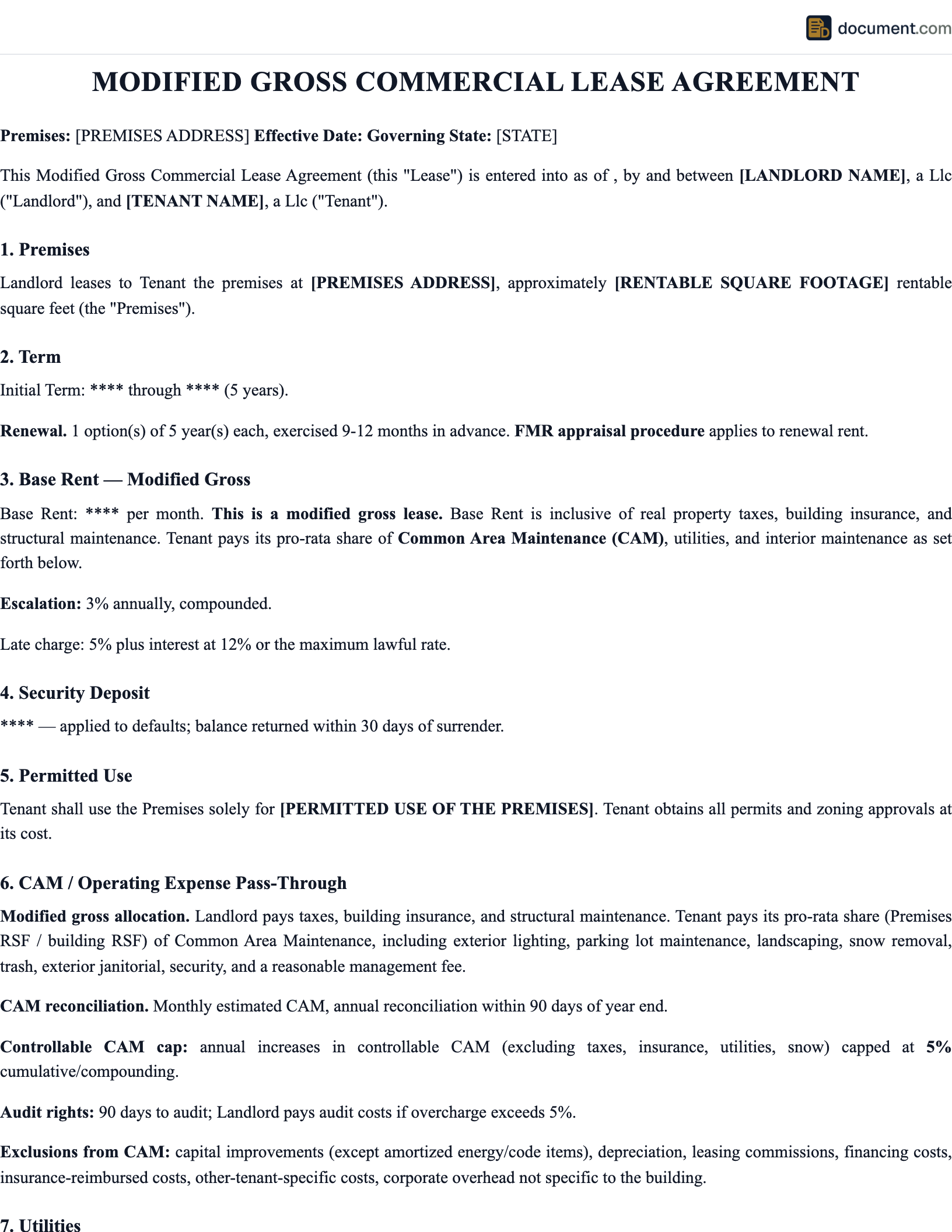
Below is a preview of our Oregon-specific commercial modified gross lease. Your customized document will include all fields and provisions required under OR law.
COMMERCIAL MODIFIED GROSS LEASE
STATE OF OREGON
OR-Compliant Template
PARTY A:
Name: [Full Legal Name]
Address: [Oregon Address]
PARTY B:
Name: [Full Legal Name]
Address: [Oregon Address]
PROPERTY / PREMISES:
Address: [Property Address]
County: [Oregon County]
OREGON COMPLIANCE
This document complies with Oregon (OR) state law requirements and includes all provisions mandated for this type of document in Oregon.