



Ohio Commercial Modified Gross Lease Overview
A modified gross lease sits between a pure gross lease and a triple net lease in terms of how expenses are allocated. The landlord and tenant negotiate a split of operating costs, with certain categories covered by base rent and others paid directly by the tenant. Ohio commercial office markets in Columbus, Cleveland, and Cincinnati use modified gross leases extensively for professional office, medical office, and suburban flex space where both parties want predictable costs but neither wants the full risk of a pure gross or pure NNN structure.
Ohio has no statute that sets a default expense split for commercial modified gross leases. Every allocation is negotiated. The most important document in any Ohio modified gross lease transaction is the expense responsibility schedule, which maps each operating cost category to either the landlord or the tenant. Vague expense schedules are the single most common source of lease disputes in Ohio commercial real estate, because the parties often have different assumptions about what was agreed when ambiguous language is used.
Split
Expense structure
Contract
Governs all terms
Schedule
Expense list required
3 Cities
Columbus, Cleveland, Cincinnati
Ohio Modified Gross Lease Requirements
Ohio governs commercial modified gross leases through contract law, not statute. The provisions below are the substantive protections and obligations that both landlords and tenants should address before executing any Ohio commercial lease with a modified gross expense structure.
Complete the Expense Schedule Before Signing
In Ohio modified gross leases, the expense responsibility schedule is the document's most important attachment. It should list every cost category and clearly assign each one to either the landlord or the tenant. Leaving expense categories unassigned or using vague language like "tenant responsible for maintenance" is the most reliable way to produce a costly dispute in the first year of the lease.
Key Lease Provisions to Address
- Expense Responsibility Schedule: Attach a complete list assigning every operating cost category: taxes, insurance, CAM, utilities, HVAC, janitorial, trash, parking lot, landscaping, and building management fee
- HVAC Allocation: Specify whether the tenant maintains only in-suite systems or all equipment serving its space, set a cap on annual repair obligation, and address replacement responsibility for end-of-life equipment at the start of the term
- Utility Metering: Confirm whether utilities serving the tenant's space are separately metered or allocated; if allocated, document the allocation methodology to prevent disputes about proportionate share
- Escalation Terms: State the annual base rent escalation as a fixed percentage, typically 2% to 3% in Ohio markets, or as a CPI adjustment with floor and ceiling; avoid open-ended escalation language
- Audit Rights: If any operating expense pass-throughs apply, include audit rights with a defined notice period, audit window, and cost-shifting provision for material overcharges
- Landlord Default Remedies: Confirm what happens if the landlord fails to perform its maintenance obligations; include a cure period and a self-help remedy allowing the tenant to perform and offset costs against rent if the landlord does not respond within a defined window
How to Draft an Ohio Commercial Modified Gross Lease
Drafting a modified gross lease in Ohio requires precision in defining which expenses belong to each party. Here is a practical process to follow.
Build a Complete Expense Category List
Before drafting, list every operating cost category for the building: property taxes, building insurance, CAM, parking lot, landscaping, exterior maintenance, roof and structure, HVAC (in-suite and common area), utilities (by meter or allocation), janitorial, pest control, trash removal, and property management fee. Include every category even if you expect the answer to be obvious, because unstated categories become disputed categories.
Assign Each Category to Landlord or Tenant
Work through the list category by category and reach a clear agreement. Typical Ohio office market practice has the landlord covering taxes, insurance, exterior maintenance, and roof while the tenant covers utilities, janitorial, and in-suite HVAC maintenance. Anything in the middle, such as parking lot repairs and property management fees, should be explicitly assigned rather than left to interpretation.
Set the Base Rent and Escalation Terms
State the base rent per square foot per year, the commencement date, and the annual escalation. Ohio modified gross leases typically use a fixed 2% to 3% step-up each year. Avoid CPI-based escalation unless both parties understand what it means in practice. Confirm any free rent or reduced-rent abatement period and how that period affects the lease term and renewal option calculations.
Have an Ohio Commercial Real Estate Attorney Review the Draft
An Ohio attorney should review the full lease with particular attention to the expense schedule, the HVAC and maintenance provisions, the default and cure language, any personal guarantee clause, and the holdover and renewal terms. Attorney review in Columbus, Cleveland, or Cincinnati typically costs $500 to $2,500 depending on the lease length and complexity.
Execute the Lease with the Expense Schedule Attached
Both parties sign the lease. The expense responsibility schedule should be attached as a numbered exhibit and incorporated by reference in the body of the lease. Distribute fully executed copies to all parties, calendar option exercise deadlines and escalation dates, and set up payment systems for any direct tenant obligations from day one.
Ohio Modified Gross Lease Key Provisions
Beyond the expense schedule, several other provisions are particularly important in Ohio commercial modified gross leases. These provisions reflect both the state's contract-based legal framework and the practical realities of the Columbus, Cleveland, and Cincinnati commercial office markets.
Holdover provisions should specify what rate applies if a tenant continues in occupancy after the lease term expires. Ohio landlords typically set holdover rent at 125% to 150% of the final month's base rent on a month-to-month basis. Tenants should note that holdover rent is not simply double rent in Ohio absent explicit lease language saying so, but landlords may pursue consequential damages if a holdover tenant prevents a new tenancy from commencing.
Default and cure provisions should include reasonable notice periods of 5 to 10 days for monetary defaults and 20 to 30 days for non-monetary defaults. Insurance requirements in Ohio commercial leases typically include commercial general liability of $1 million per occurrence and $2 million aggregate, with the landlord named as additional insured. Renewal option provisions should state the notice deadline clearly, often 6 to 12 months before expiration, and specify the rent calculation method for the renewal period.
Ohio Modified Gross Lease Costs
Cost ranges below reflect typical Ohio commercial modified gross lease transactions in Columbus, Cleveland, and Cincinnati. Actual figures depend on property class, submarket, and lease term.
| Fee / Cost | Typical Amount |
|---|---|
| Modified Gross Base Rent (Columbus suburban) | $18 - $30 per sq ft annually |
| Modified Gross Base Rent (Cleveland / Cincinnati) | $15 - $26 per sq ft annually |
| Tenant Direct Expenses (utilities, janitorial) | $3 - $7 per sq ft annually (varies by space) |
| Operating Expense Pass-Throughs (if any) | $1 - $4 per sq ft above landlord-covered baseline |
| Tenant Improvement Allowance (Class A, new tenant) | $25 - $50 per sq ft (negotiated) |
| Attorney Review | $500 - $2,500 |
Sample Ohio Commercial Modified Gross Lease
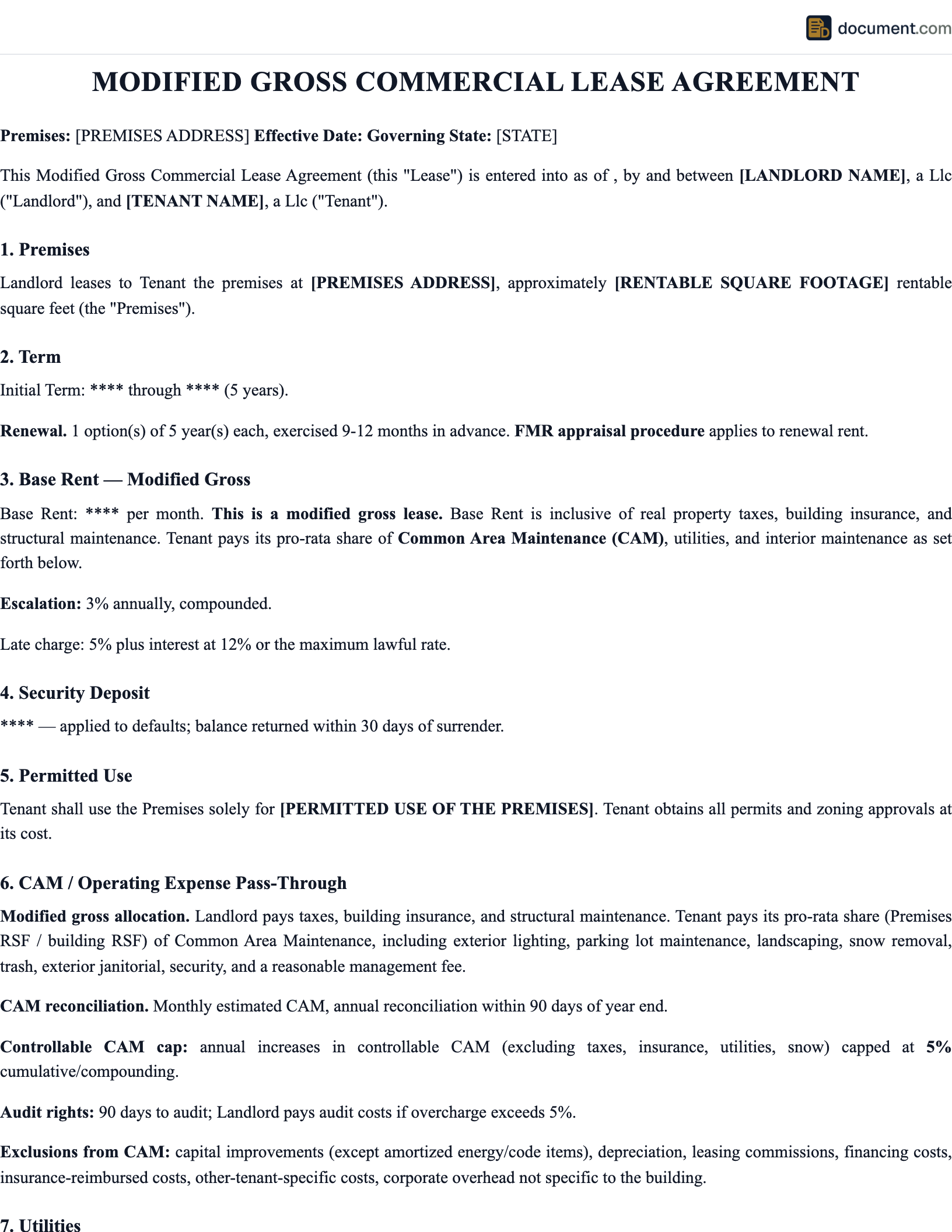
Below is a preview of our Ohio-specific commercial modified gross lease. Your customized document will include all fields and provisions required under OH law.
COMMERCIAL MODIFIED GROSS LEASE
STATE OF OHIO
OH-Compliant Template
PARTY A:
Name: [Full Legal Name]
Address: [Ohio Address]
PARTY B:
Name: [Full Legal Name]
Address: [Ohio Address]
PROPERTY / PREMISES:
Address: [Property Address]
County: [Ohio County]
OHIO COMPLIANCE
This document complies with Ohio (OH) state law requirements and includes all provisions mandated for this type of document in Ohio.