



New Jersey Commercial Modified Gross Lease Overview
A modified gross lease in New Jersey sits between a full-service gross lease and a triple net structure. The tenant pays a base rent that covers some building operating expenses, while other costs are allocated directly to the tenant. There is no standard formula for this split; it is negotiated between the parties and documented in the written lease. New Jersey has no commercial lease statute governing expense allocations, so whatever the parties wrote controls the arrangement entirely.
New Jersey's high municipal property tax environment and diverse commercial submarkets make modified gross leases particularly common in the state. Office tenants in Northern NJ suburban parks along I-287, Route 10, and Route 24 corridors frequently encounter modified gross structures where utilities and janitorial are tenant-paid while base taxes and insurance remain bundled in the landlord's rent. In transit-oriented commercial developments near NJ Transit stations in Morristown, Summit, and New Brunswick, parking and common area costs are often structured separately from the modified gross base rent.
NJ
State-specific
Varies
Filing fees
Written
Required format
Contract
Law governs
New Jersey Modified Gross Lease Requirements
There is no New Jersey statute that governs how modified gross expenses should be allocated between landlord and tenant. The lease document itself must be precise about which costs go to each party, how escalations work, and what happens if a cost category changes significantly over the lease term.
New Jersey Municipal Property Taxes Require Special Attention
New Jersey property taxes are assessed and collected by individual municipalities. With 564 separate taxing jurisdictions, rates and assessment methodologies differ substantially across the state. When negotiating a modified gross lease, confirm which municipality the property is in, obtain the current tax bill, and determine whether the lease allocates any property tax increases to the tenant. In markets with historically volatile tax assessments, a base-year approach with a cap on tenant tax exposure may be worth negotiating.
Key Expense Allocation Requirements
- Explicit expense allocation: Assign every operating expense category clearly to either landlord or tenant; do not rely on general language or custom, as NJ courts enforce what the lease says rather than inferring intent
- Written form: The NJ statute of frauds requires any lease with a term over one year to be in writing; modified gross leases with complex expense allocations should always be written regardless of term
- Utility metering and responsibility: Specify whether utilities are individually metered to the tenant or prorated across the building; New Jersey commercial buildings vary widely in how utilities are metered
- Escalation methodology: State whether rent escalates on a fixed schedule, CPI basis, or base-year expense comparison; in NJ municipalities with high property tax volatility, a base-year approach with caps on controllable increases is common
- Management fee treatment: Confirm whether the landlord's management fee is included in any tenant expense pass-through or absorbed by the landlord; Northern NJ multi-tenant office properties commonly include management fees in operating expense allocations
How to Draft a New Jersey Modified Gross Lease
A New Jersey modified gross lease requires careful preparation before drafting because the expense allocation you agree to in negotiation must be reflected precisely in the written document. Follow these steps.
Gather Property Expense and Tax Data
Obtain the current annual property tax bill from the landlord and confirm the municipality. Request the prior two years of utility cost history for the space, the building insurance premium, any CAM expense statements, and the management fee structure. In New Jersey, municipal tax rates drive much of the modified gross expense negotiation.
Negotiate the Expense Allocation and Escalation
Agree on which expenses the landlord covers in base rent and which the tenant handles separately. In Northern NJ suburban office parks, common splits include landlord covering taxes and insurance while the tenant pays utilities and janitorial. Agree on how rent escalates annually and whether any property tax increases above a base-year level are shared.
Draft the Lease with New Jersey-Specific Language
Use a New Jersey modified gross lease template that documents the agreed expense allocation explicitly for every category, states the escalation methodology, addresses management fees, and includes a governing law clause designating New Jersey. Identify the appropriate county Superior Court as the venue for disputes. Hudson, Essex, Middlesex, Morris, and Camden counties each have active commercial court vicinages for NJ lease matters.
Legal Review by NJ Commercial Real Estate Counsel
Have a New Jersey commercial real estate attorney review the expense allocation provisions, escalation terms, and any tenant improvement obligations. Modified gross leases with complex allocations benefit from counsel review to confirm the lease accurately reflects what was negotiated and that there are no gaps that could be interpreted against either party.
Execute and Distribute
Both parties sign. For commercial leases, notarization is not required between the parties unless the lease is being recorded. Confirm signing authority for entity signatories. Distribute fully executed copies to landlord, tenant, and any guarantors. Calendar escalation dates and, if applicable, any property tax base-year comparison dates.
New Jersey Modified Gross Lease: Key Provisions
Because New Jersey courts enforce commercial leases as written, the precision of the expense allocation language is the most important drafting challenge in any modified gross lease. Vague terms like "tenant pays operating expenses" without a defined list of what that includes have generated disputes in New Jersey commercial litigation. Each expense category should be named and assigned with no room for ambiguity.
Escalation provisions require particular attention in New Jersey given the state's property tax environment. If the lease allocates some property tax responsibility to the tenant, the base-year methodology and any cap on annual tax increases must be stated explicitly. New Jersey municipalities can reassess commercial properties during revaluation years, which can trigger significant step-ups in assessed value and corresponding tax increases that flow through to tenants under poorly drafted leases.
The governing law and dispute resolution clause should specify New Jersey as the controlling law and identify the appropriate county Superior Court as the venue. For Parsippany and Morris County properties, that is Morris County Superior Court. For Newark and the Route 22 corridor, Essex County Superior Court. For Jersey City and Hudson waterfront, Hudson County Superior Court. For the Route 1 technology corridor, Middlesex County Superior Court.
New Jersey Modified Gross Lease Costs
Modified gross lease costs in New Jersey reflect the negotiated expense allocation between landlord and tenant. The table below covers typical cost components.
| Fee / Cost | Typical Amount |
|---|---|
| Attorney Review and Lease Drafting | $800 to $2,500 depending on lease length and complexity; modified gross leases with multiple expense categories require more drafting attention than simple gross or NNN structures |
| Tenant-Allocated Utilities | Electricity and gas are typically metered directly to the tenant even in landlord-favorable modified gross structures; actual costs vary by building and HVAC configuration |
| Property Tax Pass-Through (if applicable) | Where the lease allocates a share of municipal property tax increases to the tenant, the cost depends on the municipality; NJ rates vary substantially across the state's 564 taxing jurisdictions |
| Recording Fee (optional) | Optional; recording fees at the NJ county clerk vary by county; notarization required for recording; advisable for long-term leases with significant tenant improvements |
| No Commercial Rent Tax | New Jersey does not impose a statewide commercial rent tax; municipal taxes are property-based rather than rent-based, so there is no gross rent surcharge to account for in modified gross lease structures |
Sample New Jersey Commercial Modified Gross Lease
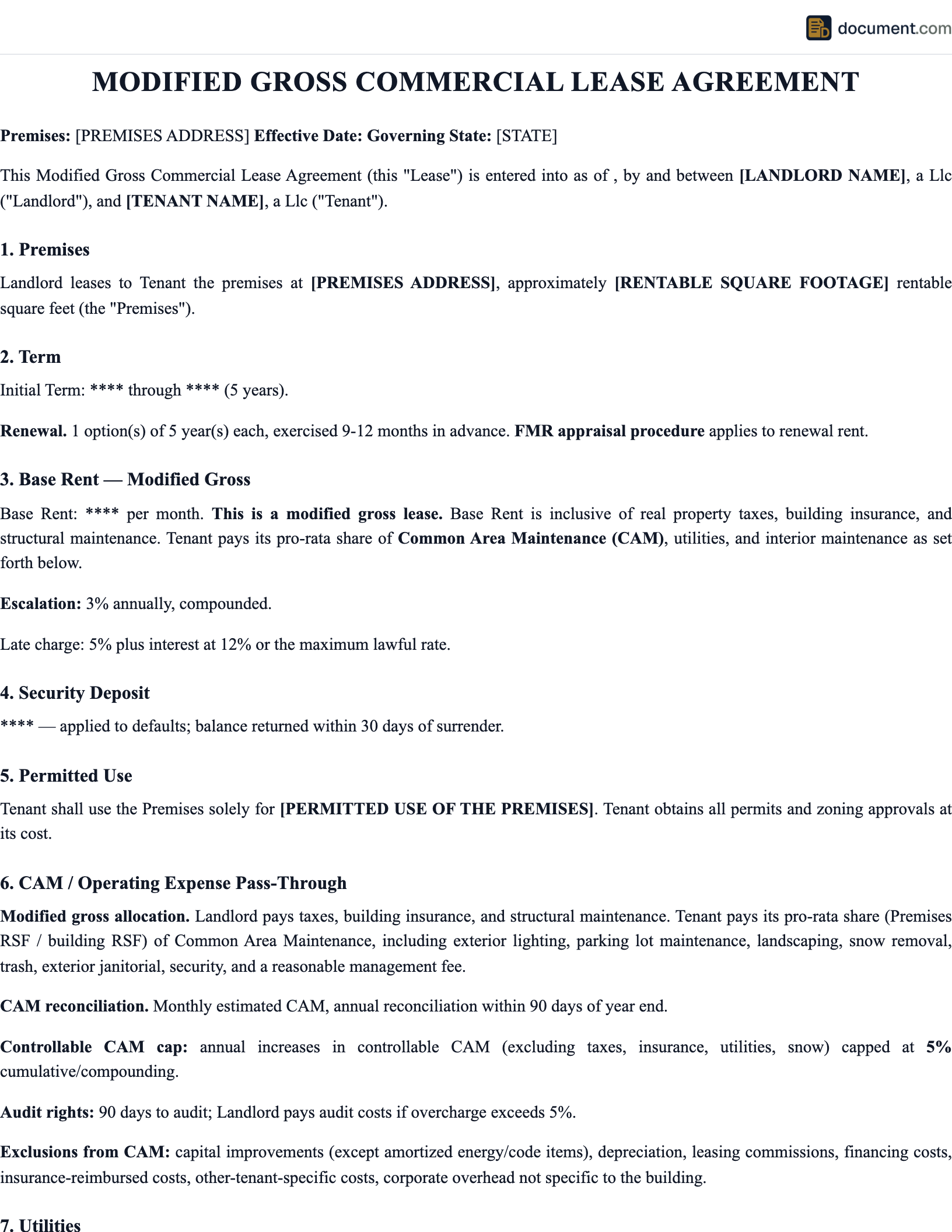
Below is a preview of our New Jersey-specific commercial modified gross lease. Your customized document will include all fields and provisions required under NJ law.
COMMERCIAL MODIFIED GROSS LEASE
STATE OF NEW JERSEY
NJ-Compliant Template
PARTY A:
Name: [Full Legal Name]
Address: [New Jersey Address]
PARTY B:
Name: [Full Legal Name]
Address: [New Jersey Address]
PROPERTY / PREMISES:
Address: [Property Address]
County: [New Jersey County]
NEW JERSEY COMPLIANCE
This document complies with New Jersey (NJ) state law requirements and includes all provisions mandated for this type of document in New Jersey.