



Massachusetts Commercial Modified Gross Lease Overview
A modified gross commercial lease occupies the middle ground between a full gross lease and a net lease. Rather than the landlord absorbing all operating costs or the tenant paying everything separately, the parties negotiate a specific split of expenses that makes sense for the building and the market. In the Boston and Cambridge office market, this structure is extremely common. Suburban Massachusetts office parks often use modified gross leases where tenants pay utilities directly but the landlord handles taxes, insurance, and building maintenance.
Massachusetts commercial leases are governed by contract law rather than a specific landlord-tenant statute covering commercial tenants. This means the terms the parties negotiate and put into writing are the terms that control. There are no statutory expense-split requirements or mandatory protections that override a poorly written lease. Getting the expense allocation documented correctly at the outset is critical because that allocation will govern the parties' financial relationship for the full lease term.
MA
State-specific
Varies
Filing fees
Written
Required format
Contract
Law governs
Massachusetts Legal Requirements
Massachusetts commercial leases are creatures of contract. The parties must carefully define which expenses are included in the base rent and which are carved out as the tenant's direct responsibility. Vague language around the expense split is the most common source of modified gross lease disputes in Massachusetts commercial real estate.
Massachusetts Specific Note
Massachusetts taxes commercial property at significantly higher rates than residential property in most cities and towns. Boston's commercial property tax classification results in rates several times higher than the residential rate. Understand where the building's property tax burden sits before agreeing to any expense stop or pass-through provision, since Massachusetts tax increases can be substantial over a multi-year lease term.
Key Modified Gross Lease Provisions for Massachusetts
- Expense allocation schedule: List specifically which expense categories the landlord covers in the base rent and which are the tenant's direct responsibility. Generic language creates disputes.
- Expense stop (if applicable): If the lease includes an expense stop, set it at the building's current actual operating costs. An artificially low stop converts a modified gross lease into something much closer to a net lease in practice.
- Utility sub-metering: In Boston-area buildings where tenants pay electricity directly, confirm whether the space is separately metered or sub-metered through the landlord. Sub-metered spaces may carry a landlord markup.
- HVAC hours and overtime: Boston Class A leases typically include HVAC during standard business hours. Overtime HVAC charges for evenings and weekends are billed separately and can be significant. Confirm rates and hours.
- Audit rights: If the lease includes any expense pass-throughs, include the right to audit the landlord's expense records annually within 12 months of receiving the reconciliation statement.
- Annual escalation: Massachusetts modified gross leases typically include annual rent increases of 2 to 3 percent or CPI adjustments. Confirm the escalation mechanism and whether there is a cap in high-inflation years.
How to Draft a Commercial Modified Gross Lease in Massachusetts
Creating a commercial modified gross lease in Massachusetts involves several key steps to ensure the document is comprehensive, legally compliant, and protective of all parties' interests under MA law.
Request the Building's Actual Expense Data
Before negotiating expense allocations, ask the landlord for two to three years of actual operating expense reports. In Massachusetts, this should include property taxes (noting the commercial vs residential classification), building insurance, and CAM costs. Understanding actual numbers prevents disputes about what is reasonable to include in the landlord's base rent coverage.
Negotiate the Expense Split and Document It Clearly
Agree on exactly which expense categories are included in the base rent and which the tenant pays directly or as a pass-through. In Massachusetts office markets, tenants commonly pay electricity and janitorial directly. Confirm HVAC coverage hours and overtime rates for any after-hours use.
Address Any Expense Stop Provisions
If the lease includes an expense stop or base year mechanism, negotiate the level carefully. Request that the stop be set at actual current operating costs, not a landlord-proposed lower number. Include gross-up language so the stop reflects fully occupied building operations, and add audit rights to review expense reconciliations annually.
Have a Massachusetts Attorney Review the Lease
Boston-area commercial real estate attorneys are familiar with local market standards and will identify provisions that deviate from normal Massachusetts practice. Given the state's high commercial property tax environment and the expense implications over a multi-year lease, attorney review is worth the investment on any lease above $50,000 in total annual rent.
Execute the Lease and Set Up Expense Tracking
Sign the lease with all parties and retain fully executed copies. Set up tracking for annual escalation dates, any option exercise windows, and expense reconciliation deadlines. Massachusetts commercial leases do not require recording to be valid, but organized documentation of expense payments protects both sides if disputes arise later.
Massachusetts Modified Gross Lease Considerations
The Boston and Cambridge office markets are among the most expensive in the country for commercial space. Modified gross leases in these markets typically reflect that cost reality with higher base rents that absorb property taxes and building operating costs. Tenants in the Seaport, Back Bay, or Cambridge's Kendall Square should budget for base rents of $60 to $100 or more per square foot annually, with utilities and janitorial paid separately on top of that.
Suburban Massachusetts office parks in markets like Route 128, Waltham, Burlington, or Needham tend to have lower base rents and more traditional modified gross structures where tenants pay electricity directly but the landlord handles everything else. These markets are generally more tenant-favorable in terms of lease negotiation because there is more competing inventory.
Massachusetts does not impose a commercial rent tax. Tenants pay no state-level tax on lease payments. The main financial exposure in a Massachusetts modified gross lease beyond the base rent is the annual escalation and any expense stop pass-throughs if operating costs rise materially. Both should be analyzed carefully before signing a multi-year lease.
Massachusetts Fees & Costs
Below is a breakdown of typical costs associated with Massachusetts modified gross commercial lease transactions.
| Fee / Cost | Typical Amount |
|---|---|
| Massachusetts Attorney (hourly) | $300 - $600 per hour |
| Modified Gross Base Rent (annual per sqft) | $25 - $45/sqft suburban; $60 - $100+/sqft Boston/Cambridge |
| Tenant Direct Utilities (electricity) | $2 - $6/sqft annually (MA rates above national average) |
| Annual Rent Escalation | Typically 2.5 - 3.5% per year or CPI-based |
| Expense Stop Pass-Through Risk | $2 - $8/sqft above stop (where applicable) |
Sample Massachusetts Commercial Modified Gross Lease
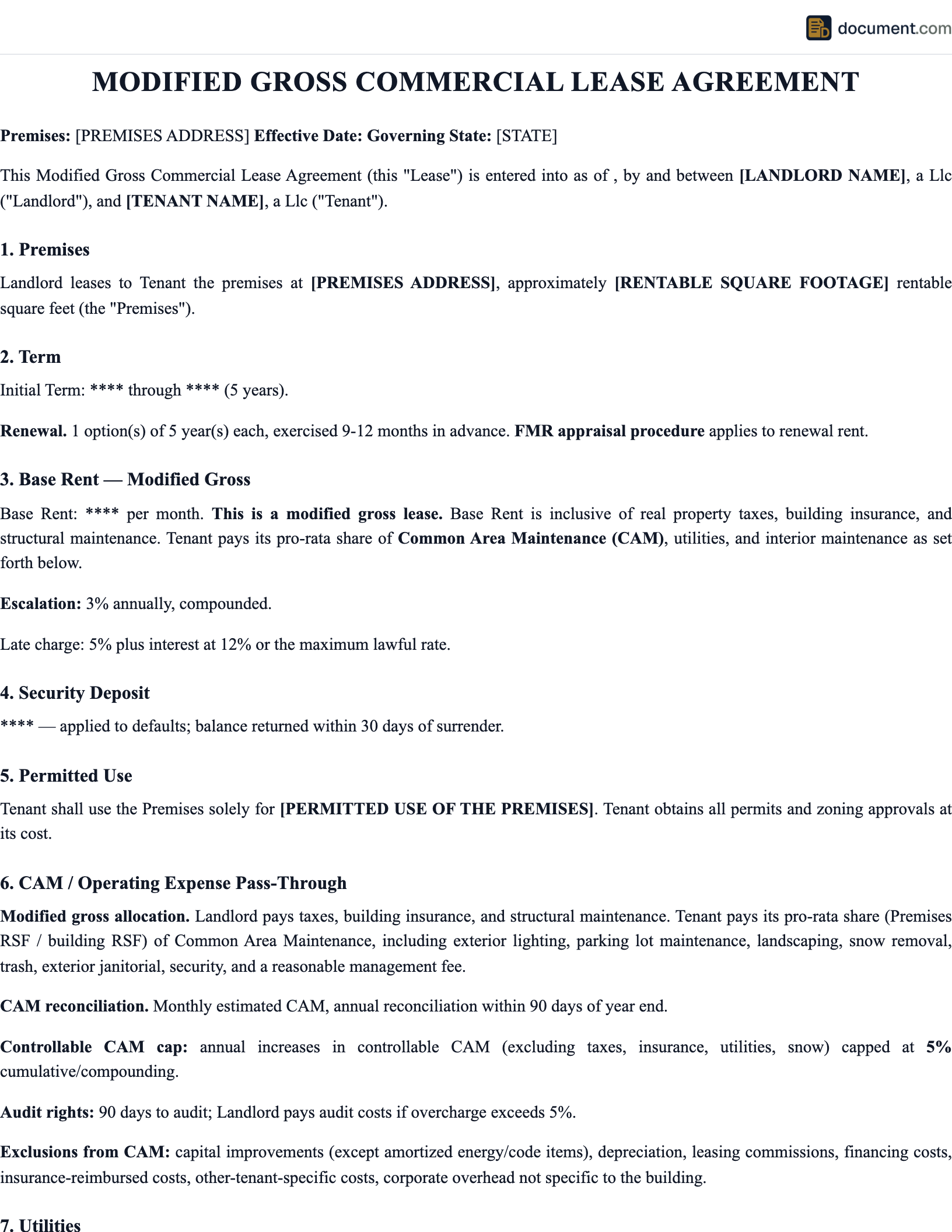
Below is a preview of our Massachusetts-specific commercial modified gross lease. Your customized document will include all fields and provisions required under MA law.
COMMERCIAL MODIFIED GROSS LEASE
STATE OF MASSACHUSETTS
MA-Compliant Template
PARTY A:
Name: [Full Legal Name]
Address: [Massachusetts Address]
PARTY B:
Name: [Full Legal Name]
Address: [Massachusetts Address]
PROPERTY / PREMISES:
Address: [Property Address]
County: [Massachusetts County]
MASSACHUSETTS COMPLIANCE
This document complies with Massachusetts (MA) state law requirements and includes all provisions mandated for this type of document in Massachusetts.