



Maryland Commercial Modified Gross Lease Overview
A modified gross commercial lease in Maryland is governed by Maryland contract law and requires particular attention to two factors that distinguish Maryland from most other states. First, Maryland imposes recordation and transfer taxes on the recording of long-term commercial leases, which creates a meaningful transaction cost for DC suburb deals. Second, SDAT's triennial assessment cycle creates periodic property tax spikes that can erode a landlord's economics if taxes are absorbed in base rent without a protective expense stop.
The DC suburb commercial office markets, particularly in Bethesda, Rockville, Chevy Chase, and the I-270 corridor, are among the most active modified gross lease markets in the region. Class A suburban office in Montgomery County routinely uses modified gross structures where the landlord covers SDAT taxes and building insurance while tenants pay utilities, janitorial, and parking. The Baltimore City and suburban Baltimore markets use similar structures at lower rent levels. The modified gross format is well suited to Montgomery County because it gives tenants cost certainty while protecting landlords from the SDAT reassessment risk through expense stop mechanisms.
MD
State-specific
Varies
Filing fees
Written
Required format
Contract
Law governs
Maryland Legal Requirements
Maryland modified gross leases must comply with the statute of frauds, address SDAT triennial assessment risks, and be planned with the potential recordation and transfer tax obligations in mind.
Maryland Specific Note
A Maryland commercial lease for a term of seven years or more (counting all renewal options) that is recorded in county land records is subject to Maryland recordation and transfer taxes on the consideration. The tax obligation can be substantial for DC suburb transactions. Parties should consult a Maryland real estate attorney before signing to determine whether a short memorandum of lease rather than the full lease should be recorded, and how the tax obligation should be allocated between landlord and tenant in the lease.
Document Requirements
- Written Form: Maryland's statute of frauds requires commercial leases for terms exceeding one year to be in writing and signed by the party to be charged
- SDAT Expense Stop: If property taxes are included in base rent, the lease should set a base-year SDAT assessment figure and define how triennial reassessment increases above the stop are passed through to the tenant
- Recordation Tax Allocation: The lease should specify which party pays Maryland recordation and transfer taxes if the lease or a memorandum is recorded in county land records
- Expense Schedule: A detailed exhibit assigning each operating expense to landlord or tenant is essential; the DC suburb market standard puts utilities and janitorial on the tenant and taxes and insurance on the landlord
- Annual Escalation: CPI-based or fixed-percent annual rent increases are standard in Montgomery County and Prince George's County office leases given high property costs
- SDAT Appeal Rights: The lease should address which party may pursue a SDAT assessment appeal and how any resulting refund or savings is shared
How to Draft a Commercial Modified Gross Lease in Maryland
Drafting a Maryland modified gross lease requires addressing the SDAT cycle and recordation tax exposure before finalizing any other terms.
Review SDAT History and Calculate Recordation Tax
Before negotiating, request the last SDAT assessment notice and the current annual tax bill for the property from the county assessor. Calculate the potential recordation and transfer tax if the lease will be recorded, using the applicable county rates. For Montgomery County, the recordation tax is $6.90 per $500 of consideration. Knowing these numbers upfront prevents surprises late in the transaction.
Negotiate the Expense Split and SDAT Stop
For DC suburb office deals, the market standard starting point is landlord covers SDAT taxes and building insurance; tenant pays utilities, janitorial, and parking. Set an expense stop tied to the base-year SDAT tax figure to cap landlord exposure from future triennial reassessments. Decide how any SDAT appeal refunds will be shared.
Decide on Full Lease or Memorandum Recording
With a Maryland attorney, determine whether to record the full modified gross lease or only a short memorandum. Recording a memorandum that does not disclose full rent consideration may reduce or eliminate the recordation tax while still providing constructive notice to third parties. The attorney can advise on the SDAT interpretive position for the relevant county.
Draft Expense Schedule and Annual Escalation
Create a detailed exhibit enumerating each expense category assigned to landlord or tenant. Include annual rent escalation (typically 2.5% to 3% for Montgomery County Class A office). Add provisions addressing SDAT appeal rights, early termination fees, and Maryland governing law with the applicable county as the venue for disputes.
Execute and Record
Both parties execute with authorized signatories, with notarized acknowledgment required for recording. File the full lease or memorandum with the Maryland State Department of Assessments and Taxation land records system in the county where the property is located. Pay any applicable recordation and transfer taxes at recording.
Maryland-Specific Key Provisions
Several Maryland-specific provisions go beyond generic modified gross drafting requirements.
The SDAT base-year tax provision deserves a dedicated lease section, not just a line in the expense schedule. The provision should specify the base-year SDAT assessment value, the base-year effective tax rate, and the base-year tax amount per square foot. It should then define the mechanism for passing through the tenant's pro-rata share of increases above the stop amount, whether the landlord must contest an excessive SDAT assessment before passing through increases, and how the reconciliation is timed relative to SDAT's triennial notice dates. Montgomery County landlords facing a SDAT reassessment in the middle of a ten-year modified gross lease can face hundreds of thousands of dollars in unbudgeted tax expense without this protection.
Parking provisions require attention in suburban Maryland markets because parking is often a separately priced item in Bethesda and Rockville Class A buildings where parking structures are common. The modified gross lease should specify whether parking is included in the base rent, how many unassigned or reserved spaces are allocated to the tenant, and who covers the cost of parking lot lighting, maintenance, and snow removal. Monthly structured parking in Bethesda can range from $150 to $300 per space, making it a meaningful line item in the total occupancy cost calculation.
Maryland Fees & Costs
Below is a breakdown of typical costs associated with commercial lease transactions in Maryland. Actual fees may vary by county and specific circumstances.
| Fee / Cost | Typical Amount |
|---|---|
| Base Rent (Bethesda / Rockville Class A office) | $30 - $58 per sq ft annually |
| Tenant-Paid Utilities and Janitorial | $2.50 - $6.00 per sq ft annually |
| SDAT Tax Stop Overage (if applicable) | Varies by SDAT triennial cycle; $0.50 - $2.00 per sq ft in reassessment years |
| Maryland Attorney Review | $1,000 - $3,500 |
| Recordation and Transfer Tax (if recording full lease) | Varies by county; 1.5% - 3%+ of consideration |
Sample Maryland Commercial Modified Gross Lease
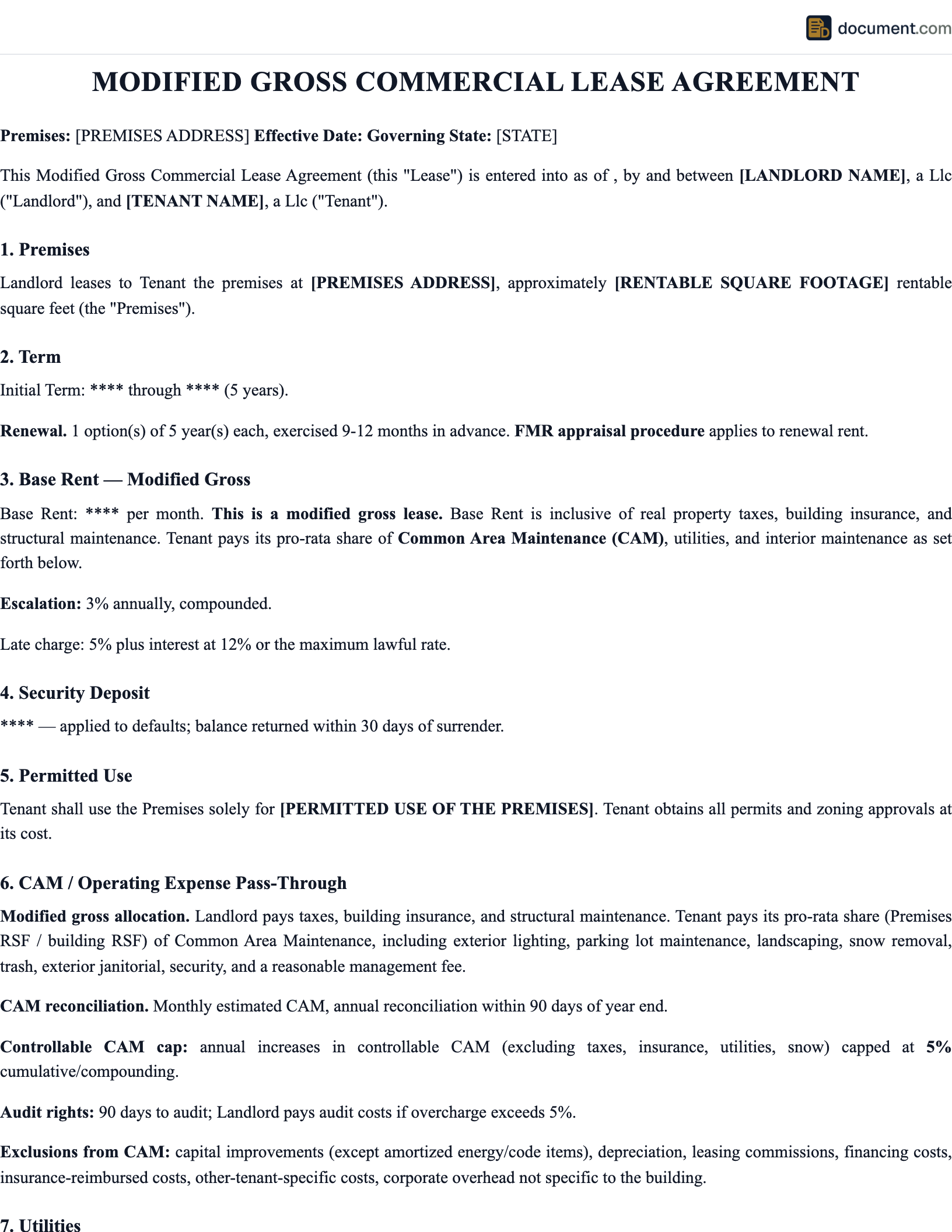
Below is a preview of our Maryland-specific commercial modified gross lease. Your customized document will include all fields and provisions required under MD law.
COMMERCIAL MODIFIED GROSS LEASE
STATE OF MARYLAND
MD-Compliant Template
PARTY A:
Name: [Full Legal Name]
Address: [Maryland Address]
PARTY B:
Name: [Full Legal Name]
Address: [Maryland Address]
PROPERTY / PREMISES:
Address: [Property Address]
County: [Maryland County]
MARYLAND COMPLIANCE
This document complies with Maryland (MD) state law requirements and includes all provisions mandated for this type of document in Maryland.