
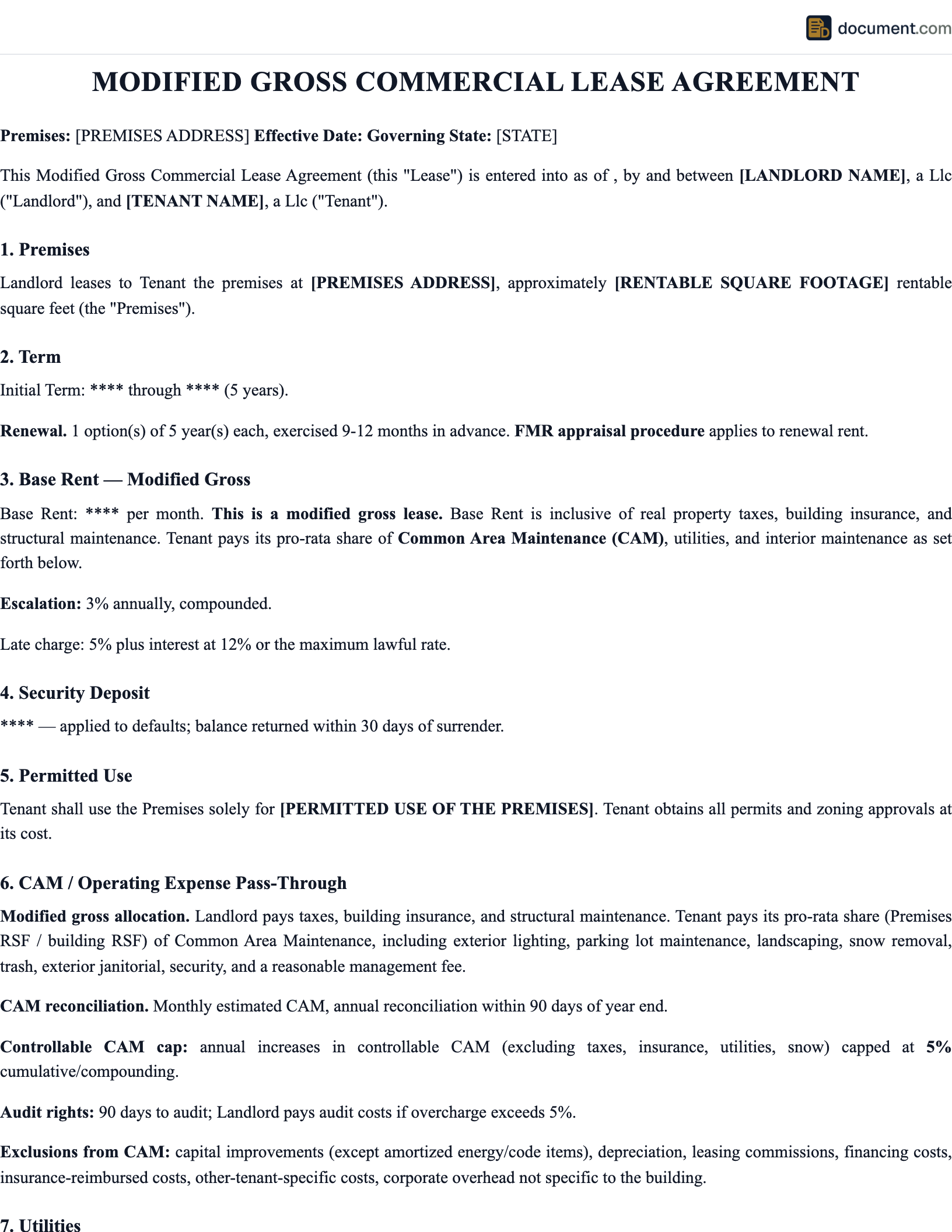



Louisiana Commercial Modified Gross Lease Overview
A modified gross commercial lease in Louisiana operates within a legal framework that is unlike any other state in the country. Louisiana follows a civil law tradition, and commercial leases are governed by the Louisiana Civil Code, Articles 2668 through 2729, rather than by common law contract principles. The modified gross structure allows parties to negotiate which operating expenses are included in the landlord's base rent and which the tenant pays separately, but those deviations from Civil Code defaults must be expressly stated in writing.
New Orleans and Baton Rouge are Louisiana's primary commercial lease markets. New Orleans office and retail leases often use modified gross structures where the landlord covers parish property taxes and building insurance while tenants pay utilities and interior maintenance. The New Orleans market adds flood insurance as a significant expense category that most other states do not have to address. Baton Rouge's suburban office corridor along Perkins Road and Bluebonnet Boulevard uses similar modified gross structures. Louisiana imposes no statewide commercial rent tax, so the base rent figure is the total rent obligation without a state tax overlay.
LA
State-specific
Varies
Filing fees
Written
Required format
Contract
Law governs
Louisiana Legal Requirements
Louisiana modified gross leases must comply with the Civil Code and be properly executed and recorded to protect both parties' interests under Louisiana law.
Louisiana Specific Note
Louisiana's Civil Code Article 2691 imposes a default maintenance obligation on lessors that differs from common law states. In a modified gross lease, any maintenance obligation the landlord wants to shift to the tenant must be expressly stated in the lease. Silence on a maintenance category in a Louisiana lease may leave the obligation with the landlord by default under the Civil Code, regardless of what both parties intended.
Document Requirements
- Civil Code Compliance: The lease must comply with Louisiana Civil Code Articles 2668 through 2729 governing commercial lease obligations
- Expense Schedule: Each operating expense must be expressly assigned to landlord or tenant; Civil Code defaults apply to any unaddressed categories
- Parish Tax Provisions: Property tax responsibility should reference the applicable parish assessor and specify whether increases above a base year are passed to the tenant
- Flood Insurance Allocation: New Orleans and coastal Louisiana leases must expressly state which party carries flood insurance on the building and who insures tenant contents
- Authentic Act Execution: For recording in parish conveyance records, the lease must be signed before a Louisiana notary public and two witnesses as an authentic act
- Lessor's Privilege Acknowledgment: The lease should address the automatic statutory lessor's privilege over tenant movables and any subordination or waiver agreed between the parties
How to Draft a Commercial Modified Gross Lease in Louisiana
Drafting a Louisiana modified gross lease requires Civil Code awareness at every stage. Using a form designed for a common law state will produce gaps that Louisiana courts fill with Civil Code defaults, not what the parties intended.
Retain a Louisiana-Licensed Attorney
Louisiana's civil law system makes attorney involvement essential, not optional. Retain a Louisiana commercial real estate attorney before beginning negotiations. The attorney should be familiar with both the Civil Code lease articles and the parish-specific market where the property sits, since Orleans Parish practices differ from Baton Rouge or Jefferson Parish.
Negotiate the Expense Split and Flood Insurance
Agree on which operating expenses are in the base rent and which the tenant pays directly. For New Orleans properties, the flood insurance allocation must be explicitly resolved. Confirm whether the property is in a FEMA flood zone and review the current flood insurance premium before finalizing base rent. A large flood insurance increase during a multi-year lease can erode the landlord's economics if the lease does not address it.
Draft Civil Code Modifications and Expense Schedule
The lease must expressly modify any Civil Code default rules the parties want to change, particularly the lessor's Article 2691 maintenance obligations. Create a detailed expense schedule that assigns every operating cost category. Address the lessor's privilege, confirming whether it is preserved, waived, or subordinated to a lender.
Execute as Authentic Act for Recording
For any commercial modified gross lease that will be recorded, both parties must sign before a Louisiana notary public with two witnesses present. This authentic act form is required for recordation in the parish conveyance records and protects the tenant against subsequent purchasers. The notary fee in Louisiana is typically higher than in common law states because of the notary's legal role in the civil law system.
Record in Parish Conveyance Records
File the authentic act lease or a recorded memorandum with the parish clerk of court's conveyance office. For New Orleans (Orleans Parish) properties, the Clerk of Civil District Court handles conveyance recordation. Recording protects the tenant's leasehold interest and provides constructive notice to all subsequent parties dealing with the property.
Louisiana-Specific Key Provisions
Louisiana modified gross leases require provisions that no other state demands because of the Civil Code framework and the state's unique physical and legal environment.
The lessor's privilege provision is among the most important Louisiana-specific clauses. Because the lessor's privilege arises automatically by operation of Civil Code Article 2707 without any filing, tenants who have lenders financing their equipment or inventory will need the landlord to subordinate the privilege to those lenders. Landlords who agree to a subordination will often want the tenant to maintain adequate insurance and security deposit in exchange. Leaving this unaddressed creates a conflict between the tenant's lender and the landlord that surfaces at the worst possible moment.
Flood and casualty provisions require more detail in Louisiana than in most other states. The lease should specify what happens to rent obligations if the premises become uninhabitable due to flood damage, whether the landlord is obligated to rebuild if the building is destroyed, how flood insurance proceeds are allocated, and what the tenant's remedies are if the landlord fails to restore the premises within a defined period. New Orleans tenants in particular should not accept silence on these points, given the city's flood history.
Louisiana Fees & Costs
Below is a breakdown of typical costs associated with commercial lease transactions in Louisiana. Actual fees may vary by county and specific circumstances.
| Fee / Cost | Typical Amount |
|---|---|
| Base Rent (New Orleans / Baton Rouge office) | $16 - $32 per sq ft annually |
| Tenant-Paid Utilities | $2.00 - $5.00 per sq ft annually |
| Parish Tax Stop Overage (if applicable) | Varies by parish assessment cycle |
| Louisiana-Licensed Attorney | $1,200 - $4,000 |
| Parish Conveyance Recording (authentic act) | $100 - $400 depending on parish and document length |
Sample Louisiana Commercial Modified Gross Lease
Below is a preview of our Louisiana-specific commercial modified gross lease. Your customized document will include all fields and provisions required under LA law.
COMMERCIAL MODIFIED GROSS LEASE
STATE OF LOUISIANA
LA-Compliant Template
PARTY A:
Name: [Full Legal Name]
Address: [Louisiana Address]
PARTY B:
Name: [Full Legal Name]
Address: [Louisiana Address]
PROPERTY / PREMISES:
Address: [Property Address]
County: [Louisiana County]
LOUISIANA COMPLIANCE
This document complies with Louisiana (LA) state law requirements and includes all provisions mandated for this type of document in Louisiana.