
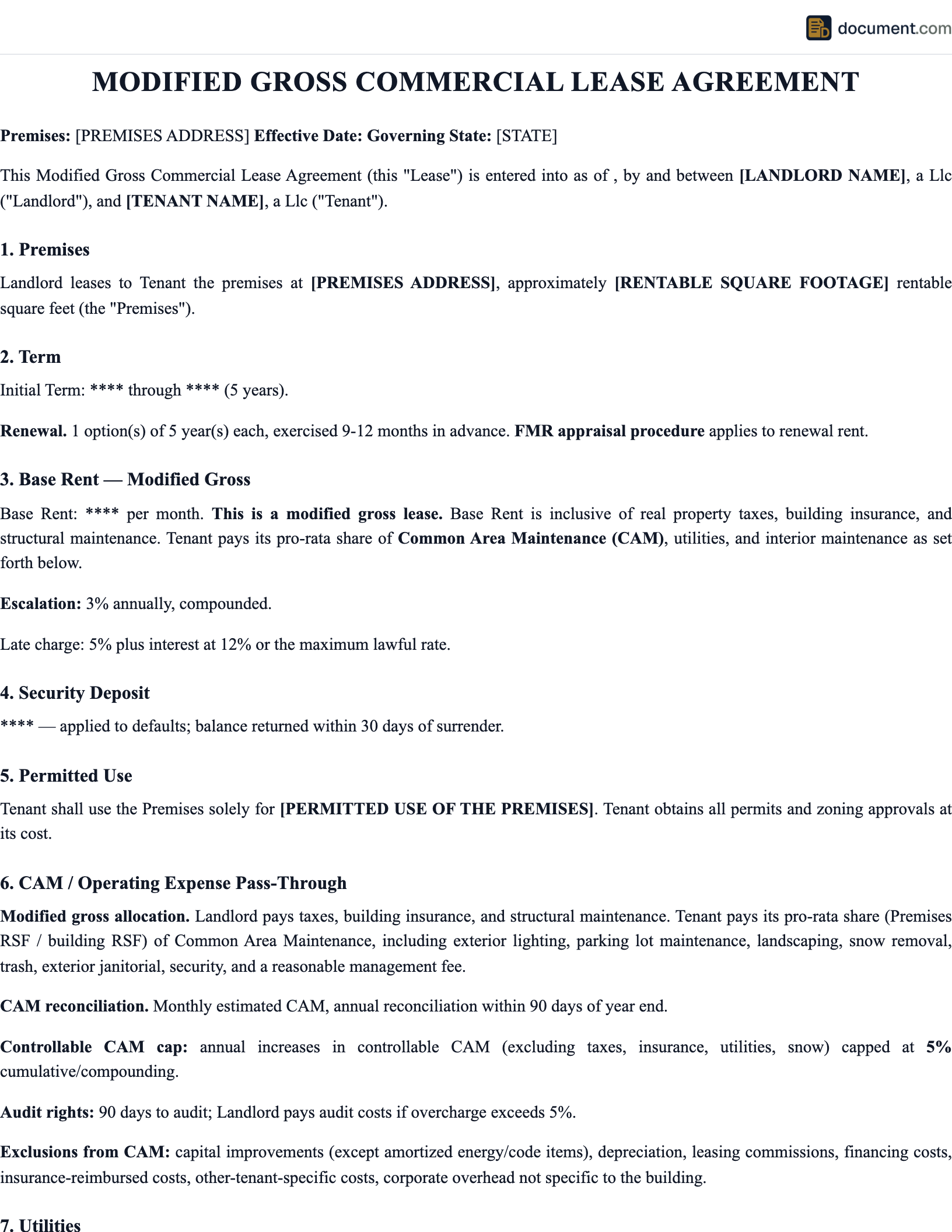



Kentucky Commercial Modified Gross Lease Overview
A modified gross lease in Kentucky is a negotiated structure where the landlord and tenant agree on exactly which operating expenses are included in the base rent and which the tenant pays separately. Unlike a triple-net lease, where the tenant absorbs taxes, insurance, and maintenance on top of base rent, a modified gross lease gives both parties flexibility to assign costs in whatever way makes sense for the building and the market. Kentucky contract law governs the relationship, so the written lease terms control.
Louisville and Lexington are the primary Kentucky markets where modified gross structures appear. Suburban office parks in Louisville's East End and Lexington's Hamburg area regularly use modified gross leases where landlords keep property taxes and building insurance in the base rent while tenants handle their own utilities and suite HVAC maintenance. Louisville's large industrial and logistics sector leans more toward NNN, so modified gross is primarily an office and retail product in Kentucky. Kentucky imposes no commercial rent tax, which simplifies modified gross rent calculations.
KY
State-specific
Varies
Filing fees
Written
Required format
Contract
Law governs
Kentucky Legal Requirements
Kentucky modified gross leases must comply with the state's statute of frauds for terms exceeding one year and should meticulously document the expense allocation to avoid future disputes under Kentucky contract law.
Kentucky Specific Note
Kentucky courts interpret commercial lease terms as written without implying additional obligations. In a modified gross lease, every expense category needs to be expressly assigned. Courts will not fill gaps by inferring what the parties intended, which means unclear language about HVAC replacement or parking lot maintenance can result in neither party clearly responsible for a necessary repair.
Document Requirements
- Written Form: Kentucky's statute of frauds requires commercial leases for terms longer than one year to be in writing and signed by the party to be charged
- Expense Allocation Schedule: A detailed exhibit enumerating which operating expenses the landlord covers in base rent and which the tenant pays is the core of any Kentucky modified gross lease
- PVA Tax Provisions: Property tax treatment should reference the applicable county PVA assessment process and specify whether increases above a base-year amount are passed through to the tenant
- HVAC Responsibility: The lease should explicitly state which party handles HVAC servicing, repairs below a dollar threshold, and full unit replacement given Kentucky's four-season climate demands
- Escalation Clause: Annual rent increases tied to CPI or a fixed percentage protect landlords who are absorbing taxes and insurance costs in base rent over a multi-year term
- Entity Authorization: Corporations should provide a resolution authorizing the signing officer; LLCs should confirm the member or manager has authority under the operating agreement
How to Draft a Commercial Modified Gross Lease in Kentucky
The drafting process for a Kentucky modified gross lease flows from the expense split decision. Getting that right before touching the document saves significant back-and-forth during negotiations.
Negotiate the Expense Split First
Before drafting, agree in writing on which expenses the landlord covers in base rent and which the tenant handles separately. For Louisville and Lexington office deals, start with the market standard: landlord pays taxes and insurance, tenant pays utilities, janitorial, and HVAC maintenance. Industrial or flex space may warrant a different split.
Review Kentucky PVA Assessment History
If the landlord is absorbing property taxes in base rent, request the last three years of PVA assessment and tax bills for the property. Understanding the tax history helps both parties set a fair expense stop or base-year threshold that accounts for potential reassessments during the lease term.
Draft a Detailed Expense Exhibit
Create a schedule attached to the lease that lists every operating expense category and marks each as landlord-responsibility or tenant-responsibility. Do not leave any category implicit. The schedule should address at minimum: property taxes, building insurance, roof and structure repairs, HVAC servicing and replacement, parking lot maintenance, utilities, janitorial, and trash removal.
Add Escalation and Kentucky-Specific Provisions
Include an annual rent escalation clause (CPI or fixed percent), Kentucky governing law and county venue selection, HVAC replacement protocol, and a provision permitting the tenant to record a lease memorandum with the County Clerk. If the lease includes tenant improvement allowances, document the repayment and amortization terms carefully.
Execute and Record
Both parties sign with authorized signatories; entities should use notarized signatures if a memorandum will be recorded. Record the memorandum with the Kentucky County Clerk in the county where the property sits to protect the tenant's leasehold interest against subsequent encumbrances.
Kentucky-Specific Key Provisions
Several provisions matter specifically in Kentucky modified gross transactions beyond the basic expense schedule.
PVA reassessment protection is a meaningful drafting point for any Kentucky landlord who absorbs property taxes in base rent. Jefferson County (Louisville) and Fayette County (Lexington) PVAs conduct periodic reassessments, and a significant upward revision during a five-year lease could substantially erode the landlord's net position. Drafting an expense stop keyed to the base-year tax bill, with increases passed through as a separate tenant obligation, is a common solution that the Louisville market routinely accepts.
Parking provisions require attention in both Louisville and Lexington where urban and suburban market norms differ. Downtown Louisville modified gross office leases frequently include structured parking at a separate monthly charge rather than embedded in the base rent. Suburban Lexington and Louisville properties more often include surface parking in the rent. The lease should clearly state whether parking is included, how many spaces are allocated, and who handles lot maintenance and snow removal.
Kentucky Fees & Costs
Below is a breakdown of typical costs associated with commercial lease transactions in Kentucky. Actual fees may vary by county and specific circumstances.
| Fee / Cost | Typical Amount |
|---|---|
| Base Rent (Louisville / Lexington office) | $14 - $24 per sq ft annually |
| Tenant-Paid Utilities | $1.50 - $3.50 per sq ft annually |
| PVA Tax Stop Overage (if applicable) | Varies by assessment cycle |
| Kentucky Attorney Review | $750 - $2,500 |
| County Clerk Recording (memorandum) | $20 - $100 depending on county and pages |
Sample Kentucky Commercial Modified Gross Lease
Below is a preview of our Kentucky-specific commercial modified gross lease. Your customized document will include all fields and provisions required under KY law.
COMMERCIAL MODIFIED GROSS LEASE
STATE OF KENTUCKY
KY-Compliant Template
PARTY A:
Name: [Full Legal Name]
Address: [Kentucky Address]
PARTY B:
Name: [Full Legal Name]
Address: [Kentucky Address]
PROPERTY / PREMISES:
Address: [Property Address]
County: [Kentucky County]
KENTUCKY COMPLIANCE
This document complies with Kentucky (KY) state law requirements and includes all provisions mandated for this type of document in Kentucky.