



Iowa Commercial Modified Gross Lease Overview
A modified gross lease occupies the middle ground between a full gross lease, where the landlord covers most operating costs, and a NNN lease, where the tenant pays nearly everything on top of base rent. In Iowa, this hybrid structure appears frequently in Des Moines office markets, medical office buildings, and suburban mixed-use properties. The tenant pays a fixed monthly rent that includes some operating expenses, with the specific allocation of other costs set out in the lease.
Iowa does not have a commercial rent tax, which keeps the cost structure straightforward. The primary complexity in Iowa modified gross leases is property taxes. Iowa assesses commercial property at 90% of actual value and applies an annual rollback factor, which means the effective property tax rate can shift year to year. Leases that include a property tax overage mechanism need to address how the rollback is factored in. Without clear language, disputes over whether overages are triggered by assessed value changes or actual tax bills are common.
No state
Commercial rent tax
Exhibit
Required for splits
Rollback
Iowa tax factor
Contract
Law governs
Iowa Legal Requirements
Iowa modified gross commercial leases are governed by contract law. There is no mandatory form or state-specific checklist. The provisions below represent the substantive lease obligations that determine each party's rights and cost exposure over the term.
The Expense Allocation Exhibit Is Critical
In an Iowa modified gross lease, the phrase "modified gross" has no fixed legal meaning. Two leases can both call themselves modified gross but allocate expenses completely differently. A written exhibit or schedule listing every expense category and which party is responsible is not optional; it is the foundation of the entire cost structure. Iowa courts will enforce the written terms without looking for implied intent.
Key Lease Provisions
- Expense Allocation Exhibit: List every operating expense category and which party covers it. Include specific Iowa costs such as snow removal, parking lot maintenance, and property tax overages. Vague language about "typical operating expenses" invites disputes.
- Utility Metering: If the tenant is directly responsible for utilities, confirm the premises are separately metered. Iowa properties are not always individually metered, and a shared meter requires a sub-metering arrangement or an estimated allocation formula.
- Property Tax Base Year: If the lease includes property tax overage obligations, set the base year with care. Iowa's rollback system means the effective rate can shift independent of changes in the property's assessed value. Define whether the overage threshold is based on actual taxes paid or assessed value.
- Rent Escalation: Iowa modified gross leases commonly use fixed annual increases of 2% to 3%. Set the escalation mechanism clearly, including whether it applies to the base rent only or to the full payment including any pass-through amounts.
- Structural Responsibility: Confirm the landlord's obligations for the roof, foundation, exterior walls, and major building systems. Iowa winters accelerate wear on roofing and HVAC systems, so defining response timelines and maintenance standards matters.
How to Draft a Commercial Modified Gross Lease in Iowa
Drafting an Iowa modified gross lease well requires resolving the expense allocation before any document language is written. These steps cover the process in order of importance.
Agree on the Expense Split First
Before drafting, landlord and tenant should discuss and agree on which operating expenses go in the base rent and which the tenant handles separately. For Iowa properties, this conversation must specifically address snow removal, property tax overages above the expense stop, and whether utilities are included or direct-paid.
Build the Expense Allocation Exhibit
Draft a detailed exhibit listing every cost category and the responsible party. Include a section on how Iowa's property tax rollback affects the base year calculation and define whether overages are measured against actual taxes paid or the assessed value. This exhibit is the most important part of the document.
Set the Escalation Schedule
Choose a rent escalation mechanism and document it clearly. Iowa modified gross leases commonly use fixed percentage bumps of 2% to 3% per year. Confirm whether the escalation applies to the base rent only or to any expense pass-through amounts as well.
Address Structural Obligations and Iowa Winter Costs
Confirm the landlord's responsibility for the roof, foundation, and major building systems, and set a timeline for repair responses. Address snow removal and parking lot maintenance specifically. For Iowa properties in Des Moines, Cedar Rapids, or other northern cities, these costs can be significant and deserve explicit treatment.
Execute and Consider Recording
Both parties sign the lease and receive copies. For long-term leases, parties may record a memorandum of lease at the Iowa county recorder to establish the leasehold in the public record without disclosing financial terms. Iowa does not require recording for enforceability.
Iowa-Specific Key Provisions
Iowa has no commercial rent tax, which is a meaningful cost advantage compared to states that impose one. The Iowa Department of Revenue does not tax commercial rent as a standalone transaction. Property taxes in Iowa are set at the county level but subject to state-controlled rollback percentages. For Des Moines properties, Polk County assessments and the applicable rollback should be confirmed before setting the base year expense stop.
Iowa does not have a local commercial rent surcharge analogous to Chicago's, which simplifies the tenant's cost modeling. The primary Iowa-specific tax issue in a modified gross lease is how property tax overages are triggered. Because the Iowa rollback can change the effective tax rate even when the assessed value stays flat, the lease should define overage obligations based on actual taxes billed, not a formula derived from assessed value alone.
Iowa Fees & Costs
Below is a breakdown of typical costs associated with commercial lease transactions in Iowa. Actual fees may vary by county and specific circumstances.
| Fee / Cost | Typical Amount |
|---|---|
| Base Rent | Negotiated; includes some operating expenses as defined in the expense allocation exhibit |
| Tenant Utilities | Paid directly by tenant; typically electricity, gas, and internet for the leased premises |
| Janitorial | Usually a direct tenant obligation in Iowa modified gross leases; confirm in the expense exhibit |
| Property Tax Overage | Tenant pays pro-rata share of Iowa property taxes above the base year expense stop; Iowa rollback affects actual amounts |
| Attorney Review | $500 to $2,000 for Iowa commercial lease review and expense exhibit drafting |
| Memorandum of Lease Recording (optional) | $15 for first page at county recorder; no transfer tax on leasehold |
Sample Iowa Commercial Modified Gross Lease
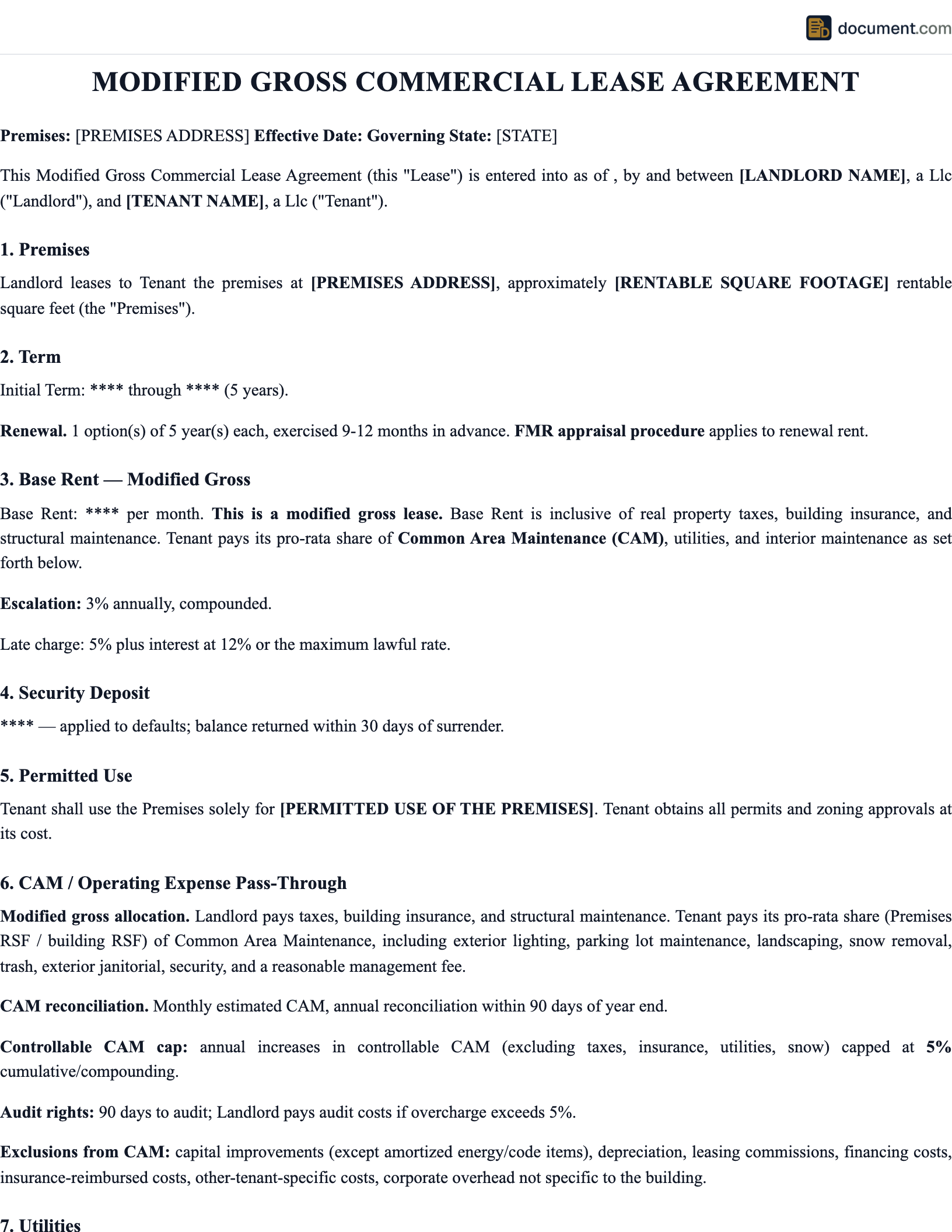
Below is a preview of our Iowa-specific commercial modified gross lease. Your customized document will include all fields and provisions required under IA law.
COMMERCIAL MODIFIED GROSS LEASE
STATE OF IOWA
IA-Compliant Template
PARTY A:
Name: [Full Legal Name]
Address: [Iowa Address]
PARTY B:
Name: [Full Legal Name]
Address: [Iowa Address]
PROPERTY / PREMISES:
Address: [Property Address]
County: [Iowa County]
IOWA COMPLIANCE
This document complies with Iowa (IA) state law requirements and includes all provisions mandated for this type of document in Iowa.