



Indiana Commercial Modified Gross Lease Overview
An Indiana modified gross lease places a base rent obligation on the tenant and then allocates specific operating expenses between the landlord and tenant through a negotiated schedule. Neither party bears all costs as in a pure gross or triple net lease. This structure is especially common in Indiana's office park market, where Indianapolis-area properties in Carmel, Fishers, Westfield, and downtown Indianapolis use modified gross terms to balance predictability for tenants against the landlord's need to manage inflation in operating costs over multi-year terms.
Indiana commercial leases are governed by contract law under Indiana Code. There is no specific commercial landlord-tenant statute that overrides negotiated lease terms. Indiana's circuit breaker cap on commercial property taxes at 3 percent of assessed value provides both parties with more cost predictability than in states without such a cap, which simplifies the expense allocation negotiation and reduces disputes about future tax exposure.
No state
Commercial rent tax
3% cap
Property tax circuit breaker
Exhibit
Expense split required
Contract
Law governs
Indiana Modified Gross Lease Requirements
Indiana modified gross leases must be in writing for terms exceeding one year under Indiana's statute of frauds. Beyond that threshold requirement, the substance of the expense allocation is determined entirely by negotiation. These are the provisions that matter most.
Expense Allocation Exhibit is Critical
A lease that simply says "modified gross" without a detailed expense exhibit does not tell either party what they are actually responsible for. Indiana courts will interpret ambiguous lease terms against the drafter. Draft a signed exhibit that lists each expense category, who bears it, and any applicable threshold or cap. This prevents the most common source of modified gross lease disputes in Indiana commercial properties.
Key Provisions
- Written Expense Allocation Exhibit: List each operating cost category and the responsible party; include any caps, base year thresholds, and reconciliation timelines
- Utility Metering: Confirm whether each tenant has separately metered utilities; if sub-metered, define the sub-metering methodology and who pays the metering cost
- Property Tax Base Year: If the tenant absorbs tax increases above a base year stop, define the base year, the tax component included, and the reconciliation process; Indiana's circuit breaker at 3 percent of assessed value sets a ceiling but the assessed value can still increase year over year
- Rent Escalation: Define the annual escalation rate; fixed 2 to 3 percent is standard in Indianapolis-area office markets; define the base year for any CPI calculation if CPI is used
- Structural Responsibility: Assign roof, foundation, and structural systems explicitly to the landlord; define the landlord's repair response timeline and tenant remedies for landlord default
How to Draft an Indiana Modified Gross Commercial Lease
Drafting an Indiana modified gross lease begins with the expense allocation, not the rent number. Follow these steps to build a complete and enforceable document.
Agree on the Expense Split Before Setting Base Rent
Decide which costs each party bears before negotiating rent. In Indiana office parks, a common starting point is: tenant pays electricity, gas, and janitorial; landlord covers property taxes (up to base year stop), building insurance, structural systems, and common area costs. Once the split is defined, price the base rent to reflect only the landlord's retained cost burden.
Build the Expense Allocation Exhibit
Draft and sign an exhibit that lists every operating cost and the responsible party. For any shared costs, define the allocation formula. If the tenant bears property tax increases above a base year, define that year, describe the reconciliation process, and reference Indiana's circuit breaker cap as context for the maximum possible tax burden.
Define Escalation and Renewal Terms
Set the base rent escalation rate for each year of the lease term. Fixed annual increases of 2 to 3 percent are standard in Indianapolis-area commercial markets. Address renewal option rent at this stage as well, whether at fair market value, a fixed amount, or a defined percentage above the expiring rent.
Address Structural and Capital Repair Obligations
Confirm the landlord is responsible for the roof, structural systems, and building mechanical infrastructure. In a modified gross structure, the tenant often maintains HVAC units that serve only their space while the landlord handles building-wide systems. Define this boundary explicitly and set a landlord repair response period.
Execute and File
Both parties sign the lease and all attached exhibits. Distribute executed copies. For leases over five years, consider recording a memorandum of lease at the Indiana county recorder's office. Indiana has no real property transfer tax, so recording costs are limited to per-page recorder fees.
Indiana Modified Gross Lease Key Provisions
Beyond the core expense split, several provisions specific to Indiana commercial markets appear in modified gross leases and deserve attention before signing.
Indiana has no statewide commercial rent tax, which simplifies the lease economics. However, local business personal property taxes can apply to tenant equipment installed in the leased space. Tenants should confirm who is responsible for personal property taxes on tenant-owned fixtures and equipment, since this cost is sometimes listed as a tenant expense in Indiana modified gross leases for industrial and flex properties.
Indiana's circuit breaker mechanism caps commercial real property taxes at 3 percent of assessed value, but assessed values themselves can increase annually through the county assessor's office. The base year chosen for the property tax stop in a modified gross lease determines how much of any future increase falls on the tenant. Choosing a high-assessment base year lowers the tenant's overage exposure in future years, while choosing a low-assessment base year achieves the opposite. This negotiating point deserves attention in any modified gross lease for Indiana commercial property.
Indiana Modified Gross Lease Costs
Typical costs associated with an Indiana modified gross commercial lease. Tenant-paid utilities and any property tax overage share are the main variable items beyond the base rent.
| Cost Item | Typical Amount |
|---|---|
| Base Rent | Negotiated; varies by Indiana submarket and building type |
| Tenant-Paid Utilities | Electric, gas, and data services typically assigned to tenant |
| Janitorial (tenant space) | Usually tenant's responsibility in Indiana modified gross leases |
| Property Tax Overage Share | Pro-rata share of increases above base year (if applicable); capped at 3% of AV by Indiana circuit breaker |
| Attorney Review | $300 - $1,500+ depending on lease complexity |
| Memorandum of Lease Recording (optional) | Indiana county recorder per-page fees; no transfer tax |
Sample Indiana Commercial Modified Gross Lease
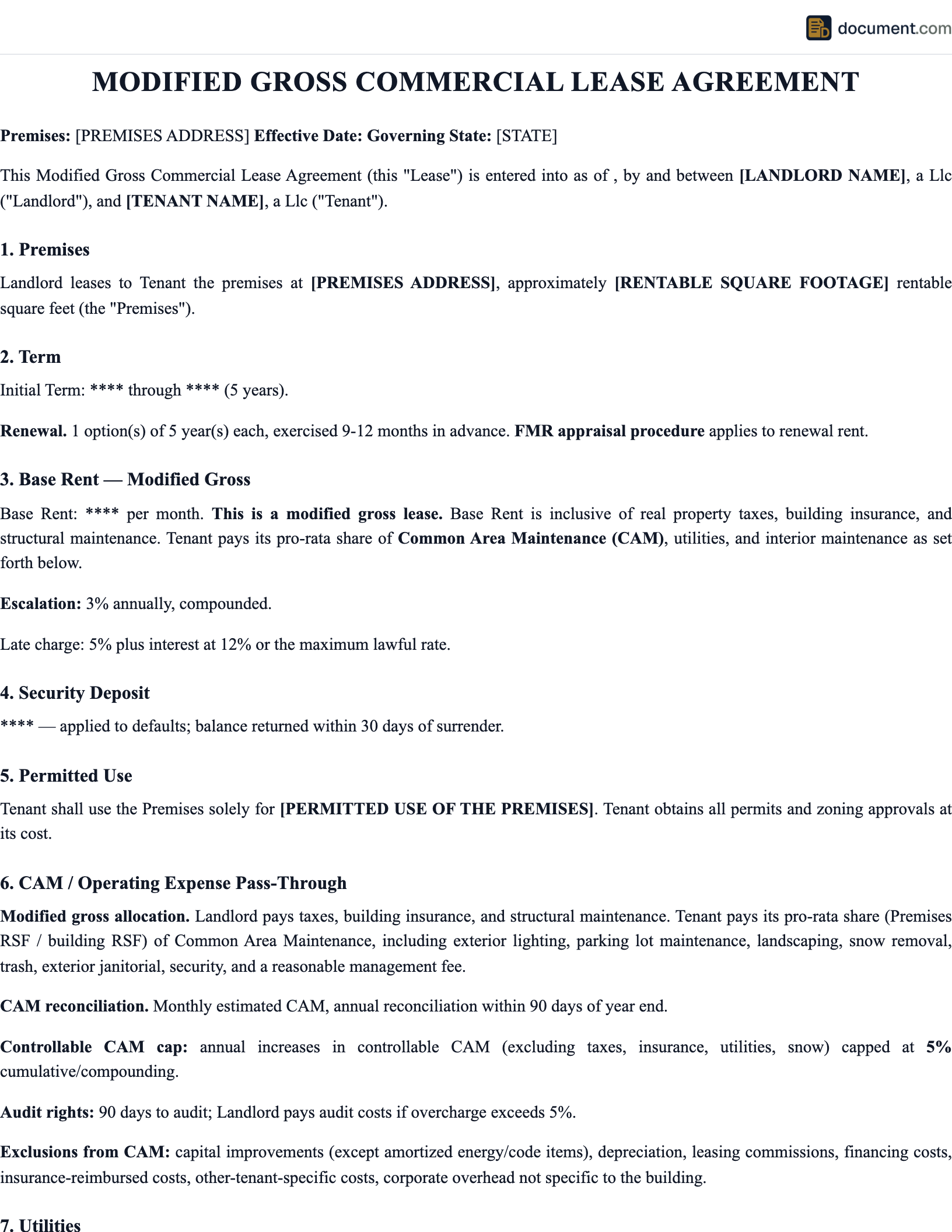
Below is a preview of our Indiana-specific commercial modified gross lease. Your customized document will include all fields and provisions required under IN law.
COMMERCIAL MODIFIED GROSS LEASE
STATE OF INDIANA
IN-Compliant Template
PARTY A:
Name: [Full Legal Name]
Address: [Indiana Address]
PARTY B:
Name: [Full Legal Name]
Address: [Indiana Address]
PROPERTY / PREMISES:
Address: [Property Address]
County: [Indiana County]
INDIANA COMPLIANCE
This document complies with Indiana (IN) state law requirements and includes all provisions mandated for this type of document in Indiana.