



Illinois Commercial Modified Gross Lease Overview
A modified gross lease in Illinois divides operating costs between the landlord and tenant according to a negotiated schedule rather than assigning all expenses to one side. The tenant pays a defined base rent, and then specific costs such as utilities, janitorial service, and sometimes a share of property tax increases are allocated to the tenant by agreement. Everything else remains the landlord's responsibility. This structure is popular in Chicago office submarkets including River North, the West Loop, and Schaumburg, as well as in flex industrial parks throughout the state.
Illinois commercial leases are governed by contract law under the Illinois Compiled Statutes. There is no commercial landlord-tenant statute equivalent to the residential Residential Landlord Tenant Ordinance that applies in many Illinois cities. That means the parties have broad latitude to customize the expense allocation, but it also means that poorly drafted expense language creates genuine legal risk. The expense split exhibit is often the most heavily negotiated part of an Illinois modified gross lease.
No state
Commercial rent tax
Exhibit
Expense split required
Triennial
Cook County reassessment
Contract
Law governs
Illinois Modified Gross Lease Requirements
Illinois modified gross leases are governed by contract law under the Illinois Compiled Statutes. The statute of frauds requires commercial leases for more than one year to be in writing, signed by the party to be charged. Beyond that threshold requirement, the substance of the expense allocation is almost entirely negotiated. These are the provisions that matter most.
Expense Allocation Exhibit is Essential
Do not rely on the lease body alone to define the expense split. A separate expense allocation exhibit or schedule that lists each cost category with the responsible party and any applicable cap or threshold is the cleanest way to document a modified gross arrangement in Illinois. Illinois courts interpret ambiguous commercial lease terms against the drafter, so precision in the exhibit protects both sides.
Key Provisions
- Written Expense Allocation: Include a signed exhibit that lists each operating cost and specifies which party is responsible; avoid relying on generic modified gross language without specifics
- Utility Metering: Confirm whether tenant utilities are separately metered or sub-metered; for multi-tenant buildings in Chicago, sub-metering arrangements require definition in the lease
- Property Tax Responsibility: Specify whether the tenant absorbs property tax increases above a base year amount; Cook County's triennial reassessment cycle makes this a material provision for Cook County properties
- Rent Escalation: Define how base rent increases each year; fixed percentage, CPI tied to the Chicago metro index, or step rents are all common approaches in Illinois office and flex industrial leases
- Structural and Capital Repairs: Confirm the landlord retains responsibility for structural elements, roof, and building systems, distinguishing these from tenant-space mechanical items that may be assigned to the tenant in a modified gross structure
How to Draft an Illinois Modified Gross Commercial Lease
The expense allocation is the defining feature of any modified gross lease. Drafting one for Illinois property requires working through the expense split carefully before finalizing the base rent number, since the two are interdependent.
Agree on the Expense Split Before Setting Base Rent
List every material operating cost category and decide who pays. In Illinois office buildings, a common starting point is tenant pays electricity, gas, and janitorial while the landlord covers property taxes, insurance, structural maintenance, and common area costs. Once the split is agreed, price the base rent to reflect only the landlord's actual retained cost burden.
Build the Expense Allocation Exhibit
Draft a signed exhibit or schedule that lists every cost item and the party responsible. Include any thresholds or caps. If the tenant will bear a share of tax increases above a base year, define the base year and the reconciliation process explicitly. For Cook County properties, note that the triennial reassessment cycle means significant expense fluctuations are normal.
Set Escalation and Renewal Terms
Define how the base rent escalates annually. Fixed annual increases of 2 to 3 percent are standard in Illinois commercial markets. If CPI is used, tie it to the Chicago metro area index. Address renewal option rent, whether at fixed rate, fair market value, or a blend, so both parties understand future obligations from the start.
Address Structural and Capital Items
Confirm that structural elements, the roof, and building-wide mechanical systems remain the landlord's responsibility. In a modified gross lease, tenants frequently maintain the HVAC within their own space while the landlord covers the building envelope and shared systems. Make these boundaries explicit to avoid disputes during the tenancy.
Execute and File
Both parties sign the lease and all attached exhibits. Distribute fully executed copies to all parties. For leases over five years, consider recording a memorandum of lease with the county recorder of deeds to protect the tenant's interest against future property transfers or financing arrangements.
Illinois Modified Gross Lease Key Provisions
Beyond the expense split, several provisions are particularly important in Illinois modified gross leases and often get overlooked in early drafts. Review these carefully whether you are the landlord or tenant.
For Chicago-area properties, the property tax reconciliation process deserves specific attention. Cook County sends commercial property tax bills in two installments, and the second installment is often delayed. Leases should account for the possibility that a reconciliation will include taxes billed during the following calendar year. Failure to address this timing issue can create disputes about which lease year's expense stop applies to a late-arriving tax bill.
Illinois does not impose a statewide commercial rent tax, which simplifies the economic analysis compared to states like Hawaii or some municipalities in other states. However, Chicago and other Illinois municipalities may impose local business taxes or license fees that affect cost of occupancy. Confirm which local fees apply to your property and whether any are appropriately allocated in the expense exhibit.
Illinois Modified Gross Lease Costs
Typical costs associated with an Illinois modified gross commercial lease. Tenant-paid utilities and any expense stop overages are the main variable items beyond the agreed base rent.
| Cost Item | Typical Amount |
|---|---|
| Base Rent | Negotiated; varies by property type and Illinois submarket |
| Tenant-Paid Utilities | Electric, gas, and data lines typically assigned to tenant |
| Janitorial (tenant space) | Usually tenant's responsibility under a modified gross structure |
| Property Tax Overage Share | Pro-rata share of increases above base year stop (if applicable) |
| Attorney Review | $500 - $2,500+ depending on lease complexity |
| Memorandum of Lease Recording (optional) | County recorder per-page fees; advisable for longer-term leases |
Sample Illinois Commercial Modified Gross Lease
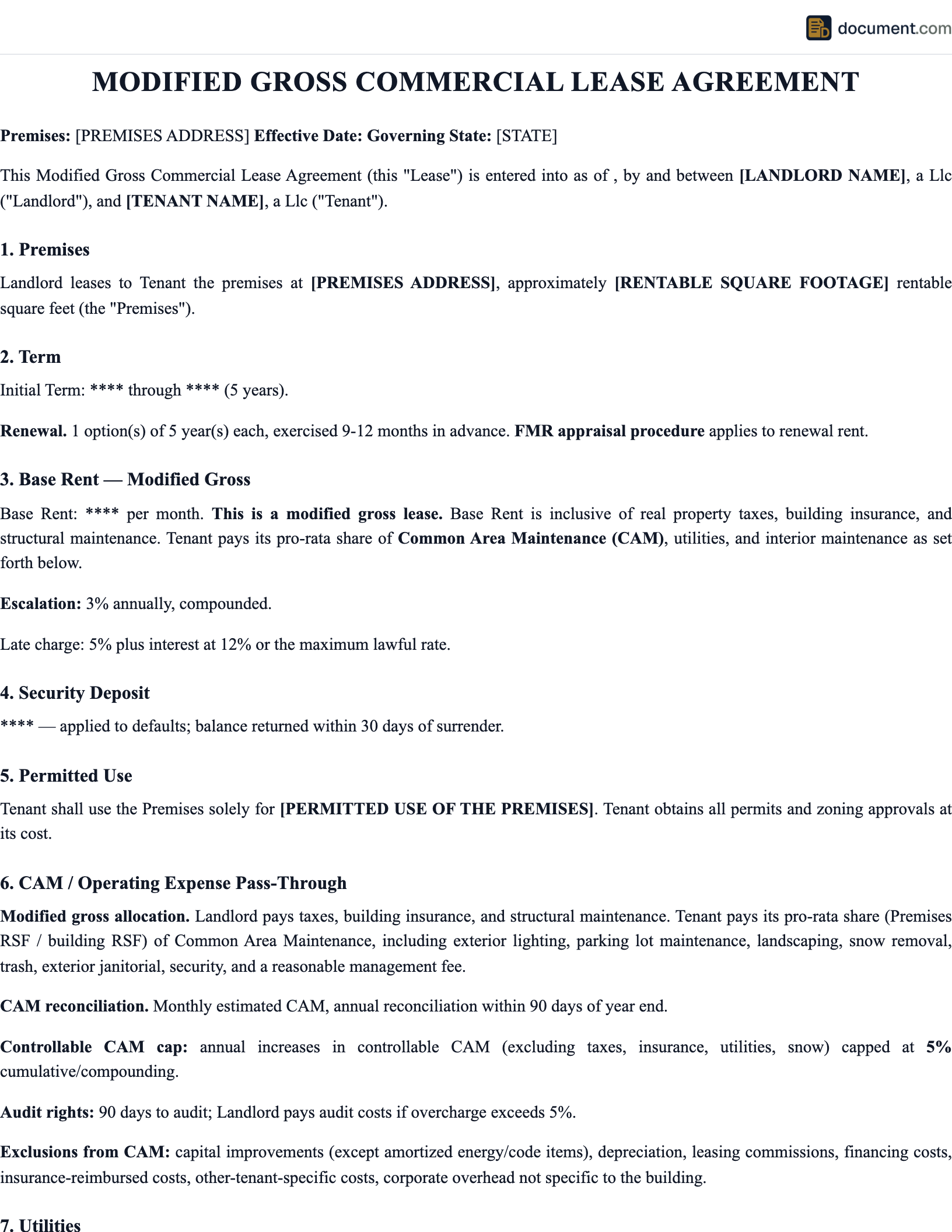
Below is a preview of our Illinois-specific commercial modified gross lease. Your customized document will include all fields and provisions required under IL law.
COMMERCIAL MODIFIED GROSS LEASE
STATE OF ILLINOIS
IL-Compliant Template
PARTY A:
Name: [Full Legal Name]
Address: [Illinois Address]
PARTY B:
Name: [Full Legal Name]
Address: [Illinois Address]
PROPERTY / PREMISES:
Address: [Property Address]
County: [Illinois County]
ILLINOIS COMPLIANCE
This document complies with Illinois (IL) state law requirements and includes all provisions mandated for this type of document in Illinois.