
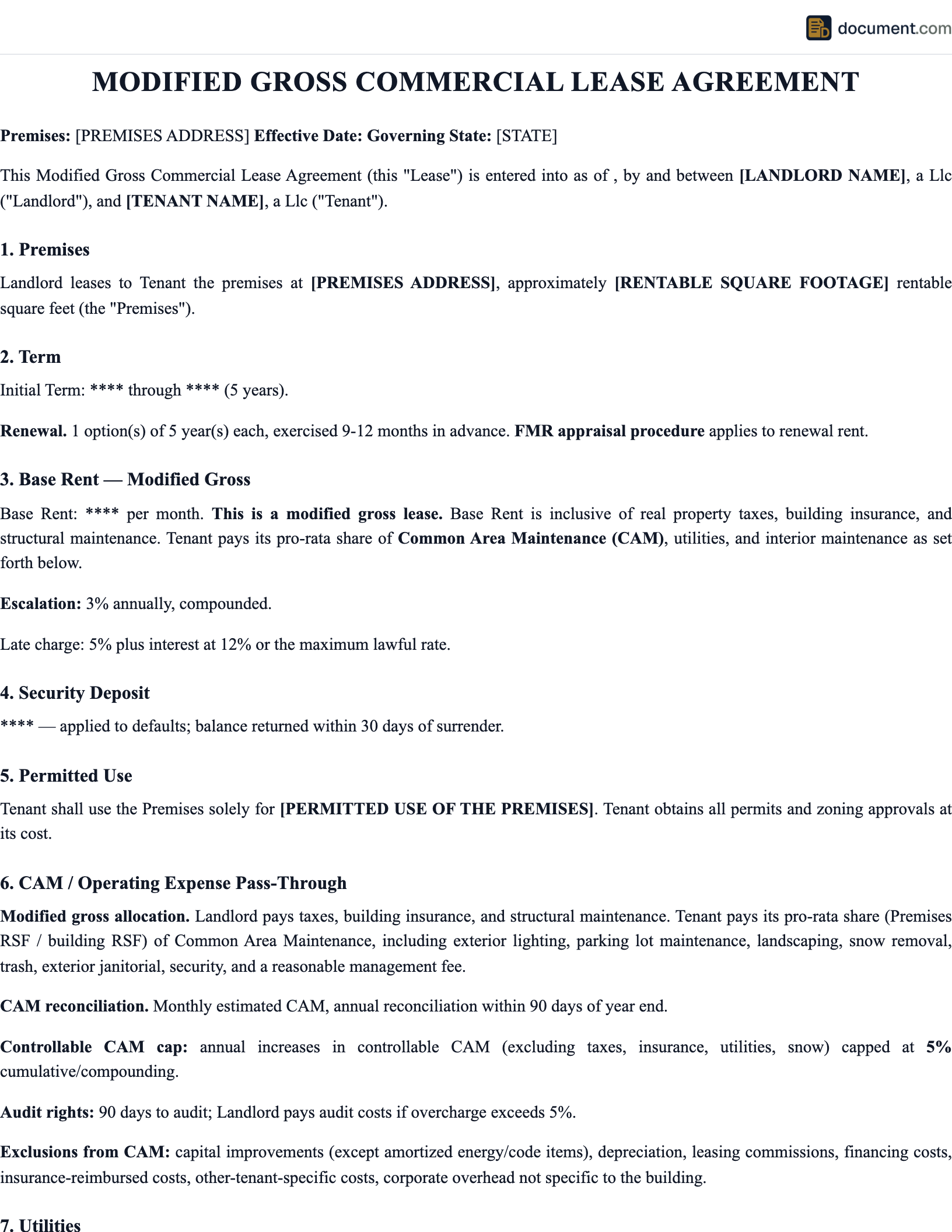



Idaho Commercial Modified Gross Lease Overview
A modified gross lease sits between a full gross lease and a triple net lease. The landlord and tenant negotiate which operating costs each party covers, and the written lease documents that split in detail. Idaho has no commercial landlord-tenant statute setting default expense rules, so the contract controls everything. Modified gross structures are common in Idaho for office, flex, and light industrial space, particularly in the Boise metro where the commercial market has grown rapidly and tenants and landlords have converged on workable hybrid cost structures.
Idaho has no commercial rent tax and no real property transfer tax, simplifying the cost structure compared to some other states. The tenant's total occupancy cost under an Idaho modified gross lease is base rent plus the specific expense categories assigned to the tenant in the lease, such as utilities, janitorial, or certain maintenance items. Getting those categories precisely defined in the lease document is the most important drafting task for both parties.
ID
State-specific
Varies
Filing fees
Written
Required format
Contract
Law governs
Idaho Modified Gross Lease Requirements
Idaho commercial leases must satisfy contract formation requirements and, for terms over one year, must be in writing under the statute of frauds. Beyond that, the lease itself creates all rights and obligations. A modified gross lease requires especially precise expense documentation because the hybrid structure creates more potential for disagreement than a pure gross or NNN lease.
Idaho Tip: Document Every Expense Category in Writing
Idaho courts will enforce the lease terms as written. A modified gross lease that uses vague language like tenant pays its own expenses or landlord covers building costs will lead to disputes over edge cases. Build a detailed expense exhibit that assigns every cost category. Idaho's rapid commercial growth in Ada and Canyon counties has increased the number of modified gross lease disputes as properties change hands and new landlords interpret vague legacy language differently.
Key Provisions for an Idaho Modified Gross Lease
- Written Expense Split: List every operating expense and assign it clearly to landlord or tenant; use an exhibit if the list is long
- Utility Metering: Specify whether tenant-paid utilities are separately metered to the premises or billed back through a landlord account
- Maintenance Responsibilities: Define maintenance obligations for HVAC, plumbing, dock equipment, and other systems by unit or by building
- Escalation Provisions: Set annual base rent increases and specify how any landlord-retained cost categories can be passed to the tenant above a threshold
- Structural Responsibility: Explicitly assign roof, foundation, and major structural repairs to one party regardless of the modified gross label
How to Draft an Idaho Modified Gross Lease
Building a clear Idaho modified gross lease starts with agreeing on the expense split before anyone opens a template. Once the allocation is settled, the drafting process moves quickly.
Agree on the Expense Split First
Before drafting, both parties should agree in a letter of intent on which specific costs the tenant pays and which the landlord covers. In Idaho this typically means the tenant takes utilities and janitorial and the landlord keeps property taxes, insurance, exterior maintenance, and roof. Document any departures from this standard clearly.
Build the Expense Exhibit
Translate the agreed split into a written exhibit listing every expense category and its assigned party. Idaho industrial leases should pay special attention to HVAC, dock equipment, and fire suppression systems, as responsibility for these can be a significant cost item in warehouse and distribution space.
Set Escalation Terms
Agree on annual base rent escalation and any mechanism for the landlord to pass through cost increases in the retained expense categories. Cap CPI escalation and specify that market rent resets at option periods require independent appraisal.
Address Structural and Capital Items
Even though the modified gross label implies the landlord handles major costs, state structural and capital expense assignments explicitly. Idaho's newer commercial construction stock means these issues may not arise soon, but for older buildings or long lease terms they can become significant.
Execute and Distribute
Both parties sign with authorized signatures. Provide executed copies to all parties. Attach all exhibits. A memorandum of lease can be recorded with the county recorder for public notice if desired.
Idaho Modified Gross Lease Costs
Idaho has no commercial rent tax, making the cost structure for a modified gross lease relatively straightforward. The tenant pays base rent plus the assigned tenant expense categories. The table summarizes typical cost categories.
| Cost Item | Typical Range |
|---|---|
| Base Rent (fixed) | Negotiated; lower than gross lease rents because tenant pays certain extras |
| Tenant-Paid Utilities | Varies based on usage; Idaho utility rates are generally moderate |
| Janitorial Services (if tenant-paid) | Typically $0.05 to $0.15 per sq ft monthly depending on frequency |
| Attorney Review | $400 to $1,500 depending on lease complexity |
| Memorandum of Lease Recording (optional) | $10 base fee at county recorder |
Sample Idaho Commercial Modified Gross Lease
Below is a preview of our Idaho-specific commercial modified gross lease. Your customized document will include all fields and provisions required under ID law.
COMMERCIAL MODIFIED GROSS LEASE
STATE OF IDAHO
ID-Compliant Template
PARTY A:
Name: [Full Legal Name]
Address: [Idaho Address]
PARTY B:
Name: [Full Legal Name]
Address: [Idaho Address]
PROPERTY / PREMISES:
Address: [Property Address]
County: [Idaho County]
IDAHO COMPLIANCE
This document complies with Idaho (ID) state law requirements and includes all provisions mandated for this type of document in Idaho.