
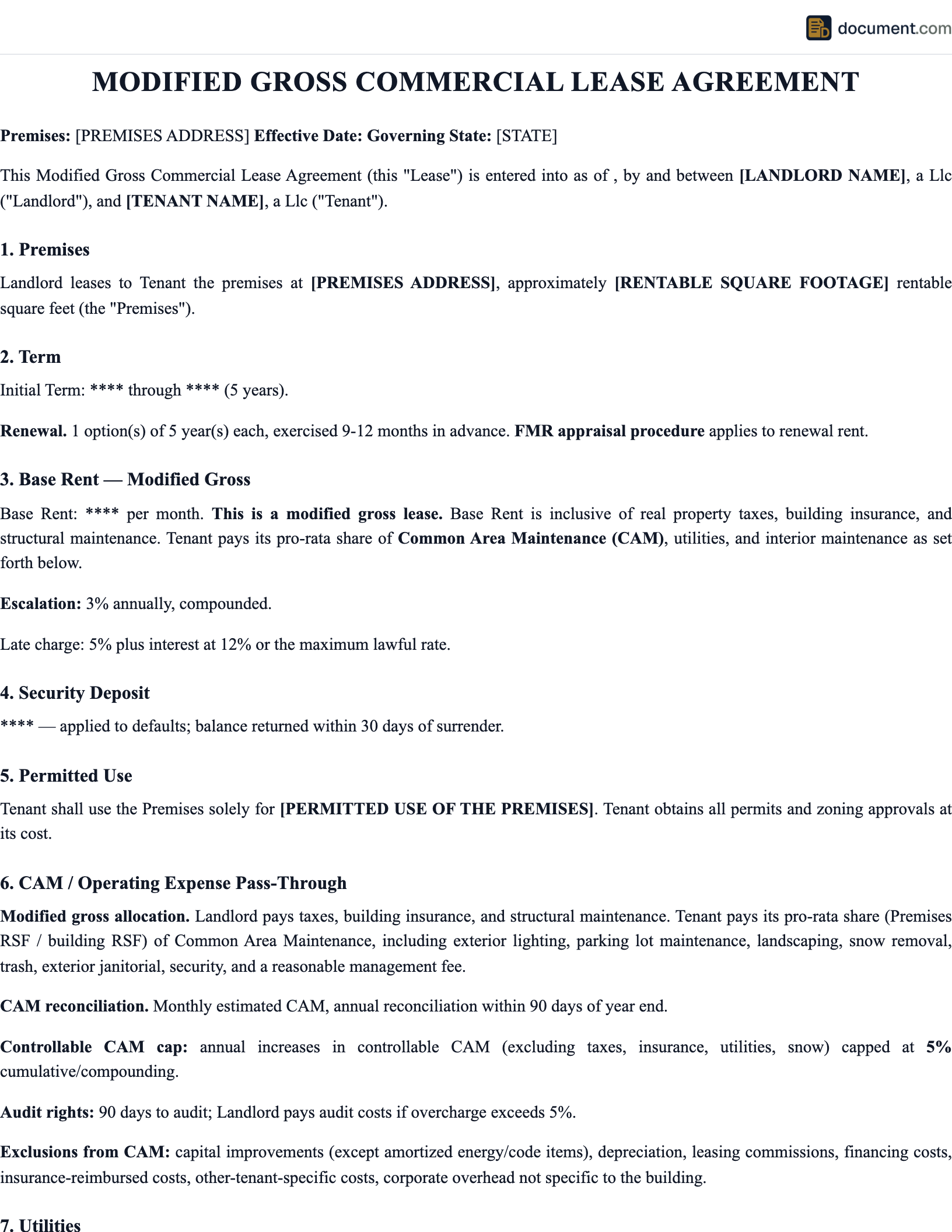



Hawaii Commercial Modified Gross Lease Overview
A modified gross lease occupies the middle ground between a full gross lease (where the landlord pays all operating costs) and a triple net lease (where the tenant pays property taxes, insurance, and maintenance). In Hawaii, this hybrid structure is common for office and flex commercial space, where tenants want some cost predictability while landlords want protection against rising expenses for specific cost categories they find difficult to control. The exact split is entirely negotiated and should be documented in detail in the lease.
Hawaii's general excise tax on commercial rental income is an important consideration even in a modified gross structure. The GET at 4% statewide (4.5% on Oahu) applies to the rent the landlord receives, and most Hawaii landlords pass it through to tenants as a separately stated line item. When comparing modified gross rent quotes across different Hawaii properties, always confirm how each quote handles GET to make meaningful cost comparisons.
HI
State-specific
Varies
Filing fees
Written
Required format
Contract
Law governs
Hawaii Modified Gross Lease Requirements
A Hawaii modified gross lease must meet general contract formation requirements and clearly assign each operating expense category to either the landlord or tenant. Because Hawaii commercial law does not impose mandatory expense-sharing rules the way some states do for residential tenancies, the written document is the only source of those obligations. Gaps or ambiguities in the expense split will be interpreted against the drafter.
Hawaii GET: Always Specify Who Pays
Hawaii's general excise tax applies to commercial rental income and is not a standard operating expense the landlord controls. Even in a modified gross structure where the landlord pays taxes and insurance, the GET is almost always passed to the tenant because it is a function of the rental income itself. The lease should specify exactly how GET is calculated and invoiced on both base rent and any expense reimbursements.
What a Hawaii Modified Gross Lease Must Address
- Written Form: Leases longer than one year must be in writing under Hawaii's statute of frauds
- Expense Split Exhibit: A separate schedule or exhibit listing every operating expense and its assigned party prevents later disputes
- GET Passthrough Provision: Address whether the tenant pays GET on base rent, on expense reimbursements, or on both, and at what rate
- Utility Metering: Specify whether utilities are separately metered to the premises or billed back as part of a landlord-managed account
- Escalation Provisions: Define how base rent and any retained landlord expense contributions escalate over the lease term
- Ground Lease Disclosure: If the property sits on a ground lease from a Hawaii landowner, disclose the ground lease term and any subordination requirements
How to Draft a Hawaii Modified Gross Lease
Drafting a modified gross lease in Hawaii requires more careful expense documentation than either a pure gross or NNN lease, because the hybrid structure creates more room for misunderstanding. The steps below will help landlords and tenants build a clear, enforceable agreement.
Agree on the Expense Split Before Drafting
Before opening a template, landlord and tenant should reach a clear understanding of which costs each party is responsible for. Write this out in a term sheet or letter of intent so the formal lease reflects the actual agreement rather than becoming a negotiation tool.
Address the GET Passthrough Explicitly
Include a separate GET provision stating the current rate, which components it applies to (base rent, reimbursements, or both), and what happens if the rate changes. Hawaii's GET is not optional for landlords, so the only real question is whether it is bundled into quoted rent or added on top.
Build the Expense Exhibit
Create an exhibit listing every operating expense category such as property taxes, building insurance, common area maintenance, landscaping, exterior repairs, utility costs, janitorial, and HVAC maintenance. Assign each line to landlord, tenant, or pro-rata split. Do not leave any major cost category unassigned.
Define Escalation for Each Component
Specify how base rent increases year over year and how any landlord-managed expense categories can be passed through if costs exceed a threshold. Hawaii's higher operating cost environment makes escalation provisions important for landlords while cost caps matter to tenants.
Execute and File if Desired
Both parties sign with authorized signatures. Provide executed copies to all parties. A memorandum of lease can be recorded with the Bureau of Conveyances for public notice purposes without recording the full lease document.
Hawaii-Specific Key Provisions
When drafting a commercial modified gross lease for use in Hawaii, several state-specific provisions should be included to ensure full compliance with HI law and adequate protection for all parties.
Hawaii commercial real estate law allows significant flexibility in negotiating lease terms. However, certain provisions are essential for enforceability and dispute resolution under HI law. These include proper governing law clauses, Hawaii-compliant dispute resolution provisions, insurance requirements that meet HI standards, and environmental compliance provisions.
Additionally, Hawaii may have specific requirements regarding commercial rent tax, signage regulations, parking requirements, ADA compliance, and local business licensing that should be addressed in the document. A Hawaii commercial real estate attorney can help identify all applicable HI-specific provisions for your particular transaction.
Hawaii Modified Gross Lease Costs
Total cost under a Hawaii modified gross lease includes the negotiated base rent, GET on top of that rent, and the tenant-paid expense categories defined in the lease. Professional fees to prepare and review the lease are a one-time cost. The table below summarizes typical cost categories.
| Cost Item | Typical Range |
|---|---|
| General Excise Tax on Rent | 4% statewide; 4.5% on Oahu (added to base rent and reimbursements) |
| Tenant-Paid Utilities | Varies; Hawaii electric rates are among the highest nationally |
| Janitorial Services (if tenant-paid) | $0.05 to $0.15 per sq ft per month depending on frequency and building type |
| Attorney Review | $500 to $2,500 depending on lease length and complexity |
| Memorandum of Lease Recording (optional) | $36 base filing fee at Bureau of Conveyances |
Sample Hawaii Commercial Modified Gross Lease
Below is a preview of our Hawaii-specific commercial modified gross lease. Your customized document will include all fields and provisions required under HI law.
COMMERCIAL MODIFIED GROSS LEASE
STATE OF HAWAII
HI-Compliant Template
PARTY A:
Name: [Full Legal Name]
Address: [Hawaii Address]
PARTY B:
Name: [Full Legal Name]
Address: [Hawaii Address]
PROPERTY / PREMISES:
Address: [Property Address]
County: [Hawaii County]
HAWAII COMPLIANCE
This document complies with Hawaii (HI) state law requirements and includes all provisions mandated for this type of document in Hawaii.