



Georgia Commercial Modified Gross Lease Overview
A Georgia commercial modified gross lease is a hybrid structure in which the tenant pays a fixed base rent and, separately, a defined set of operating expenses that the parties have negotiated and allocated in the lease. Unlike a full gross lease, the modified gross structure gives the tenant direct exposure to specific cost categories. Unlike a triple-net lease, the landlord retains responsibility for the remaining operating costs. The written expense allocation schedule is the defining document in any Georgia modified gross lease.
Modified gross lease structures are prevalent in Atlanta's suburban office submarkets including the Perimeter Center corridor, the Cumberland/Galleria area, and the I-285 office parks in Gwinnett and Cobb Counties. Older Atlanta Class B office buildings in Midtown and Buckhead also commonly use modified gross structures. Georgia does not impose a commercial rent tax or a documentary stamp tax on leases, which simplifies the cost structure. Georgia courts enforce commercial lease terms as written contracts with no implied terms, so the allocation schedule must be complete and unambiguous to be effective.
GA
State-specific
Varies
Filing fees
Written
Required format
Contract
Law governs
Georgia Modified Gross Lease Requirements
Georgia enforces commercial leases as written contracts. The state's courts will not fill gaps in a modified gross lease's expense allocation by implying terms that the parties should have included. A complete and detailed expense allocation schedule is the most important legal document in a Georgia modified gross lease transaction.
List Every Expense Category Explicitly
Georgia courts interpret commercial leases based on their written terms. Any expense not clearly assigned to the tenant by name defaults to the landlord's obligation under most lease structures, but disputes are expensive and the outcome depends on the specific language used. Do not use shorthand like "tenant pays utilities" without specifying exactly which utilities, how they are measured, and who bills for them. Atlanta market participants have seen significant disputes arise from vague expense allocation language in modified gross leases.
Key Lease Provisions
- Expense Allocation Schedule: A complete line-by-line schedule assigning every operating expense category to landlord or tenant, covering electricity, janitorial, HVAC, property taxes, building insurance, common area costs, roof and structural, management fees, and all other recurring costs
- Electricity Metering: Whether tenant electricity is submetered, submeter-equivalent billed, or allocated by square footage, and whether the landlord may charge an administrative markup above the utility rate
- HVAC Responsibility: Whether the landlord maintains the base building HVAC system and the tenant pays for after-hours usage at a specified rate, or whether the tenant has dedicated equipment and bears maintenance and replacement costs
- Annual Escalation Cap: A cap on controllable operating expense increases, typically 3 to 5 percent per year, with explicit identification of which expense categories are controllable and which are excluded because they are outside the landlord's control
- Georgia Business Personal Property Tax: Confirmation that the tenant is responsible for Georgia county ad valorem tax on its own equipment, trade fixtures, and personal property installed in the leased premises, which is a separate obligation from building property taxes
How to Draft a Georgia Modified Gross Lease
Drafting a Georgia modified gross lease requires more detailed negotiation than a standard gross lease because every expense category must be specifically allocated. The process below reflects how Georgia commercial real estate attorneys approach these transactions.
Research Georgia Market Norms for the Building Type
Request two to three years of actual building operating expense history from the landlord. In Atlanta's multi-tenant office market, ask specifically about electricity billing structure, HVAC service arrangements, and how county property tax assessments have trended. Fulton and DeKalb County commercial assessments can increase meaningfully year over year, and understanding this history helps you evaluate whether the proposed expense allocation gives the landlord too much pass-through exposure.
Build a Complete Expense Allocation Schedule
List every operating expense category and assign each to landlord or tenant. Common Georgia modified gross lease tenant-paid categories include submetered electricity, janitorial within the premises, and after-hours HVAC at a specified hourly rate. Landlord-retained categories typically include building property taxes, building insurance, structural maintenance, parking lot, landscaping, common area utilities, and building management fees. Leave no category unresolved; any gap will be a source of future dispute.
Negotiate Escalation Caps and Audit Rights
Agree on an annual cap on controllable operating expense increases, typically 3 to 5 percent. Confirm which categories are controllable and which are excluded, such as county property taxes, insurance premiums, and direct utility rate changes. Include an audit right allowing the tenant to verify any landlord-managed pass-through billings for the prior one to two lease years. Specify that a completed audit is final for the audited period so the landlord cannot re-audit.
Have a Georgia Attorney Review Before Signing
Georgia courts enforce commercial leases as written and will not insert missing terms. A Georgia commercial real estate attorney can verify that the expense allocation schedule is complete, that the escalation cap language is effective, and that there are no provisions that create unintended landlord pass-through rights. Given that a multi-year Atlanta office lease can represent a substantial financial commitment, attorney review is a sound investment.
Execute and Retain Originals
Execute the lease with authorized signatures from both parties. Georgia's statute of frauds requires commercial leases exceeding one year to be in writing. Retain fully executed originals for both parties. Recording with the clerk of superior court is optional but may be appropriate for long-term leases where constructive notice is valuable.
Georgia Modified Gross Lease Key Provisions
Several Georgia-specific factors make modified gross lease drafting meaningfully different from other states. Georgia imposes no commercial rent tax and no documentary stamp tax on leases, which simplifies the expense structure compared to Florida. The absence of these taxes means the parties can structure expense reimbursements and base rent without worrying about a lease-specific state tax obligation at execution.
Georgia's business personal property tax is an important tenant consideration. Georgia counties levy ad valorem tax on business personal property including equipment, trade fixtures, machinery, and furniture installed in commercial leased premises. This is a separate tax obligation from the building property tax that flows through the landlord's NNN or modified gross expense pool. A modified gross lease that passes through building property taxes does not include the tenant's personal property tax obligation, which the tenant must file and pay directly to the applicable Georgia county by April 1 of each year. Atlanta tenants operating in Fulton County, Cobb County, Gwinnett County, or DeKalb County should confirm their business personal property tax filing requirement with a Georgia tax advisor.
Georgia Modified Gross Lease Transaction Costs
Below are the typical costs associated with negotiating and executing a Georgia commercial modified gross lease. Actual amounts depend on the Atlanta market submarket, lease term, and complexity of the expense allocation negotiation.
| Fee / Cost | Typical Amount |
|---|---|
| Attorney (Tenant), lease negotiation and review | $750 - $4,000 |
| Expense Allocation Negotiation (additional hours) | 2 - 5 hrs at $250 - $450/hr |
| Annual Billing Dispute or Review | $300 - $1,500 |
| Optional Clerk of Superior Court Recording | $25 |
Sample Georgia Commercial Modified Gross Lease
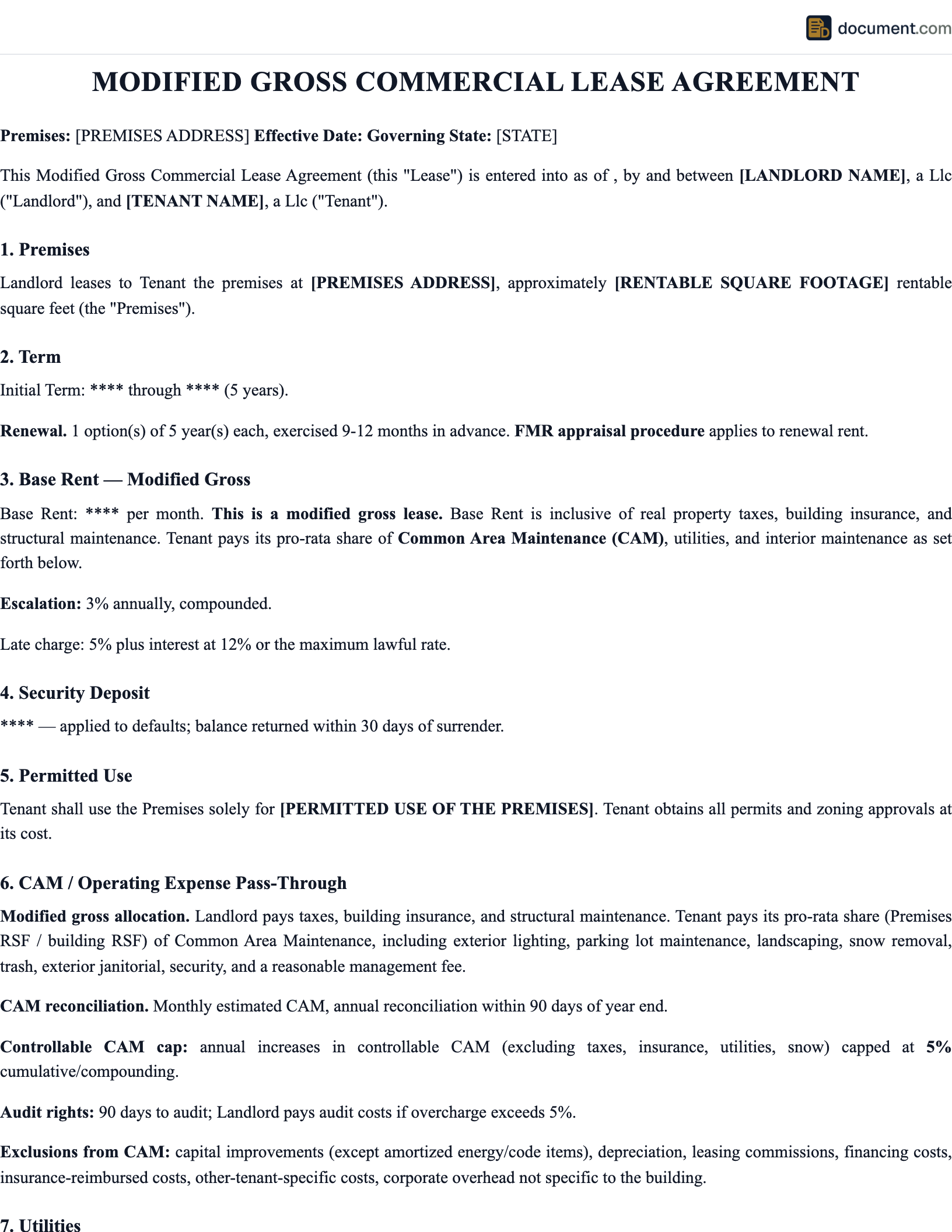
Below is a preview of our Georgia-specific commercial modified gross lease. Your customized document will include all fields and provisions required under GA law.
COMMERCIAL MODIFIED GROSS LEASE
STATE OF GEORGIA
GA-Compliant Template
PARTY A:
Name: [Full Legal Name]
Address: [Georgia Address]
PARTY B:
Name: [Full Legal Name]
Address: [Georgia Address]
PROPERTY / PREMISES:
Address: [Property Address]
County: [Georgia County]
GEORGIA COMPLIANCE
This document complies with Georgia (GA) state law requirements and includes all provisions mandated for this type of document in Georgia.