
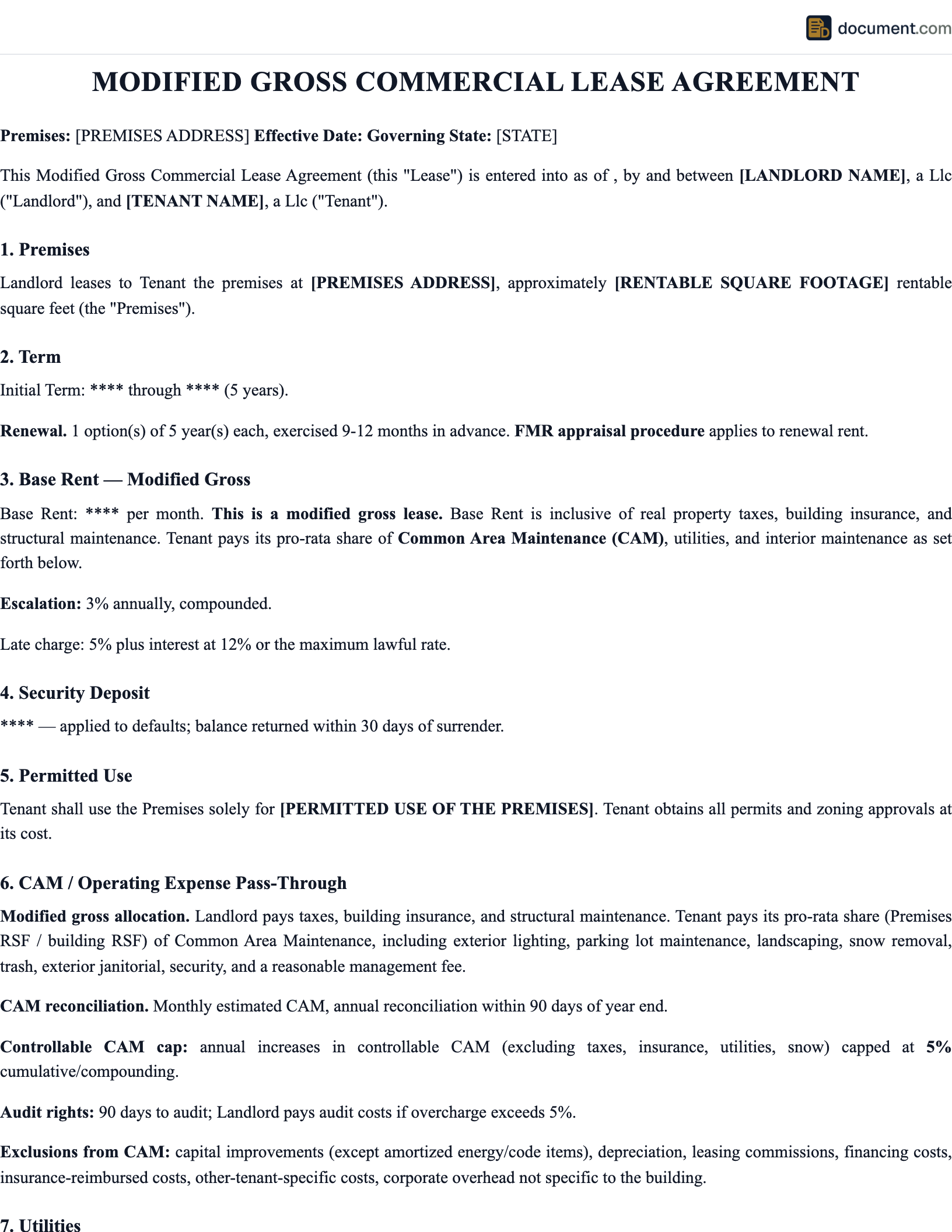



Florida Commercial Modified Gross Lease Overview
A Florida commercial modified gross lease is a hybrid structure that sits between a full gross lease and a triple-net lease. The landlord sets a base rent intended to cover most operating costs, and then the parties negotiate a specific split of remaining expenses. In practice, most Florida multi-tenant office modified gross leases assign electricity and janitorial for the tenant's own space to the tenant, while the landlord retains property taxes, building insurance, structural maintenance, and common area operating costs. Every expense that is not assigned to the tenant by name remains the landlord's obligation, so the written expense allocation schedule is the most important part of the lease.
Florida's commercial markets span several distinct submarkets with different rent structures. In Miami-Dade and Broward counties, modified gross leases are prevalent in suburban office parks, with HVAC being a dominant cost issue because cooling loads run nearly year-round. Orlando and Tampa Bay office corridors use modified gross structures heavily in Class B and Class C buildings. The Jacksonville market and the I-4 corridor industrial flex market also see modified gross arrangements, particularly for small-bay flex space where tenants control their own utilities. Florida courts enforce commercial lease terms as written, and expense disputes turn on the specific language in the allocation schedule.
FL
State-specific
Varies
Filing fees
Written
Required format
Contract
Law governs
Florida Modified Gross Lease Requirements
Florida enforces commercial leases as written contracts. The state's courts will not rewrite an ambiguous expense allocation provision to favor either party, so getting the expense split right in the original document is critical. Modified gross leases in Florida also trigger the documentary stamp tax, which applies to the base rent portion for the full lease term at $0.35 per $100.
Write Out Every Expense Assignment
Florida courts treat commercial leases as arms-length contracts between sophisticated parties. Any expense that is not clearly assigned to the tenant by name in the allocation schedule defaults to the landlord's obligation under most lease structures, but disputes are expensive and the outcome depends entirely on how the lease is worded. Do not rely on shorthand like "tenant pays utilities" without specifying exactly which utilities, how they are measured, and at what rate.
Key Lease Provisions
- Expense Allocation Schedule: A complete line-by-line schedule assigning every category of operating expense to landlord or tenant, leaving no gap for dispute
- HVAC Terms: Identification of who maintains the base building HVAC system, who pays for after-hours usage, the after-hours billing rate, and who bears capital replacement costs for any dedicated rooftop units serving the tenant
- Electricity Metering: Submetering or submeter-equivalent billing for tenant electricity is common in Florida; specify the measurement method and whether the landlord may charge an administrative markup
- Insurance Provisions: Florida's coastal insurance market means building insurance can increase significantly between lease years; address whether insurance cost spikes pass through to the tenant's share and whether any cap applies
- Documentary Stamp Tax: The base rent is subject to Florida's $0.35 per $100 documentary stamp tax on the total rent for the full lease term; confirm which party is responsible and how renewals or extensions affect the calculation
- Escalation Caps: Controllable operating expense increases are typically capped at 3 to 5 percent per year; the lease should identify which categories are controllable and which are excluded from the cap
How to Draft a Florida Modified Gross Lease
Drafting a Florida commercial modified gross lease requires more upfront negotiation than a standard gross lease because the parties must reach agreement on each expense category individually. The process below reflects how experienced Florida commercial real estate attorneys typically approach these transactions.
Request Building Operating Data
Ask the landlord for two to three years of actual operating expense history, including property tax bills, insurance invoices, HVAC service records, and electricity billing by floor or zone. In Florida's volatile insurance market, year-over-year premium changes are often significant and worth analyzing before signing.
Build the Complete Expense Allocation Schedule
List every operating expense category and assign each to landlord or tenant. Common Florida modified gross lease tenant-paid categories include submetered electricity, janitorial within the premises, and after-hours HVAC at a specified hourly rate. Landlord-retained categories typically include property taxes, building insurance, structural maintenance, parking lot, landscaping, and common area costs. Leave no category undefined.
Address HVAC Specifically for Florida Climate
Define whether the landlord maintains the base building HVAC system or whether the tenant has dedicated rooftop units. Specify the after-hours HVAC billing rate in the lease rather than leaving it to landlord determination. If the tenant has dedicated equipment, confirm whether the tenant is responsible for capital replacement or only routine maintenance. Florida's humidity and cooling load make this provision materially more significant than in most other states.
Negotiate Escalation Caps and Dispute Rights
Secure an annual cap on controllable operating expense increases, typically 3 to 5 percent. Confirm that direct utility costs and insurance premiums are excluded from the cap as costs outside the landlord's control. Include an audit right so the tenant can verify any landlord-managed pass-through billings. Florida's insurance market can produce large premium swings, so clarify whether a cap applies to insurance pass-throughs or not.
Calculate Documentary Stamp Tax and Execute
Calculate Florida's documentary stamp tax at $0.35 per $100 of total base rent for the full lease term before signing. Confirm which party pays the tax and document it in the lease. Execute the lease with authorized signatures from both parties. Florida's statute of frauds requires any commercial lease exceeding one year to be in writing. Retain fully executed originals for both parties; recording with the county comptroller is optional but can provide constructive notice.
Florida Modified Gross Lease Key Provisions
Several Florida-specific factors make modified gross lease drafting meaningfully different from what you would encounter in most other states. Understanding them up front prevents costly disputes during the lease term.
Florida does not have a state income tax, but it does impose a documentary stamp tax on commercial leases. The tax is $0.35 per $100 of total rent for the full lease term and is typically calculated based on base rent. Because modified gross leases have a fixed base rent with separately billed expense reimbursements, structuring the rent components clearly matters for tax purposes. Expense reimbursements billed separately from base rent are generally not treated as rent for documentary stamp tax purposes, but the lease language controls. Florida also has a sales tax that can apply to commercial rent in certain circumstances; confirm with a Florida tax professional whether the specific transaction is subject to sales tax.
Florida's coastal geography creates an insurance market that does not behave like other states. Building insurance premiums can spike significantly after active hurricane seasons, and wind and flood coverage in coastal counties is often placed through specialty markets at rates that are difficult to predict. A modified gross lease tenant whose share of building insurance passes through as a landlord-managed cost should secure a cap or a notice-and-negotiation right before committing to a multi-year term. Inland Florida markets like Orlando and Gainesville face less insurance volatility than coastal South Florida, but the risk is present in any market with significant storm exposure. Coastal tenants should also confirm whether the landlord carries adequate flood insurance, since standard property policies exclude flood damage.
Florida Modified Gross Lease Transaction Costs
Below are the typical costs associated with negotiating and executing a Florida commercial modified gross lease. Actual amounts depend on the market, lease complexity, and transaction size.
| Fee / Cost | Typical Amount |
|---|---|
| Documentary Stamp Tax (base rent, full term) | $0.35 per $100 of total base rent |
| Attorney (Tenant), lease negotiation and review | $750 - $4,000 |
| Expense Allocation Negotiation (additional hours) | 2 - 5 hrs at $300 - $500/hr |
| Annual Billing Review or Dispute Resolution | $300 - $1,500 |
| Optional County Comptroller Recording | $10 per page |
Sample Florida Commercial Modified Gross Lease
Below is a preview of our Florida-specific commercial modified gross lease. Your customized document will include all fields and provisions required under FL law.
COMMERCIAL MODIFIED GROSS LEASE
STATE OF FLORIDA
FL-Compliant Template
PARTY A:
Name: [Full Legal Name]
Address: [Florida Address]
PARTY B:
Name: [Full Legal Name]
Address: [Florida Address]
PROPERTY / PREMISES:
Address: [Property Address]
County: [Florida County]
FLORIDA COMPLIANCE
This document complies with Florida (FL) state law requirements and includes all provisions mandated for this type of document in Florida.