
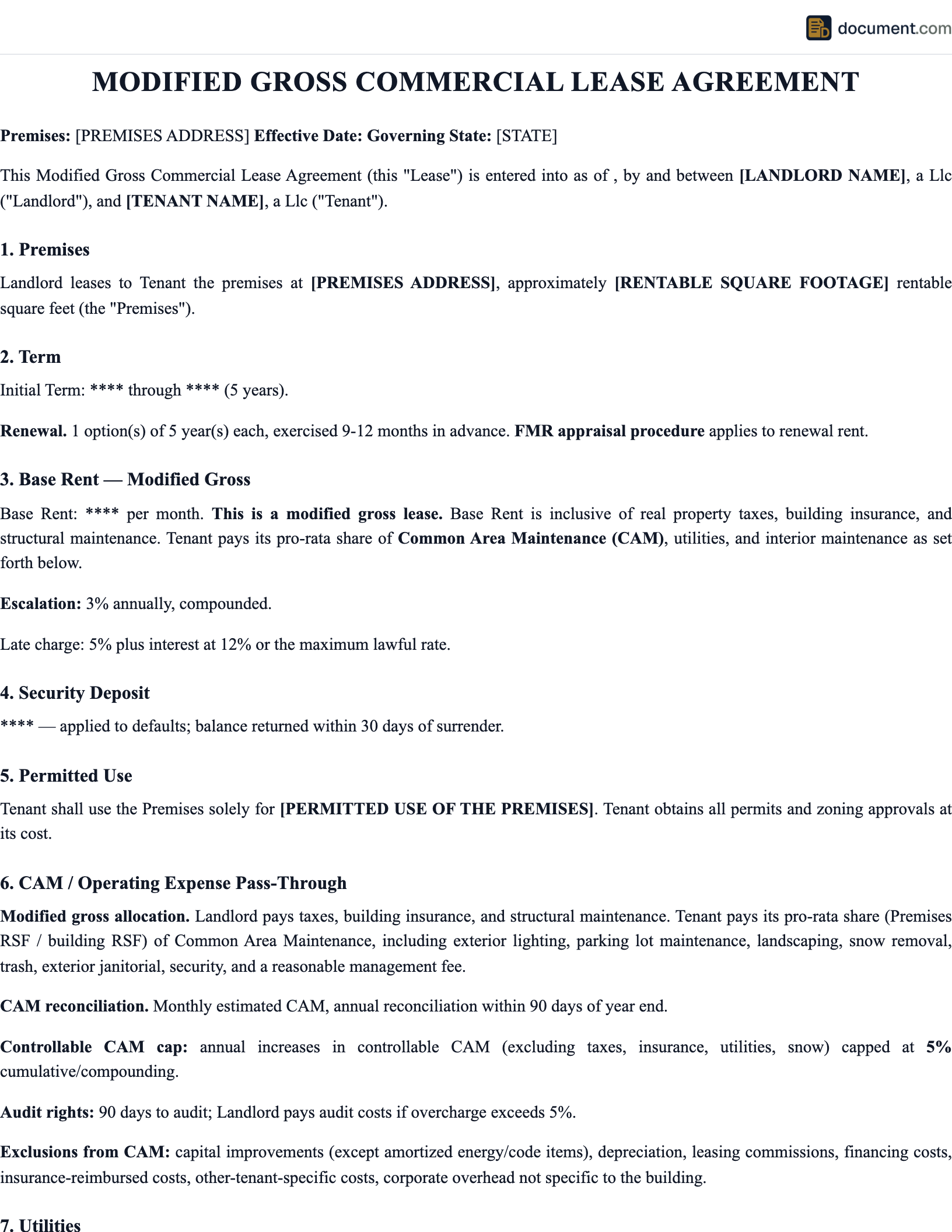



Delaware Modified Gross Lease Overview
A Delaware modified gross lease allocates operating expenses between landlord and tenant through a negotiated written schedule rather than following the all-landlord model of a gross lease or the all-tenant model of an NNN lease. The typical Delaware modified gross lease has the tenant paying electricity and janitorial for the tenant's own space while the landlord retains responsibility for property taxes, building insurance, structural systems, and common area maintenance. The modified gross format is the standard structure for multi-tenant office space in Wilmington and the northern New Castle County suburban office market.
Delaware's Court of Chancery applies sophisticated commercial contract standards to lease disputes and enforces written terms with minimal implied obligations. The practical consequence is that a Delaware modified gross lease that fails to specify who pays a particular expense category will be enforced exactly as written, without any implied obligation to cover the gap in the tenant's favor. Every expense category that matters to either party should appear in the lease with a clear designation of responsibility. Delaware has no sales tax and no commercial rent tax, which keeps the modified gross structure simpler than in neighboring states.
DE
State-specific
Varies
Filing fees
Written
Required format
Contract
Law governs
Delaware Modified Gross Lease Requirements
Delaware commercial leases are governed primarily by contract law. There are no mandatory expense allocation formulas or tenant protections specific to modified gross leases under Delaware statutes. The obligations of both parties are determined by the written lease document, interpreted by the Court of Chancery if a dispute arises.
Document Every Expense Assignment Explicitly
Delaware courts interpret commercial lease terms as written and will not imply obligations that the parties could have but did not include. A modified gross lease that uses general language like "tenant pays utilities" without specifying which utilities, at what metering point, during what hours, and subject to what escalation caps will be enforced as written when a dispute arises. The Court of Chancery is sophisticated and will not rewrite ambiguous terms in the tenant's favor. Build a complete expense allocation schedule that lists every relevant cost category.
Key Delaware Modified Gross Lease Provisions
- Expense Allocation Schedule: List every operating expense category and designate landlord or tenant responsibility in a specific exhibit to the lease
- Tenant-Paid Utilities: Specify metering arrangements for electricity, confirm whether submetering applies, and set building standard hours for included HVAC service
- Landlord-Retained Obligations: List landlord's retained responsibilities: property taxes, building insurance, structural systems, common area maintenance, and management
- Annual Escalation Caps: Negotiate caps on controllable expenses paid by the tenant, using a fixed percentage or CPI-based formula
- HVAC Maintenance and Replacement: Address who is responsible for HVAC maintenance, filter replacement, and major system replacements during the lease term
- Dispute Resolution: Include a specific dispute resolution process for billing disputes, with a defined cure period before either party can declare a default
How to Draft a Delaware Modified Gross Lease
Delaware modified gross lease drafting requires more precision than other states because the Court of Chancery enforces written terms strictly. The expense allocation schedule is the most important document in the negotiation, and it should be treated as such from the start.
Research Delaware Market Norms for the Property Type
Review comparable lease transactions in the same Wilmington submarket or suburban New Castle County corridor to understand what expense splits are market standard. Knowing the typical modified gross structure for your property type strengthens your negotiating position and helps identify areas where the landlord's proposed terms are out of market.
Build a Complete Expense Allocation Schedule
Draft a comprehensive written schedule listing every operating expense category with a landlord or tenant designation. Categories to cover include: electricity, gas, water and sewer, base building HVAC, after-hours HVAC, janitorial for the premises, janitorial for common areas, property taxes, building insurance, roof maintenance and replacement, structural systems, elevators, parking lot maintenance, landscaping, and management fees. No category should be left undesignated.
Negotiate Escalation Caps and Reconciliation Provisions
For tenant-paid expenses that are billed through the landlord rather than metered directly, negotiate annual escalation caps on controllable costs. Set the annual billing reconciliation deadline, the documentation requirements, and the tenant's right to dispute invoices within a defined period. Address what happens to billing disputes during any cure period to prevent disputes from triggering defaults.
Have a Delaware Attorney Review the Document
Because Delaware courts enforce commercial leases between sophisticated parties without filling gaps in the tenant's favor, a Delaware commercial real estate attorney should review the expense allocation schedule and the base rent escalation provisions before execution. The cost of legal review is modest compared to the financial exposure from an ambiguous allocation over a multi-year lease term.
Execute and Retain Originals
Both parties should execute the lease with original signatures. Delaware commercial leases do not require notarization to be binding between the parties. Each party should retain a fully executed original of the lease and all exhibits, including the expense allocation schedule. Optional recording with the county Recorder of Deeds protects the tenant's possessory interest against subsequent encumbrances on the property.
Delaware Modified Gross Lease Key Provisions
Several Delaware-specific features affect how modified gross leases are structured and enforced in the state. Understanding them before drafting protects both parties from unnecessary disputes.
Delaware has no state sales tax and no commercial rent tax on lease payments. Operating expense pass-throughs from landlord to tenant in a Delaware modified gross lease do not create any state sales tax obligation, unlike in Pennsylvania or Maryland where certain reimbursements can be taxable. Delaware's corporate income tax structure also means that most commercial tenants operating in Delaware are organized as Delaware entities and have their own state tax obligations entirely separate from the lease expense structure.
Delaware's older commercial building stock in Wilmington and surrounding areas sometimes presents environmental considerations that should be addressed in the modified gross lease. Older office buildings may have legacy environmental conditions that create costs during a renovation or tenant improvement project. The lease should specify which party is responsible for environmental compliance costs triggered by the tenant's alterations to the space, and how any pre-existing conditions discovered during the lease term are allocated between the parties.
Delaware Modified Gross Lease Transaction Costs
Modified gross lease negotiations in Delaware require attorney attention to the expense allocation schedule, escalation provisions, and dispute resolution mechanics. Budget for legal review before execution, particularly given Delaware's Court of Chancery standard of strict written contract enforcement.
| Fee / Cost | Typical Amount |
|---|---|
| Attorney Drafting and Review (Tenant) | $750 – $4,000 |
| Expense Allocation Negotiation | 2 – 5 hours at $250 – $450 per hour |
| Annual Billing Dispute or Reconciliation | $300 – $1,500 |
| Optional Recorder of Deeds Filing | $33 base (varies by county) |
Sample Delaware Commercial Modified Gross Lease
Below is a preview of our Delaware-specific commercial modified gross lease. Your customized document will include all fields and provisions required under DE law.
COMMERCIAL MODIFIED GROSS LEASE
STATE OF DELAWARE
DE-Compliant Template
PARTY A:
Name: [Full Legal Name]
Address: [Delaware Address]
PARTY B:
Name: [Full Legal Name]
Address: [Delaware Address]
PROPERTY / PREMISES:
Address: [Property Address]
County: [Delaware County]
DELAWARE COMPLIANCE
This document complies with Delaware (DE) state law requirements and includes all provisions mandated for this type of document in Delaware.