



Connecticut Commercial Modified Gross Lease Overview
A modified gross lease splits the operating expense burden between landlord and tenant with the specific allocation negotiated in the lease. In Connecticut, this is the predominant structure for multi-tenant office buildings, especially in Stamford's central business district and suburban Fairfield County markets. Tenants pay a base rent covering most costs but are responsible for certain itemized expenses, most commonly electricity and janitorial service for their own suite.
Connecticut's commercial real estate market is governed by contract law. The expense allocation in a modified gross lease is whatever the parties write into the document. Given Fairfield County's exceptionally high property tax environment, the modified gross structure serves tenants well when taxes remain the landlord's responsibility. However, some Connecticut leases include expense stop mechanisms that shift tax increases back to the tenant once assessments exceed the base year amount. Careful review of the operating expense provisions is essential before executing any Connecticut commercial lease.
CT
State-specific
Varies
Filing fees
Written
Required format
Contract
Law governs
Connecticut Modified Gross Lease Requirements
Connecticut requires commercial leases over one year to be in writing. For modified gross leases, the written expense allocation is the functional core of the agreement. Every operating expense category should be explicitly assigned to either the landlord or the tenant. Ambiguity is the most common source of Connecticut commercial lease disputes.
Explicitly List Every Expense Category
Connecticut courts enforce lease terms as written, and they will not fill gaps that the parties left open. A lease that says "tenant pays its own utilities" has generated real disputes in Connecticut about whether that includes water, natural gas, after-hours HVAC, and common area electricity. List each category separately and assign it unambiguously. This protects both landlord and tenant from costly disputes over what the lease means.
Key Connecticut Modified Gross Provisions
- Expense Allocation Schedule: Include a comprehensive list of every major operating expense category with a clear landlord or tenant designation for each
- Electricity Metering: Confirm whether tenant electricity is separately metered, submetered, or shared, and specify the billing methodology
- After-Hours HVAC: Specify whether after-hours HVAC is available, at what cost per hour, and how the tenant requests it
- Escalation Caps: Negotiate annual caps on controllable expense increases, particularly important in Connecticut where operating costs trend upward
- Connecticut Governing Law: Specify Connecticut as the governing law and identify the venue for any dispute resolution proceedings
How to Draft a Connecticut Modified Gross Lease
The key to a well-drafted Connecticut modified gross lease is precision in the expense allocation. Here is a practical approach for both landlords and tenants in Connecticut.
Identify the Market Norms for the Property Type
Connecticut Fairfield County office leases and Hartford suburban leases have different standard modified gross structures. Understanding what is typical for your specific market helps you identify which provisions are worth pushing back on and which are standard.
Build a Granular Expense Allocation List
Go through every operating expense category: electricity, natural gas, water, sewer, HVAC maintenance and repair, after-hours HVAC, janitorial for premises, janitorial for common areas, trash, landscaping, snow removal, property taxes, building insurance, roof and structural repairs, and management fees. Assign each one to landlord or tenant explicitly.
Negotiate Escalation Caps
For any tenant-paid or pass-through expense categories, negotiate annual caps on controllable expense increases. Connecticut's operating cost environment makes this particularly valuable for tenants with multi-year lease terms.
Attorney Review
A Connecticut commercial real estate attorney should review the lease before execution. Connecticut courts enforce terms as written, so the time to identify and fix problems is before the lease is signed, not after a dispute arises.
Execute and Distribute
Both parties execute with authorized signatures. Provide fully executed copies to all parties and lenders. Attach exhibits including floor plans and the expense allocation schedule as part of the binding Connecticut agreement.
Connecticut Modified Gross Lease: Key Provisions
Beyond the expense split, several additional provisions matter specifically in Connecticut's commercial lease context.
Connecticut has no statewide commercial rent tax, which simplifies occupancy cost modeling compared to states like Florida. However, Connecticut has a complex state income tax regime, and the income and expense treatment of commercial lease payments should be reviewed by a Connecticut tax professional for any unusual structures, including leases with significant tenant improvement allowances, step rents, or rent abatement periods.
Connecticut's environmental disclosure obligations can be relevant in older commercial properties, particularly in Fairfield County and Hartford where industrial history has left environmental legacies on some sites. A commercial tenant in Connecticut should confirm the environmental status of a property before executing a long-term lease, especially if the permitted use involves any chemical storage or industrial processes that could create regulatory exposure.
Connecticut Modified Gross Lease Costs
Typical transaction costs for drafting and executing a Connecticut commercial modified gross lease.
| Cost Item | Typical Range |
|---|---|
| Attorney Drafting or Review | $1,000 - $4,500 (higher for Fairfield County transactions) |
| Expense Allocation Negotiation | Included in attorney review or separately 2 to 5 hours at $250 to $450 per hour |
| Annual Billing Dispute Resolution | $500 - $2,000 if professional review needed |
| Optional Town Clerk Recording | $60 per document plus per-page fees |
Sample Connecticut Commercial Modified Gross Lease
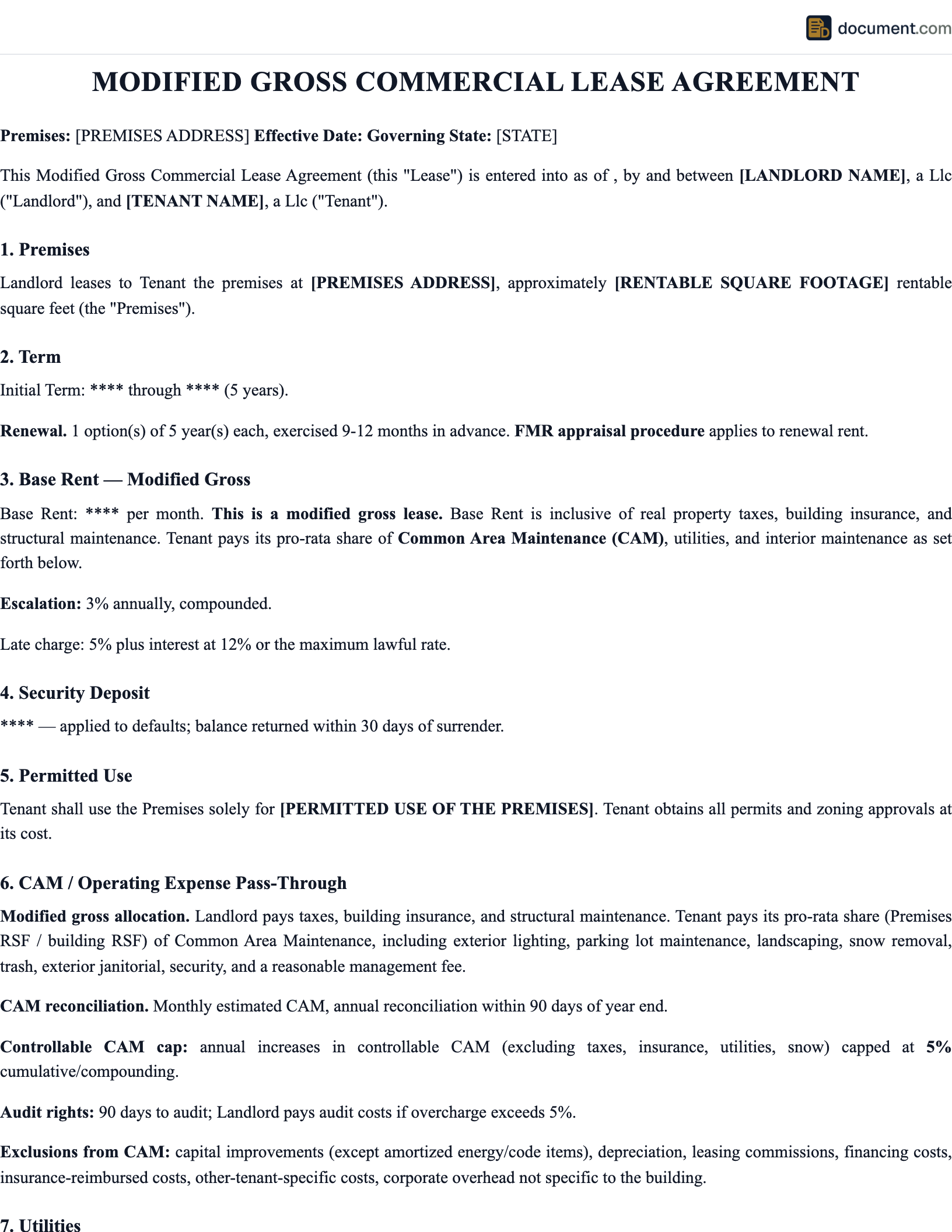
Below is a preview of our Connecticut-specific commercial modified gross lease. Your customized document will include all fields and provisions required under CT law.
COMMERCIAL MODIFIED GROSS LEASE
STATE OF CONNECTICUT
CT-Compliant Template
PARTY A:
Name: [Full Legal Name]
Address: [Connecticut Address]
PARTY B:
Name: [Full Legal Name]
Address: [Connecticut Address]
PROPERTY / PREMISES:
Address: [Property Address]
County: [Connecticut County]
CONNECTICUT COMPLIANCE
This document complies with Connecticut (CT) state law requirements and includes all provisions mandated for this type of document in Connecticut.