



Colorado Commercial Modified Gross Lease Overview
A modified gross lease sits between a full gross lease and a triple-net structure. The landlord and tenant negotiate which operating expenses each party pays, rather than having the landlord cover everything or the tenant cover everything. In Colorado's office market, this hybrid structure is the dominant format for multi-tenant buildings. Tenants often pay their own electricity and janitorial while the landlord handles taxes, insurance, and structural costs.
Colorado commercial leases are governed by contract law, with no comprehensive commercial tenant protection statute. That means the expense split in a modified gross lease is whatever the parties write into the document. Denver and Boulder market norms provide a useful starting point for negotiations, but every lease is different. The risk in a poorly drafted Colorado modified gross lease is ambiguity: when an expense category is not clearly assigned, disputes arise and the default outcome is often determined by litigation rather than intent.
CO
State-specific
Varies
Filing fees
Written
Required format
Contract
Law governs
Colorado Modified Gross Lease Requirements
Colorado requires commercial leases exceeding one year to be in writing under the state's statute of frauds. For modified gross leases in particular, the written expense allocation is not just a legal formality; it is the operational backbone of the lease. Ambiguity in expense assignments generates the most common commercial lease disputes in Colorado.
Document Every Expense Assignment
Colorado courts enforce commercial lease terms as written. A provision that says "tenant pays utilities" without specifying which utilities has generated disputes in Colorado office leases. List electricity, natural gas, water, sewer, and telecommunications separately and assign each one explicitly. This takes an extra hour at drafting and saves thousands in potential disputes.
Key Modified Gross Lease Provisions
- Expense Allocation Table: Include a clear list of every major operating expense category and designate it as landlord's or tenant's obligation
- Tenant-Paid Utilities: Specify whether electricity is separately metered or submetered, and how after-hours HVAC is billed
- Landlord-Retained Obligations: Confirm which costs the landlord retains, typically property taxes, building insurance, and roof and structural repairs
- Annual Escalation Caps: Negotiate maximum annual increases for shared or pass-through cost categories, especially in multi-year Colorado leases
- HVAC Maintenance Responsibility: Clarify whether tenant maintains HVAC for its own space and address Colorado-specific weather demands on building systems
- Dispute Resolution: Include a Colorado governing law clause and a preferred dispute resolution mechanism, whether mediation, arbitration, or litigation
How to Draft a Colorado Modified Gross Lease
Getting a modified gross lease right requires careful attention to the expense allocation, escalation mechanics, and any carve-outs that deviate from what each party initially expects. Here is a step-by-step approach for Colorado.
Research Market Norms for the Property Type
Colorado office, retail, and industrial markets have different standard modified gross structures. A Denver Class B office building typically allocates differently than a Boulder flex space. Understanding market norms helps you know which items are worth pushing back on.
Build a Complete Expense Allocation List
Draft a comprehensive list of every expense category and assign it to landlord or tenant. Do not rely on catch-all language. Electricity, natural gas, water, sewer, HVAC maintenance, janitorial, trash, landscaping, snow removal, property taxes, and insurance should each be addressed individually.
Negotiate Escalation and Cap Provisions
For any pass-through expense categories, negotiate an annual cap on increases. Colorado tenants with multi-year leases are particularly exposed to property insurance cost increases, which have risen sharply in some markets. Capping controllable expense categories protects the tenant's occupancy cost projections.
Review with a Colorado Commercial Real Estate Attorney
Colorado courts enforce lease terms as negotiated, so an attorney review before execution is the most cost-effective protection available. An experienced Colorado commercial real estate attorney can identify provisions that deviate from market standards and flag unusual risk allocations.
Execute and Distribute
Both parties sign with authorized signatures. Provide fully executed copies to all parties and any lenders. Attach any exhibits including floor plans, expense allocation schedules, and permitted use descriptions as they become part of the binding agreement.
Colorado Modified Gross Lease: Key Provisions
Beyond the basic expense split, a Colorado modified gross lease should address several operational and legal provisions that affect both parties over the lease term.
Force majeure language is standard in Colorado commercial leases, given the state's exposure to weather events and, more recently, public health emergencies. A well-drafted force majeure clause specifies which obligations are excused, for how long, and what notice is required. Most Colorado commercial leases limit force majeure relief to non-monetary performance obligations, keeping rent payment obligations intact.
Colorado's no-state-income-tax environment makes it attractive for businesses, but local tax rules in Denver and other municipalities can add complexity. Confirm whether any local occupancy or business taxes apply to your specific location. Colorado has no statewide commercial rent tax, but some municipalities have their own business-related taxes that affect occupancy cost calculations.
Colorado Modified Gross Lease Costs
Typical transaction costs for a Colorado commercial modified gross lease. More complex expense splits with escalation mechanics typically require more attorney time.
| Cost Item | Typical Range |
|---|---|
| Attorney Drafting or Review | $750 - $3,500 depending on lease complexity |
| Expense Allocation Negotiation | Included in attorney time or 2 to 5 hours at $200 to $400 per hour |
| Annual Reconciliation Review | $300 - $800 if accountant involvement needed |
| Optional County Recording | $13 first page, $5 per additional page |
Sample Colorado Commercial Modified Gross Lease
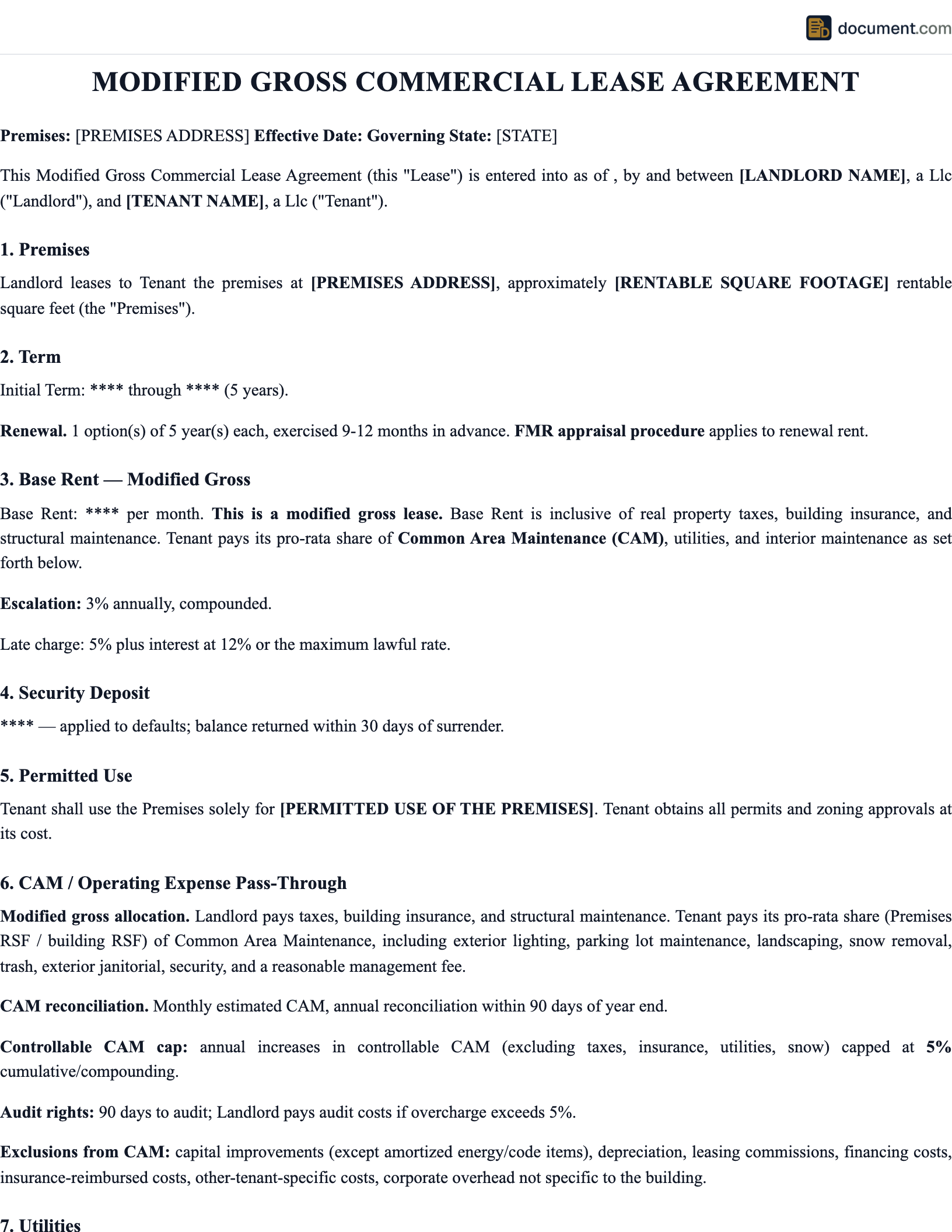
Below is a preview of our Colorado-specific commercial modified gross lease. Your customized document will include all fields and provisions required under CO law.
COMMERCIAL MODIFIED GROSS LEASE
STATE OF COLORADO
CO-Compliant Template
PARTY A:
Name: [Full Legal Name]
Address: [Colorado Address]
PARTY B:
Name: [Full Legal Name]
Address: [Colorado Address]
PROPERTY / PREMISES:
Address: [Property Address]
County: [Colorado County]
COLORADO COMPLIANCE
This document complies with Colorado (CO) state law requirements and includes all provisions mandated for this type of document in Colorado.