
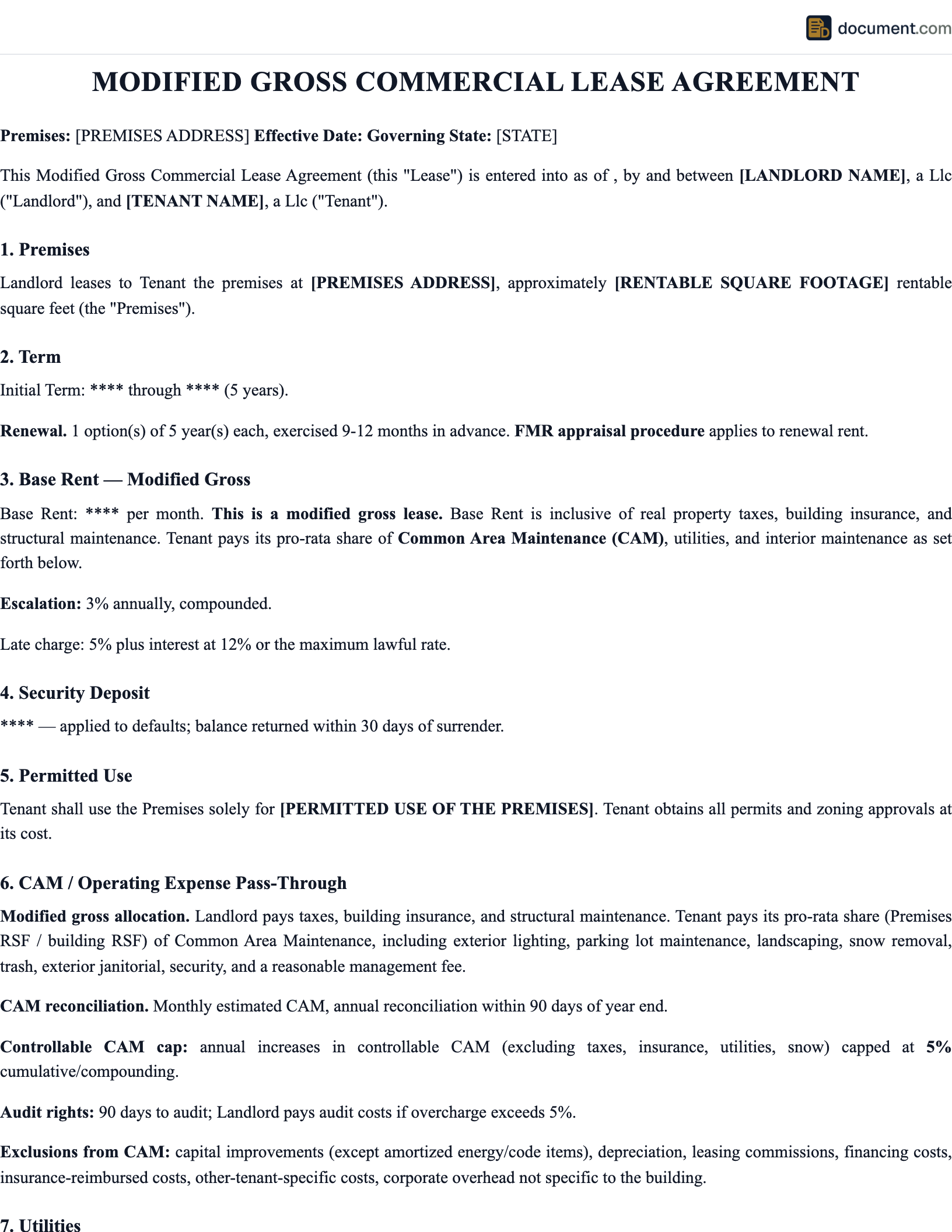



California Commercial Modified Gross Lease Overview
A commercial modified gross lease in California is shaped by two factors that are unique to the state. Proposition 13 locks in property tax increases at two percent annually until a sale triggers a full reassessment, which gives California landlords predictable tax costs when they retain property taxes on their side of the expense split. California's Unruh Civil Rights Act and Cal/OSHA standards impose accessibility and workplace safety obligations that exceed federal requirements, and the lease must address who is responsible for compliance costs when they arise.
Los Angeles and San Francisco Class A office buildings frequently use modified gross structures with base year expense stops, where the landlord covers operating costs at base year levels and passes through annual increases above that threshold on a pro-rata basis. This is a more complex version of the modified gross structure that requires careful drafting of the base year definition, the operating cost categories subject to pass-through, and the gross-up provisions used to account for partial building occupancy.
CA
State-specific
Varies
Filing fees
Written
Required format
Contract
Law governs
California Legal Requirements
California has specific requirements for commercial lease documents that must be followed to ensure enforceability. Understanding CA's legal framework helps protect both landlord and tenant interests.
California Specific Note
California modified gross leases are affected by Proposition 13 property tax dynamics, the Unruh Civil Rights Act (which creates broader ADA exposure than federal law), Cal/OSHA requirements, and potential supplemental tax bills following building sales. Base year expense stop provisions common in LA and San Francisco require precise drafting to avoid disputes. Attorney review by a California commercial real estate lawyer is strongly recommended.
Document Requirements
- Statute of Frauds: California Civil Code Section 1624 requires leases for more than one year to be in writing; leases for 10 years or more have additional execution requirements
- Base Year Definition: For leases using expense stop provisions, the base year must be defined precisely, with clarity on whether base year costs are actual or normalized and how partial-year occupancy is treated
- Gross-Up Provision: If the building is not fully occupied, expense categories with fixed and variable components should be grossed up to reflect full occupancy, protecting tenants from inflated per-square-foot pass-throughs
- ADA and Unruh Act Compliance: The lease should assign responsibility for accessibility modifications required under the Unruh Civil Rights Act, which goes beyond federal ADA in creating liability exposure
- Prop 13 and Supplemental Tax Provisions: The lease should address how supplemental property tax bills following a building sale are handled, particularly whether they fall to the landlord or can be passed through to tenants
- Cal/OSHA Compliance Allocation: The lease should distinguish between landlord responsibility for shared building systems and tenant responsibility for workplace safety within their leased premises
How to Draft a Commercial Modified Gross Lease in California
California modified gross leases in major markets involve more complex provisions than most other states, particularly around base year expense stops and Proposition 13 dynamics. These steps address the critical drafting points for California.
Determine the Expense Structure and Base Year
California Class A office leases often use a base year expense stop rather than a simple landlord/tenant expense split. Decide which structure applies to this transaction and, if using a base year stop, select and define the base year carefully. The base year should ideally be a year of normal building occupancy and operation to give a fair starting point for future cost comparisons. The first year of a new lease is commonly used as the base year in California.
Draft the Gross-Up Provision
If the building has variable occupancy, include a gross-up clause requiring that variable operating costs be grossed up to reflect a minimum occupancy level (typically 95 percent) before being allocated among tenants. Without a gross-up, a partially occupied building could pass inflated per-square-foot costs to the tenants who are present. This provision is standard in California Class A leases and protects tenants from occupancy-related cost distortions.
Address Proposition 13 and Supplemental Taxes
The lease should clarify that property taxes are the landlord's responsibility and address supplemental tax bills specifically. If the landlord intends to pass through supplemental taxes arising from a building sale during the lease term, that right must be written into the lease explicitly. Many California tenants negotiate a cap on any Prop 13 reassessment pass-through or request that supplemental taxes be excluded from operating cost pass-throughs entirely.
Include ADA, Unruh Act, and Cal/OSHA Provisions
California's Unruh Civil Rights Act can create liability for accessibility deficiencies that federal ADA law might not directly reach. The lease should assign responsibility for accessibility modifications in common areas (typically landlord) versus the tenant's own premises (typically tenant). Cal/OSHA obligations within the tenant's workspace should also be addressed, distinguishing tenant workplace obligations from shared building system safety requirements.
Execute and Record if Appropriate
Parties execute through authorized representatives. For California commercial leases of 10 years or more, California Civil Code Section 1091 imposes additional formality requirements. Recording with the county recorder requires notarization. Long-term California commercial leases are frequently recorded to protect the tenant's leasehold interest against subsequent encumbrances or ownership changes.
California-Specific Key Provisions
California modified gross leases in the Los Angeles and San Francisco markets commonly include an expense stop provision layered on top of the basic landlord/tenant expense split. Under this structure, the landlord covers operating costs up to the base year level, and any increases above the base year stop are allocated among tenants on a proportionate basis. The base year definition is a critical negotiating point. Tenants should push for a base year that reflects actual normal operating costs rather than an artificially low year that would trigger immediate pass-throughs.
Seismic retrofit obligations deserve specific attention in California modified gross leases. Los Angeles and San Francisco both have mandatory retrofit programs for certain building classes. A modified gross lease should address which party is responsible for funding seismic upgrades required under local ordinance, how costs are allocated if a retrofit is required mid-lease, and whether the landlord has the right to recover capital improvement costs through operating expense pass-throughs or rent adjustments during the lease term.
Tenant improvement allowances are a common feature of California commercial leases, particularly in Class A office space in San Francisco's Financial District and Los Angeles's Westside submarkets. In a modified gross lease, the tenant improvement allowance should be documented separately from the expense allocation structure, with clear provisions on how allowance repayment interacts with early termination rights. California courts have addressed these interactions in several cases, and precise language avoids the ambiguity those cases highlight.
California Fees & Costs
Below is a breakdown of typical costs associated with commercial lease transactions in California. Actual fees may vary by county and specific circumstances.
| Fee / Cost | Typical Amount |
|---|---|
| Base Modified Gross Rent (LA / SF Class A) | $40 - $90 per sq ft annually |
| Operating Cost Pass-Through Above Base Year Stop | $2 - $6 per sq ft annually (typical increase) |
| Tenant Utility Costs (electricity) | $3 - $8 per sq ft annually |
| Attorney Lease Review (CA commercial) | $1,500 - $5,000 |
| County Recorder Recording Fee | $15 - $100 per page |
Sample California Commercial Modified Gross Lease
Below is a preview of our California-specific commercial modified gross lease. Your customized document will include all fields and provisions required under CA law.
COMMERCIAL MODIFIED GROSS LEASE
STATE OF CALIFORNIA
CA-Compliant Template
PARTY A:
Name: [Full Legal Name]
Address: [California Address]
PARTY B:
Name: [Full Legal Name]
Address: [California Address]
PROPERTY / PREMISES:
Address: [Property Address]
County: [California County]
CALIFORNIA COMPLIANCE
This document complies with California (CA) state law requirements and includes all provisions mandated for this type of document in California.