
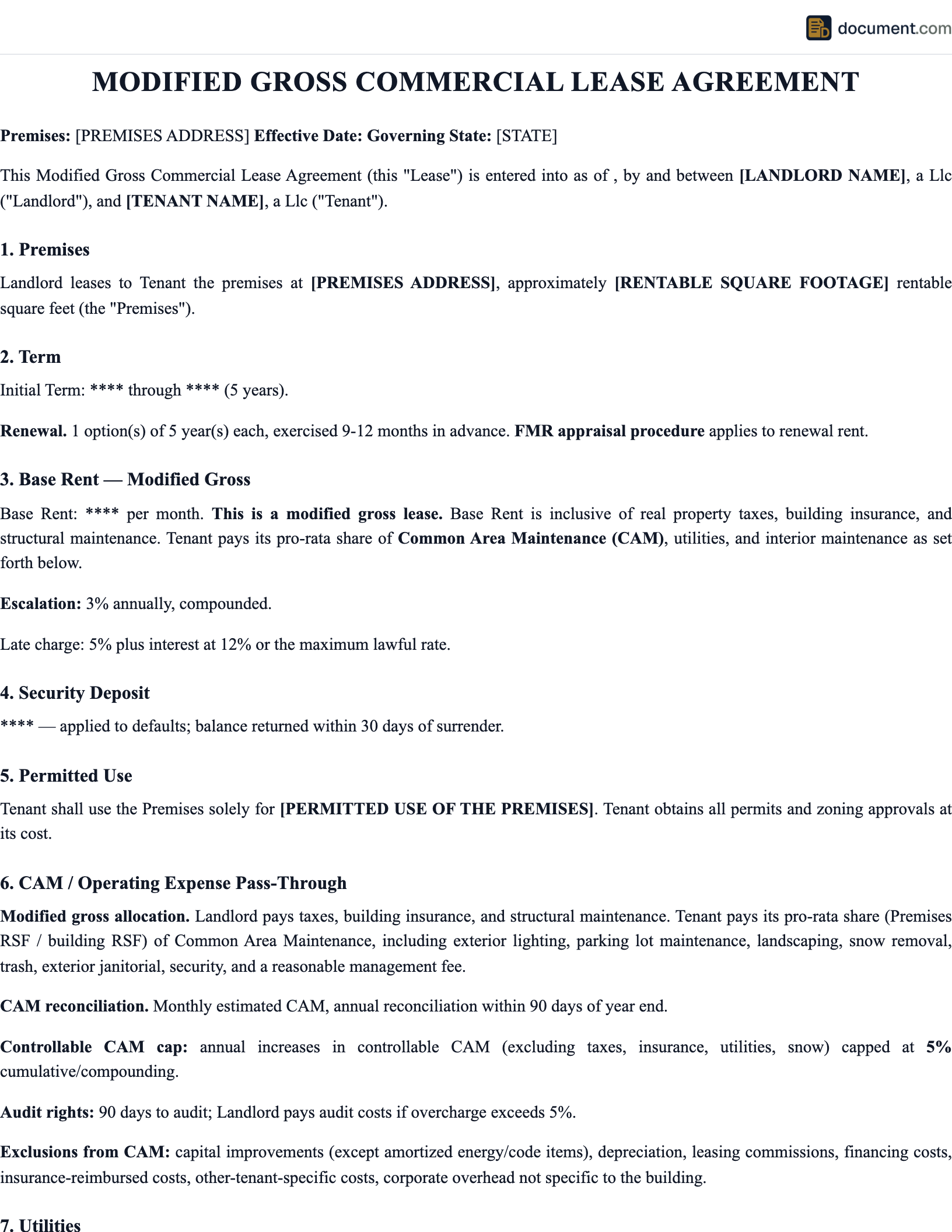



Arizona Commercial Modified Gross Lease Overview
Arizona's modified gross lease market is shaped by two forces that are not present in most other states: the Transaction Privilege Tax on commercial rent and the extreme desert climate that drives HVAC costs far above national averages. A modified gross lease in Arizona divides operating expenses between landlord and tenant along a negotiated line, with the TPT obligation addressed as a separate item that must be assigned to one party or the other. Arizona commercial lease law is entirely contract-based, so the specific structure the parties agree to controls.
Phoenix, Scottsdale, Tempe, and Chandler have active commercial office and retail leasing markets where modified gross structures are common. In Maricopa County office buildings, landlords typically retain property taxes and building insurance while tenants pay their own utility costs. During Arizona summers, utility costs can be one of the most significant occupancy expenses for a commercial tenant, so the allocation of electricity in the expense schedule is one of the most material provisions in any Arizona modified gross lease.
AZ
State-specific
Varies
Filing fees
Written
Required format
Contract
Law governs
Arizona Legal Requirements
Arizona has specific requirements for commercial lease documents that must be followed to ensure enforceability. Understanding AZ's legal framework helps protect both landlord and tenant interests.
Arizona Specific Note
Arizona imposes a Transaction Privilege Tax on commercial rent that is distinct from the landlord/tenant expense split in a modified gross lease. The TPT rate varies by municipality (Phoenix, Scottsdale, Mesa, and Tucson all have different rates) and must be addressed explicitly in the lease. Arizona has no statute defining modified gross lease defaults, so every expense category must be negotiated and written into the agreement. Attorney review is recommended before signing any Arizona commercial lease.
Document Requirements
- Statute of Frauds: Arizona Revised Statutes Section 44-101 requires leases for more than one year to be in writing and signed by the party to be charged
- TPT Allocation: The lease must state which party pays the Transaction Privilege Tax and whether the stated rent amount is inclusive of TPT or excludes it as an additional charge
- HVAC Cost Assignment: Maintenance and replacement responsibilities for rooftop HVAC units must be explicitly assigned; Arizona heat accelerates HVAC degradation and creates significant cost exposure
- Expense Schedule: A complete list of operating expense categories with landlord, tenant, and shared designations is required; Arizona courts will not fill in missing terms for commercial parties
- Permitted Use: Arizona commercial leases should define the permitted business use clearly, particularly for retail spaces in shopping centers where exclusive use provisions may apply
- County Recorder Recording: Long-term leases may be recorded with the Maricopa, Pima, or relevant county recorder; notarization is required for recording
How to Draft a Commercial Modified Gross Lease in Arizona
Drafting an Arizona modified gross lease requires attention to the TPT allocation and the HVAC expense structure in addition to the standard provisions. These steps walk through the key considerations for getting an Arizona modified gross lease right.
Confirm the TPT Rate for the Property Location
Before drafting, look up the applicable Transaction Privilege Tax rate for the specific municipality where the property is located. Phoenix, Scottsdale, Tempe, Mesa, and Chandler all have their own rates, and unincorporated Maricopa County has yet another. The lease should state the applicable rate and which party is responsible for the tax, whether it is included in the stated rent or charged separately.
Negotiate the Expense Allocation with HVAC in Mind
Arizona HVAC systems run almost year-round and degrade faster than in most states. The lease should separately address routine maintenance (filter changes, annual service) and equipment replacement. Most modified gross leases in Arizona treat maintenance as a tenant cost for their space while keeping replacement as a landlord capital expense. If the building has central air handling, the allocation becomes more complex and requires a proportionate share methodology.
Draft the Complete Expense Schedule
Create a written list covering property taxes, building insurance, electricity for common areas and tenant space, water and sewer, HVAC maintenance, HVAC replacement, parking lot upkeep, roof repair and replacement, landscaping (common in Arizona due to desert landscaping requirements), and janitorial services. Assign each item to landlord, tenant, or shared. Arizona courts will not supply default terms for commercial lease provisions that the parties omitted.
Set Rent Amount with Escalation Terms
State whether the base rent is inclusive or exclusive of TPT. Set an escalation mechanism, whether fixed annual percentage or CPI-tied. In the Phoenix metro market, fixed increases of two to three percent annually are common. Where the tenant pays variable costs directly, consider whether caps on controllable expenses are appropriate to provide budget certainty.
Execute and Optionally Record
Both parties sign through authorized representatives. Arizona does not require notarization for the lease to be enforceable between the parties, but recording with the applicable county recorder requires notarization. For leases longer than five years, recording provides additional protection against subsequent encumbrances on the property.
Arizona-Specific Key Provisions
The TPT pass-through provision is the first Arizona-specific clause to get right. The lease should state the applicable TPT rate (or reference the current municipal rate), identify which party bears the tax, and specify whether the rent amount stated in the lease includes TPT or is net of TPT. If TPT rates change during the lease term, the lease should address how the change affects the tenant's obligation. Most Arizona commercial leases permit the landlord to adjust the TPT pass-through to reflect actual rate changes.
The HVAC expense provision should distinguish between routine maintenance, emergency repairs, and equipment replacement. In Arizona, it is worth specifying a dollar threshold that separates repairs from replacements, since this distinction is often contested. For example, a provision stating that HVAC repairs under $1,500 are tenant expenses and anything over that threshold is a landlord capital expense creates a clear allocation rule that reduces disputes.
Arizona commercial leases should also address exterior maintenance provisions specific to the desert environment. Parking lot maintenance in Arizona requires more frequent sealcoating than in northern climates due to UV degradation. Desert landscaping maintenance, whether the property uses natural desert landscaping or irrigated plantings, should be assigned to one party. Common area cooling for covered parking or shaded walkways may also need to be addressed in high-end retail or office properties.
Arizona Fees & Costs
Below is a breakdown of typical costs associated with commercial lease transactions in Arizona. Actual fees may vary by county and specific circumstances.
| Fee / Cost | Typical Amount |
|---|---|
| Base Modified Gross Rent (Phoenix/Scottsdale) | $18 - $35 per sq ft annually |
| Transaction Privilege Tax (varies by municipality) | 1.5% - 3% of rent |
| Tenant Electricity Costs (HVAC-heavy) | $3 - $7 per sq ft annually |
| Attorney Lease Review | $750 - $2,500 |
| County Recorder Recording Fee | $30 - $150 |
Sample Arizona Commercial Modified Gross Lease
Below is a preview of our Arizona-specific commercial modified gross lease. Your customized document will include all fields and provisions required under AZ law.
COMMERCIAL MODIFIED GROSS LEASE
STATE OF ARIZONA
AZ-Compliant Template
PARTY A:
Name: [Full Legal Name]
Address: [Arizona Address]
PARTY B:
Name: [Full Legal Name]
Address: [Arizona Address]
PROPERTY / PREMISES:
Address: [Property Address]
County: [Arizona County]
ARIZONA COMPLIANCE
This document complies with Arizona (AZ) state law requirements and includes all provisions mandated for this type of document in Arizona.