
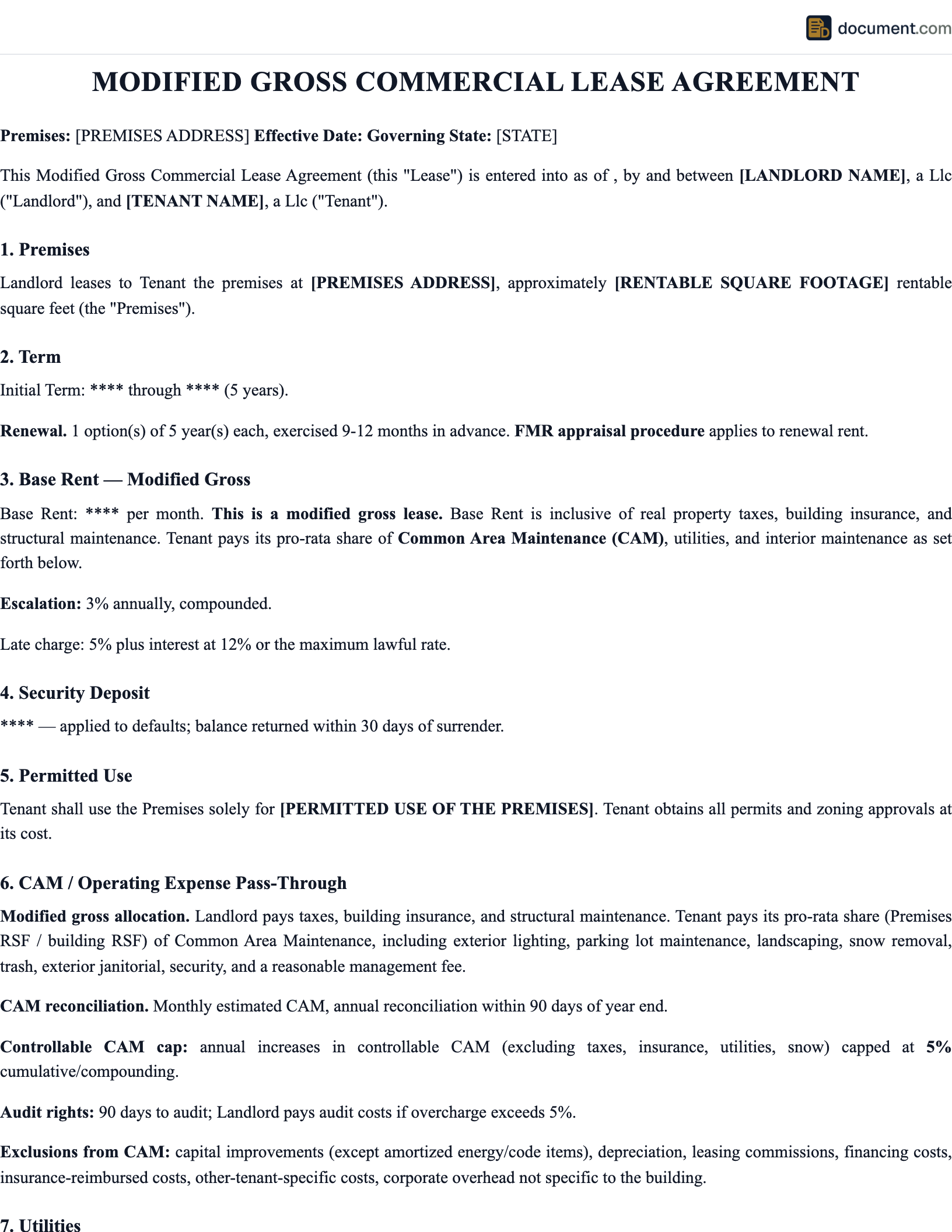



Alabama Commercial Modified Gross Lease Overview
A commercial modified gross lease in Alabama places the two parties in a middle ground between full gross and triple-net structures. Rather than the landlord absorbing all operating costs or the tenant paying taxes, insurance, and maintenance on top of rent, a modified gross lease divides those expenses along a negotiated line. Because Alabama has no statute defining what a modified gross lease must include, the division is entirely a matter of contract, and whatever the document says is what the parties are bound to honor.
Alabama commercial office and retail markets, particularly in Birmingham, Huntsville, and Montgomery, commonly use modified gross structures for multi-tenant buildings where landlords manage central building systems. The arrangement lets landlords control property tax and insurance while giving tenants responsibility for their own utilities and interior upkeep. Because Alabama imposes no state-level commercial rent tax, the cost structure is simpler than in states where transaction taxes add another variable.
AL
State-specific
Varies
Filing fees
Written
Required format
Contract
Law governs
Alabama Legal Requirements
Alabama has specific requirements for commercial lease documents that must be followed to ensure enforceability. Understanding AL's legal framework helps protect both landlord and tenant interests.
Alabama Specific Note
Alabama commercial leases are entirely contract-governed. There are no state statutes that define the modified gross structure or fill in undefined expense categories. Every expense category must be explicitly addressed in the document, because Alabama courts will not supply default rules for sophisticated commercial parties who left terms open. Attorney review is strongly recommended.
Document Requirements
- Statute of Frauds: Alabama Code Section 8-9-2 requires leases longer than one year to be in writing and signed by the party to be charged
- Expense Allocation Table: Every operating expense category must be assigned to landlord, tenant, or shared with a documented methodology
- Base Rent and Payment Terms: Rent amount, due date, grace period, and late fee must all be specified; Alabama enforces whatever the document states
- Permitted Use: Alabama commercial leases should define permissible business activities and address any exclusive use protections in multi-tenant buildings
- HVAC Responsibility: Specify whether HVAC maintenance and replacement are landlord or tenant obligations; this is one of the most contested categories in Alabama office leases
- Entity Authorization: Corporate or LLC signatories must be authorized to bind the entity; Alabama courts scrutinize authority when disputes arise
How to Draft a Commercial Modified Gross Lease in Alabama
Because Alabama law will enforce whatever the parties put in writing, the drafting process for a modified gross lease requires careful attention to how each expense category is handled. These steps walk through the key stages of putting together a solid Alabama modified gross lease.
Establish the Expense Allocation Framework
Before drafting any other provisions, decide which operating expenses the landlord will cover and which the tenant will pay. In Alabama, the most common modified gross structure has the landlord paying property taxes, building insurance, and exterior maintenance while the tenant pays utilities, janitorial, and interior repairs. Document this split as a defined list, not a general description.
Address HVAC and Building Systems Explicitly
HVAC responsibility is the most frequently disputed item in Alabama office leases. The lease must distinguish between routine maintenance (often tenant) and equipment replacement (often landlord). If HVAC units serve multiple tenants, the lease should address how replacement costs are allocated across tenants in proportion to square footage or usage.
Draft the Rent and Escalation Provisions
Specify the base rent amount, payment due date, late fee structure, and any annual escalation mechanism. Fixed percentage increases are common in Alabama modified gross leases. If the tenant pays certain variable costs directly, consider capping controllable expense categories so the tenant can budget with reasonable predictability.
Include Audit and Documentation Rights
Where the tenant reimburses any portion of shared expenses, the lease should give the tenant the right to inspect supporting invoices and records. Alabama courts have no default audit right for commercial tenants, so it must be written into the lease. An annual reconciliation process should also be specified for any expense categories that are estimated and adjusted.
Execute with Proper Authorization
Both parties should sign through their authorized representatives, with documentation of authority if either party is a corporation or LLC. Alabama courts will examine authority when one party later challenges the binding nature of the lease. Notarization is not required for the lease to be enforceable, but if the parties intend to record the lease with the county probate court, notarization is necessary.
Alabama-Specific Key Provisions
The most important provision in any Alabama modified gross lease is the expense allocation schedule. This is typically formatted as a table listing each major operating expense category alongside a column for landlord responsibility, tenant responsibility, or shared. Categories that frequently get left out include HVAC replacement, parking lot resurfacing, roof repair under a certain dollar threshold, and common area janitorial. Every item left undefined is a potential dispute point.
Rent escalation provisions in Alabama modified gross leases often rely on fixed annual percentage increases, typically two to three percent per year in the current Birmingham and Huntsville markets. Some landlords use CPI adjustments, but Alabama tenants in smaller markets tend to resist CPI clauses because cost of living in the state can diverge significantly from national indices. Whichever method is chosen, the calculation formula should be spelled out completely in the lease to prevent later disagreements.
Alabama does not impose a state-level commercial rent tax, so the gross rent amount is what the parties negotiate without that additional layer. Local municipalities can impose occupational or business taxes that apply to the tenant as operator, but those are separate from the lease rent obligation. ADA compliance obligations are another provision worth addressing explicitly. Federal law applies to both landlord and tenant, and the lease should allocate responsibility for making accessibility modifications if the need arises during the lease term.
Alabama Fees & Costs
Below is a breakdown of typical costs associated with commercial lease transactions in Alabama. Actual fees may vary by county and specific circumstances.
| Fee / Cost | Typical Amount |
|---|---|
| Base Gross Rent (Alabama office) | $10 - $22 per sq ft annually |
| Tenant Utility Costs (electricity, metered) | $1.50 - $4 per sq ft annually |
| Landlord Property Tax Portion | $1 - $3 per sq ft annually |
| Attorney Lease Review | $500 - $2,000 |
| Lease Recording (if elected) | $200 - $500 |
Sample Alabama Commercial Modified Gross Lease
Below is a preview of our Alabama-specific commercial modified gross lease. Your customized document will include all fields and provisions required under AL law.
COMMERCIAL MODIFIED GROSS LEASE
STATE OF ALABAMA
AL-Compliant Template
PARTY A:
Name: [Full Legal Name]
Address: [Alabama Address]
PARTY B:
Name: [Full Legal Name]
Address: [Alabama Address]
PROPERTY / PREMISES:
Address: [Property Address]
County: [Alabama County]
ALABAMA COMPLIANCE
This document complies with Alabama (AL) state law requirements and includes all provisions mandated for this type of document in Alabama.