
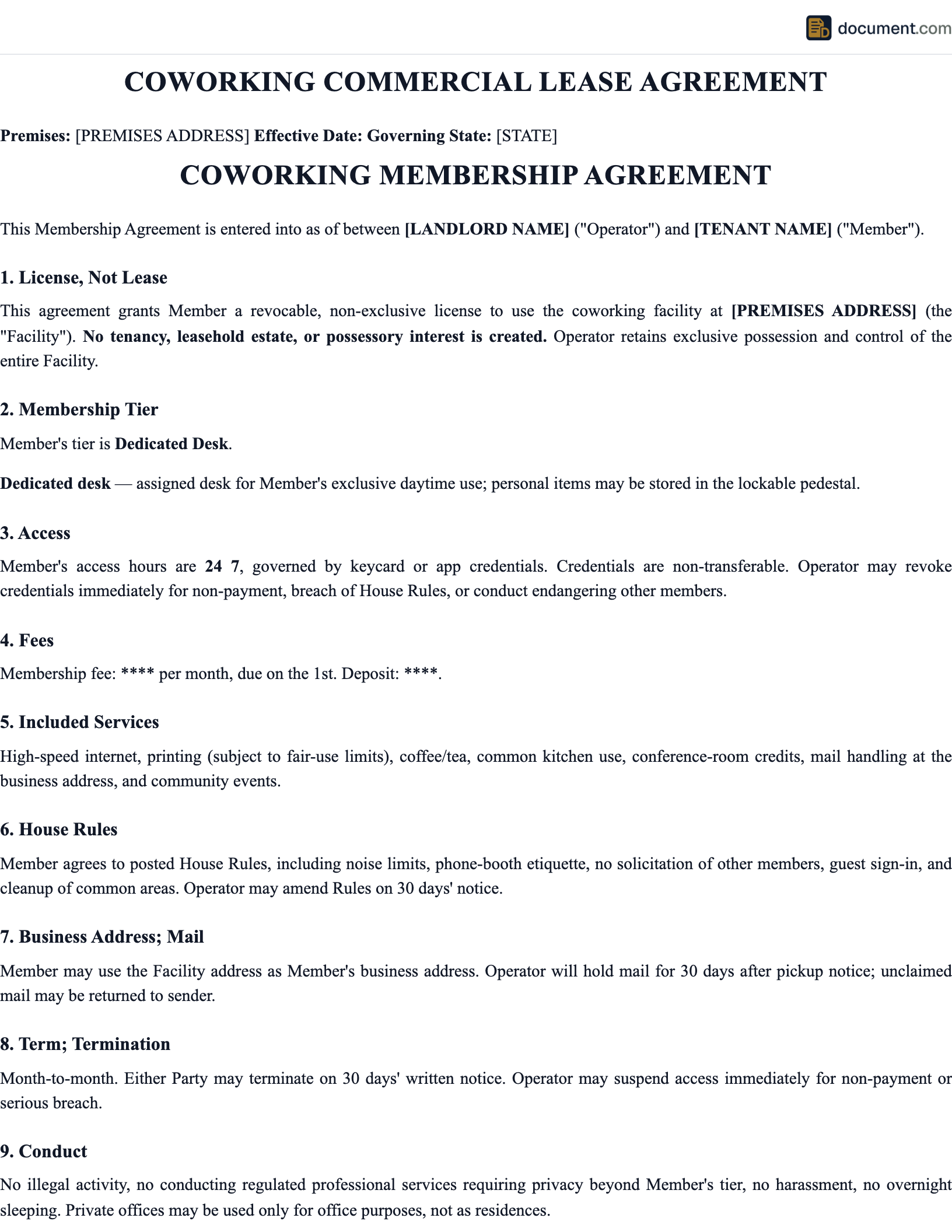



Wisconsin Coworking Space Lease Agreement Overview
Wisconsin coworking memberships and flexible office licenses are governed entirely by contract law, with no dedicated state statute addressing flexible workspace arrangements. Members in Milwaukee, Madison, and smaller Wisconsin markets have only the written terms of their agreements as protection. Wis. Stat. Ch. 704 covers landlord-tenant law in Wisconsin but is structured around residential tenancies and formal commercial leases, meaning most coworking license arrangements operate outside its protective framework.
Wisconsin's two major coworking markets serve distinct tenant populations. Milwaukee attracts members from healthcare, manufacturing consulting, and financial services sectors, with growing demand from remote workers at larger regional employers. Madison's market is more closely tied to the university ecosystem, state government contractors, and early-stage tech and biotech companies. Wisconsin imposes no sales tax on commercial rent or most membership fees, and unlike some peer states has no gross receipts tax that would affect members operating businesses out of coworking locations.
WI
State-specific
Varies
Filing fees
Written
Required format
Contract
Law governs
Wisconsin Legal Requirements
Wisconsin has specific requirements for commercial lease documents that must be followed to ensure enforceability. Understanding WI's legal framework helps protect both landlord and tenant interests.
Wisconsin Specific Note
Wisconsin has no statute specifically protecting coworking members. Your membership agreement is the governing document and courts will enforce it as written. Connectivity quality varies significantly across Wisconsin buildings, and older Milwaukee industrial conversions and Madison mid-century commercial buildings may have infrastructure limitations that affect your operations. No sales tax applies to Wisconsin coworking membership fees in most configurations. Members using a coworking address as their principal business location may create Wisconsin tax nexus, requiring registration with the Department of Revenue.
Document Requirements
- License vs. Sublease Clarity: Confirm whether your agreement is structured as a license granting access rights or a sublease granting exclusive possession of a specific space. The distinction affects your termination rights, legal protections, and the process required for the operator to remove you.
- Termination Notice Period: Specify the number of days of notice required by both parties to terminate the membership. Month-to-month agreements with only 30-day termination notice offer minimal planning security for members who rely on the space for daily operations.
- Connectivity Specifications: Define the minimum internet speed guaranteed, the ISP provider, whether backup connections exist, and whether the operator provides any service level credits if connectivity falls below stated thresholds. In Wisconsin, building infrastructure quality varies substantially.
- Address and Mail Rights: Confirm in writing whether you may use the coworking address for business registration, Wisconsin DOR filings, and mail receipt, and what happens to forwarding obligations if your membership ends or the location closes.
- Prepayment Refund Policy: If you are paying in advance for multiple months, define the refund policy explicitly. Wisconsin has no statute requiring operators to return prepaid membership fees if a location closes, so this must be in the written agreement.
- Conference Room and Amenity Access: Specify exactly what is included in the base membership fee, the per-hour rate for conference rooms above any included allocation, and whether amenity policies can be changed mid-term without your consent.
How to Execute a Wisconsin Coworking Agreement
Joining a Wisconsin coworking space requires evaluating the space on your specific operational needs, understanding the agreement structure, and confirming tax and business registration implications before committing.
Visit and Test the Space
Visit during peak hours to assess crowding, noise levels, and actual internet performance. Test speeds using multiple devices at the same time to simulate realistic working conditions. Confirm heating system reliability, as Wisconsin winters make inadequate HVAC a material operational concern. Evaluate whether the location serves your clients and team members across Milwaukee, Madison, or wherever your business operates.
Review the Agreement Structure
Confirm whether the agreement is a license or a sublease, the notice period required for termination, the prepayment refund policy, and whether the operator can change amenity terms mid-membership. Wisconsin courts enforce membership agreements as written, so read every provision before signing.
Confirm Business Registration and Tax Obligations
If you are using the Wisconsin coworking address as your principal business address, confirm that the operator permits this use and that your business is properly registered with the Wisconsin Department of Revenue. Operating in Wisconsin creates state tax nexus, and using a coworking address for official state filings requires the operator's written permission.
Negotiate Key Terms
Ask for written confirmation of the internet service provider and speed guarantees, the conference room credit allocation included in your plan, the notice period before any rent increases, and the refund policy if the location closes. Many Wisconsin coworking operators are willing to negotiate these terms, particularly for members committing to longer terms or multiple desks.
Execute and Set Up Operations
Sign the membership agreement with all negotiated terms reflected in writing, pay any security deposit and first month fees, obtain key fob or access credentials, and confirm the onboarding process for network access, conference room booking, and mail handling. Set a reminder to re-evaluate the membership against your space needs and costs at each renewal point.
Important Considerations for Wisconsin Coworking Members
Wisconsin's coworking market offers competitive pricing relative to peer Midwest markets. Milwaukee hot desk memberships typically run $150 to $300 per month, with dedicated desks ranging from $350 to $600 per month. Madison pricing is modestly higher given lower vacancy and stronger university-driven demand, with dedicated desks running $400 to $700 per month in central locations. The month-to-month flexibility that coworking memberships offer comes at the cost of security, and members whose businesses depend on stable workspace should carefully evaluate whether short notice termination provisions create unacceptable operational risk.
Connectivity quality is a critical and variable factor in Wisconsin coworking spaces. Buildings in the Historic Third Ward and Walker's Point in Milwaukee tend to have better fiber infrastructure than older commercial buildings in secondary locations. Madison's university proximity has driven solid broadband investment in central coworking locations. Members whose work involves large file transfers, video production, or frequent video conferencing should verify actual upload and download speeds during a trial period before committing to a longer term.
Wisconsin imposes no sales tax on most coworking membership fees and has no B&O-style gross receipts tax. Corporate income tax at 7.9% applies to Wisconsin-nexus C-corporations, and Wisconsin personal income tax applies to self-employed members at graduated rates. ADA compliance obligations for the physical coworking space rest with the building owner and operator, not individual members, though members who invite clients or conduct public-facing business activities at the space should confirm that common areas and meeting facilities meet ADA accessibility standards.
Wisconsin Coworking Membership Costs and Tax Context
Wisconsin does not tax coworking membership fees, and the state has a straightforward business tax structure with no gross receipts tax. The following reflects typical Wisconsin market pricing and relevant tax items for coworking members.
| Cost / Tax Item | Details |
|---|---|
| Sales Tax on Membership Fees | None on most membership fee structures. Wisconsin does not impose sales tax on commercial lease or license payments. |
| Corporate Income Tax | 7.9% on net income for C-corporations with Wisconsin nexus. No B&O or gross receipts tax at the state level. |
| Hot Desk Memberships (Milwaukee) | $150 to $300 per month. Third Ward and Walker's Point locations at higher end; suburban Milwaukee at lower end. |
| Dedicated Desks (Milwaukee) | $350 to $600 per month depending on location and included amenities. |
| Dedicated Desks (Madison) | $400 to $700 per month in central Madison. University district locations at higher end given demand. |
| Conference Room Overage | $20 to $60 per hour beyond any included allocation. Confirm included hours and overage rates before selecting a membership tier. |
Sample Wisconsin Coworking Space Lease Agreement
Below is a preview of our Wisconsin-specific coworking space lease agreement. Your customized document will include all fields and provisions required under WI law.
COWORKING SPACE LEASE AGREEMENT
STATE OF WISCONSIN
WI-Compliant Template
PARTY A:
Name: [Full Legal Name]
Address: [Wisconsin Address]
PARTY B:
Name: [Full Legal Name]
Address: [Wisconsin Address]
PROPERTY / PREMISES:
Address: [Property Address]
County: [Wisconsin County]
WISCONSIN COMPLIANCE
This document complies with Wisconsin (WI) state law requirements and includes all provisions mandated for this type of document in Wisconsin.