



Washington Coworking Space Lease Agreement Overview
Washington state hosts a robust and growing coworking market, built primarily on the tech sector's embrace of flexible work arrangements and the region's strong culture of startup formation and independent contracting. Seattle and its Eastside suburbs have a concentration of national coworking operators as well as homegrown independent spaces that cater to specific tech, creative, and professional communities. The market softened somewhat as large tech employers expanded their own campuses, but freelancer and small business demand has remained durable.
Washington has no dedicated statute governing coworking membership arrangements. The membership agreement is the primary legal document, and Washington courts will enforce contract terms as written with limited override. Members considering a Washington coworking arrangement should pay particular attention to how the agreement characterizes the relationship (license versus sublease), what notice is required for termination, how the B&O tax obligation affects their overall cost of operating a business from a Washington address, and whether the space's connectivity and security infrastructure meets their actual needs.
WA
State-specific
Varies
Filing fees
Written
Required format
Contract
Law governs
Washington Legal Requirements
Washington has specific requirements for commercial lease documents that must be followed to ensure enforceability. Understanding WA's legal framework helps protect both landlord and tenant interests.
Washington-Specific Note
Washington has no dedicated coworking or commercial sublicense statute. The membership agreement is your primary legal protection. Washington businesses operating from a coworking address must register for and pay the state's Business and Occupation tax on gross receipts. Seattle also has a commercial parking tax that adds cost for members who use included or purchased parking. Seismic safety is a relevant consideration for older buildings in the Seattle area.
Agreement Requirements
- License vs. Sublease Classification: Washington courts treat these differently; a license gives the operator more flexibility to terminate without formal eviction proceedings
- Termination Notice: Washington has no statutory minimum notice for commercial license terminations; negotiate at least 30 days and preferably 60 days of advance notice
- Connectivity Specifications: Seattle market operators often market specific bandwidth guarantees; get these in writing with remedies for service failures
- B&O Tax Registration: Confirm that using a Washington coworking address triggers B&O tax registration obligations with the Department of Revenue
- Prepayment Refund Policy: Washington law does not require operators to refund unused prepaid fees; negotiate a written refund policy, particularly for quarterly or annual prepayments
- Address Use Rights: Confirm whether the membership tier allows the coworking address to be used for Secretary of State registration and Department of Revenue correspondence
How to Execute a Washington Coworking Space Agreement
Washington coworking memberships are typically fast to set up, but the agreement deserves careful reading before you sign. Washington contract law will enforce whatever is in the document.
Evaluate the Space for Your Actual Needs
Visit the space during peak hours to assess actual internet speed, noise levels, conference room availability, and parking situation. Seattle operators in South Lake Union and Capitol Hill are in high-foot-traffic buildings; Eastside operators may offer more parking and quieter work environments at similar price points.
Review the Agreement Structure and Termination Rights
Confirm whether the agreement is a license or sublease. Read the termination notice provision and the refund policy for prepaid amounts. Washington has no minimum notice statute for commercial licenses, so what the contract says is what you have.
Confirm B&O Tax and Business Registration
If you will use the coworking address for your business registration, confirm with the operator that the membership tier permits this. Register with the Washington Secretary of State and the Department of Revenue for B&O tax purposes before commencing operations from a Washington address.
Negotiate Key Terms
Push for 30 to 60 days minimum termination notice, a written refund policy for prepaid periods, specific bandwidth guarantees with remedies, conference room booking limits that match your actual usage, and clarity on guest and visitor policies. Seattle market operators are used to negotiating with tech-savvy members.
Execute and Set Up Operations
Sign the agreement, obtain your access credentials, set up mail forwarding if applicable, confirm insurance requirements, and test the internet connection and key systems before relying on the space for critical work.
Washington-Specific Considerations
Washington's coworking market is shaped by the tech industry in ways that distinguish it from most other states. Members from outside the region are often surprised to find that Seattle-area coworking rates rival or exceed New York and San Francisco rates, particularly in South Lake Union and premium Eastside buildings with strong fiber connectivity and proximity to major tech campuses.
The B&O tax is the most commonly overlooked cost factor for businesses new to Washington. Unlike states with corporate income taxes, Washington's B&O applies from the first dollar of gross receipts with no deduction for business expenses or losses. A startup operating at a loss still owes B&O tax on its revenue. The applicable rate depends on the business classification and can range from 0.13 percent to 1.5 percent or more of gross receipts. This is a meaningful additional cost of operating a Washington business that affects total occupancy economics.
ADA compliance obligations apply to coworking spaces throughout Washington. Operators are responsible for maintaining accessible common areas and paths of travel. Members who undertake any modifications to dedicated spaces assume ADA compliance responsibility for those alterations. Seattle has its own building code requirements that go beyond state minimums in some areas, and coworking spaces in older Pioneer Square or Capitol Hill buildings may have different accessibility characteristics than purpose-built newer spaces.
Washington Coworking Tax and Cost Context
Washington has no state income tax but does impose a Business and Occupation gross receipts tax and a retail sales tax on certain services. Coworking members need to account for these costs when budgeting their total Washington operating expense.
| Cost or Tax Item | Details |
|---|---|
| State Income Tax | None; Washington has no state income tax |
| B&O Tax on Membership Business Activity | Members operating a Washington business must pay B&O tax on gross receipts; rate depends on business classification; no deduction for expenses or losses |
| Sales Tax on Membership Services | Base coworking rent is generally not subject to retail sales tax; bundled service components may be taxable depending on how the operator structures them |
| Seattle Commercial Parking Tax | Applies to paid parking in Seattle; adds cost for members using parking included or purchased through the coworking operator in the city |
| Membership Rates (Seattle Market) | Hot desks from $250 to $500 per month; dedicated desks from $450 to $800; private offices from $900 to $3,000 and above depending on size and location |
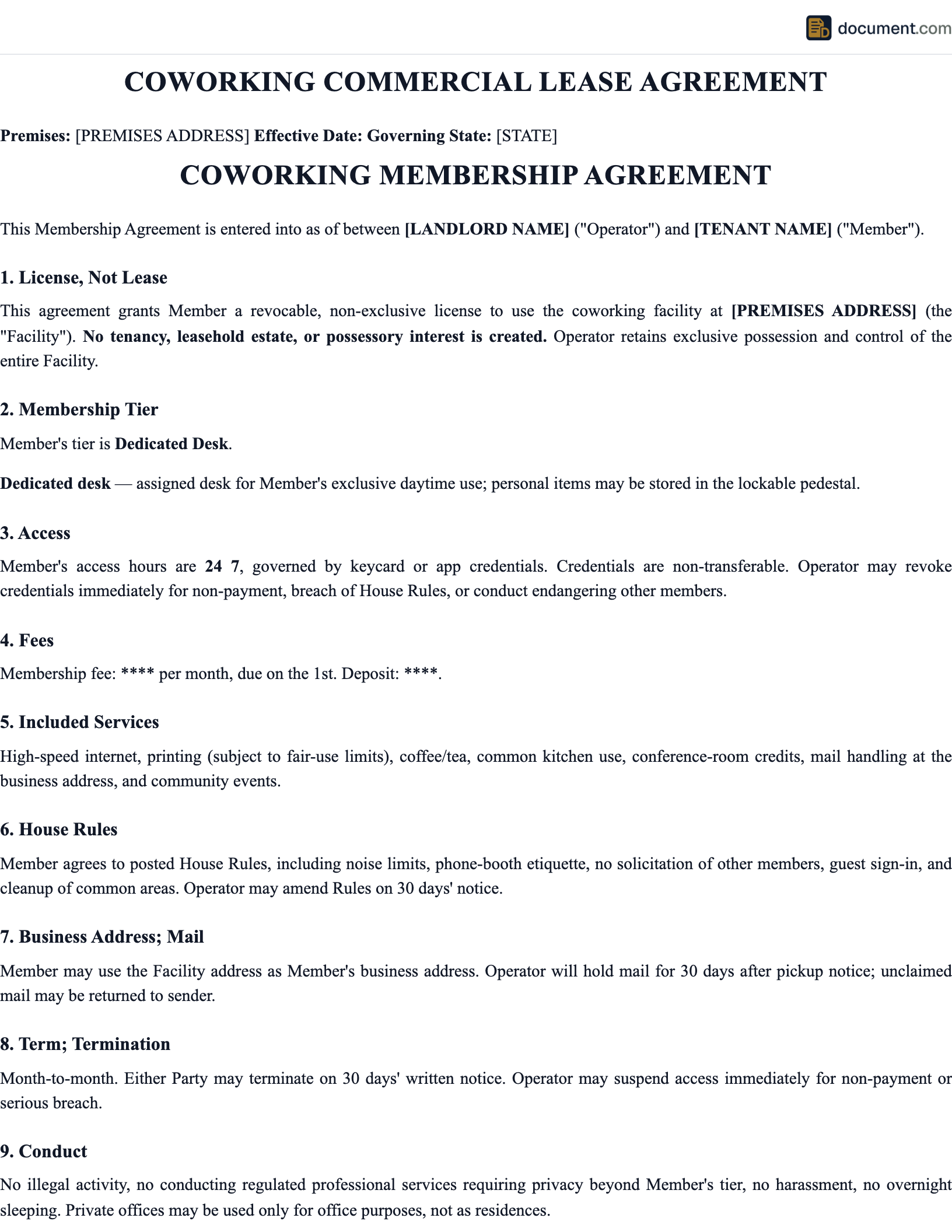
Sample Washington Coworking Space Lease Agreement
Below is a preview of our Washington-specific coworking space lease agreement. Your customized document will include all fields and provisions required under WA law.
COWORKING SPACE LEASE AGREEMENT
STATE OF WASHINGTON
WA-Compliant Template
PARTY A:
Name: [Full Legal Name]
Address: [Washington Address]
PARTY B:
Name: [Full Legal Name]
Address: [Washington Address]
PROPERTY / PREMISES:
Address: [Property Address]
County: [Washington County]
WASHINGTON COMPLIANCE
This document complies with Washington (WA) state law requirements and includes all provisions mandated for this type of document in Washington.